Category: News
Grantee Highlight: “Ghana, Walk for the Cure, 2015” – Breast Care International organise walk for Breast Cancer Awareness Month
This article was originally posted on Citi FM online (Ghana)
Sunday 1st November,
More than 500 residents of Sekondi-Takoradi Metropolis at the weekend participated in a breast cancer awareness health walk to sensitise Ghanaians on the dangers of the disease. The event which was organised by Breast Care International, a non-governmental organisation, brought together hundreds of people from all walks of life. The participants took part in a 17-kilometre walk from the Takoradi Jubilee Park through the principal streets of Sekondi-Takoradi and ended up at the Essipon Sports Stadium.
The campaign christened: “Ghana, Walk for the Cure, 2015,” targeted the youth to undertake regular breast cancer screening and diagnostic test for early treatment. Dr. Mrs Beatrice Wiafe Addai, the Founder and President of Breast Care International (BCI), speaking on the topic: “Fighting for a breast cancer free future for our children,” said breast cancer is the most frequently diagnosed cancer and the leading cause of deaths among women globally. She, therefore, called for concerted efforts by stakeholders including, chiefs, teachers, the media, health workers, members of parliament, opinion leaders, the clergy and all well-meaning Ghanaians, to join forces to campaign against the disease in order to save precious lives. Dr. Wiafe Addai noted that the cause of the disease is unknown, but people who consume excessive alcohol, fatty food, smoking cigarette and sedentary lifestyle and family history of the disease are more likely to be infected. She therefore charged Ghanaians to undertake regular check-ups, exercise frequently and reduce alcohol and fat intake.
Grantee Highlight: Sixty-Nine Women Graduate from NEWIG’s Youth-in-Entrepreneurship Initiative
This story was originally posted on Graphic Online (Ghana)
Sixty-nine young women have graduated from a three-month intensive training in vocational skills under the Youth-in-Entrepreneurship initiative.
The initiative, which forms part of the Network of Women in Growth-Ghana’s (NEWIG) project, seeks to empower young women to be gainfully employed to make them self-reliant.
They were trained in bead making, basic catering, soap making, batik, tie-dye, floral arrangement, textile designing and basic financial management.
At an event held at Tefle in the Volta Region on October 2, 2015 on the theme, “Promoting sustainable economic development through skills training for women”, the young ladies were presented with tools that would help them set up their own businesses.
The Executive Director of NEWIG, Mrs Mawusi Nudekor Awity, announced that approximately $21,000 was used in the training programme.
“Things haven’t been easy. But we believe in squeezing water out of stones to empower these young ladies. Of course, we received support from Empower, British High Commission, Crossroads International, and African Women’s Development Fund,” she said.
Mrs Awity said the NEWIG initiative used local raw materials such as coconut, cocoa pods, shea butter, paper, empty sachet water packets to create products.
According to her, there is the need to encourage the setting up of cottage industries in parts of the country, to propagate the idea of domestication through patronage of local produce.
A Senior Field Officer of NEWIG, Ms Naomi Biney, said NEWIG had a monitoring mechanism to help the graduates grow their businesses.
For his part, the Head of Rural Enterprise Programmes at Sogakope, Mr Eric Batse, said: “Small Scale Enterprises (SMEs) account for 90 per cent of the total operations in the industrial sector and offer 58 per cent of employment in the country.”
He said encouraging the growth of SMEs was a viable means of tackling the growing unemployment problem in the country.
Meanwhile, the District Coordinating Director for South Tongu, Mrs Jemima Apedo, has underscored the need for attitudinal change on the part of some Ghanaians who have insatiable taste for foreign produce, which she described as a bane of local economic growth.
The Last Days of This Ebola Outbreak are As Much about Access to Information as Access to Healthcare
Read published article here: on Qz.com
BY Amba Mpoke-Bigg
Nurse Mariatu Fofana says she should have known better than to touch and hug her father as he lay dying at his home near the capital of Sierra Leone, but she has paid an unbearable price for her error.
It also means that information campaigns to educate the public in Guinea, Liberia and Sierra Leone are far from over.
At the height of the epidemic in Sierra Leone, Media Matters for Women, a journalist-led non-profit organization deployed Bluetooth technology to provide critical information to women and girls.
Even though new cases of Ebola have dwindled almost to zero many women say they are still fighting an uphill battle against the basic social deficiencies that allowed the virus to spread with ease.
These include ignorance and traditional practices but inadequate access to basic health care also played a huge part.
For a cash-strapped country like Sierra Leone, the long term answer could lie in community ownership of health care through organizations such as German Kooperation Sierra Leone (GECKO), said Baba Car Conteh, a psycho-social worker who works with Ebola survivors in the southwestern Sierra Leone town of Port Loko.
EQUALITY NOW Job Vacancy: Program Officer Anti-Harmful Practices/Agent de Programme les Pratiques Nuisibles
Position: Program Officer, Anti-Harmful Practices
Deadline: October 15th, 2015
Background (About Equality Now)
Equality Now, an international human rights organization dedicated to ending violence and discrimination against women and girls globally, is seeking an experienced Program Officer to manage the ‘Enhancing Collaboration and Legal Action to End Female Genital Mutilation (FGM) and Child, Early and Forced Marriage (CEFM)’ project.
Responsibilities:
Based in Nairobi the Program Officer’s prime responsibility will be for work under the Enhancing Collaboration and Legal Action to End Female Genital Mutilation (FGM) and Child, Early and Forced Marriage (CEFM)’ project. S/he will report to the FGM Program Manager.
The successful candidate will manage project activities in Kenya, Uganda and Tanzania in East Africa and Benin, Burkina Faso and Mali in West Africa with a focus on:
- Partnership support and capacity building;
- National, regional and international legal advocacy;
- Project Implementation, Monitoring, Evaluation and Reporting; and
- Media and communications.
Partnership support;
The Program Officer will support the Program Manager and the partners in the:
- Identification of potential cases of violations of girls’ rights through CEFM and FGM for strategic impact litigation with the goal of setting legal precedents in collaboration with partners;
- Provision of legal advice and support to partners in the selected strategic litigation cases on CEFM and FGM either through domestic courts or using regional or international mechanisms;
Legal Advocacy;
The Program Officer will, under the guidance of the Program Manager:
- Support partners in the development and implementation of regional and international advocacy strategies using regional and international human rights law and protocols;
- Organize training for lawyers on the use of international and regional human rights mechanisms in litigation relating to HTPs;
- Establish and maintain contacts with organisations campaigning against CEFM and FGM and;
- Generate and update Equality Now actions and alerts.
Project Implementation, monitoring and evaluation;
In line with donor requirements and Equality Now commitments and systems:
- Prepare a work plan with partners and Equality Now team;
- Ensure the timely and effective implementation of project activities according to the project proposal;
- Work with partners to ensure that activities are monitored and evaluated and also identify specific challenges or successes that would interest the donor or partners;
- Provide timely, accurate reports on activities to donors including learning to inform future activities to achieve project objective;
- In close collaboration with Equality Now’s media and communications team represent Equality Now to the media to raise public awareness of CEFM and FGM, and
- Support partners to increase visibility of CEFM and FGM in the media as a human rights violation
Qualifications, skills and competencies:
- Master’s degree in law/ international law/human rights law preferred;
- Knowledge of international and regional human rights framework and relevant UN and African human rights mechanisms/instruments;
- Strong understanding of and experience in working on international human rights law with regional and international treaty monitoring bodies on issues of women’s and girls’ rights;
- Experience in training and facilitation;
- Skill and experience to effectively communicate and advocate for justice;
- Fluency in French and English required;
- Experience working in and networking with civil society organizations;
- Experience in promoting mutual learning and development of civil society organizations;
- Experience in project management and strong organization to work effectively;
- Ability to work effectively within a multi-cultural team;
- Ability to work independently;
- Excellent communications and interpersonal skills;
- Experience in monitoring and evaluation, particularly of legal/social change processes
- Excellent analytical, conceptual, writing and editing skills and use of computer software; and;
- Basic budgeting and accounting
- Experience in public speaking and media engagement;
- Willingness to travel relatively frequently.
Salary:
Competitive salary commensurate with qualifications and experience will be offered.
To Apply:
Please send resume and cover letter, in either French or English, detailing how your qualifications, skills and experience are relevant to the scope of work to:
Applications Program Officer- Anti-Harmful Practices
Equality Now Africa Regional Office
P.O Box 2018-00202
Nairobi, Kenya
Fax: +254-20-2719913
Email: equalitynownairobi@equalitynow.org
Applications must reach Equality Now by October 15, 2015. Equality Now will unfortunately only be able to respond to short-listed candidates.
***
Agent de Programme-Lutte Contre les Pratiques Nuisibles
Egalité Maintenant, une organisation internationale de droits humains consacrée à l’éradication de la violence et de la discrimination à l’égard des femmes et des filles dans le monde, voudrait recruter un agent de programme expérimenté pour gérer le projet ‘Renforcer la collaboration et l’action en justice pour mettre fin aux MGF et au mariage d’enfants, précoce et forcé (MEFC).
Responsabilités :
Basé à Nairobi, la responsabilité première de l’Agent du Programme sera de travailler sous le projet Amélioration de la collaboration et des poursuites judiciaires pour mettre fin aux MGF et au mariage d’enfants, précoce et forcé (MEFC). Il/elle rendra compte à la Gestionnaire du Programme MGF.
La/le candidat(e) va gérer les activités de projet au Kenya, en Ouganda et en Tanzanie enAfrique de l’est et puis au Bénin, au Burkina Faso et au Mali en Afrique de l’ouest en mettant l’accent sur:
- L’appui au partenariat et renforcement des capacités;
- Le plaidoyer juridique nationaux, régionaux et internationaux;
- La mise en œuvre du projet, le suivi, l’évaluation et la présentation des rapports et
- Les médias et communications.
Appui au partenariat;
L’Agent de Programme travaillera conjointement avec la Gestionnaire de Programme et les partenaires dans:
- L’identification des potentielles cas de violations des droits des filles par CEFM et MGF en vue d’engager des litiges avec impact stratégique permettant d’avoir des précédents juridiques en collaboration avec les partenaires;
- La fourniture d’avis juridiques et d’appui aux partenaires dans les cas de litiges stratégiques sélectionnés sur MEFC et MGF par les tribunaux nationaux ou à travers les mécanismes régionaux ou internationaux;
Plaidoyer juridique;
- Sous les orientations de la Gestionnaire de Programmes, l’Agent de Programme:
- Appuiera les partenaires dans l’élaboration et la mise en œuvre des stratégies régionales et international de plaidoyer en utilisant les lois et protocoles internationaux de droits humains;
- Organisera la formation des juristes sur l’utilisation des mécanismes internationaux et régionaux de droits humains dans les litiges relatifs aux pratiques traditionnelles nuisibles;
- Etablira et entretiendra des contacts avec les organisations qui font campagne contre MEFC et la MGF et;
- Produira et mettra à jour les actions et alertes d’Egalité Maintenant.
Mise en œuvre, suivi et évaluation;
Conformément aux exigences des bailleurs et aux engagements et systèmes d’Egalité Maintenant:
- Préparer un plan de travail annuel avec les partenaires et l’équipe d’Egalité Maintenant ;
- Assurer la mise en œuvre rapide et efficace des activités du projet selon la proposition de projet;
- Collaborer avec les partenaires pour s’assurer que les activités sont suivies et évaluées et puis identifier des défis précis ou les réussites qui intéresseraient les bailleurs ou partenaires;
- Fournir des rapports dans les délais prescrits et précis sur les activités des bailleurs y compris les leçons apprise afin d’éclairer les activités futures pour atteindre l’objectif du projet;
- En collaboration étroite avec l’équipe Médias et Communications d’Egalité Maintenant, représenter Egalité Maintenant auprès des médias pour sensibiliser le public sur les MGF et MEFC, et;
- Appuyer les partenaires pour accroître la visibilité des MGF et MEFC dans les médias en tant qu’une violation des droits humains.
Qualifications, aptitudes et compétences:
- Maîtrise en droit / droit international/droits humains de préférence;
- Connaissance du cadre international et régional de droits humains et des mécanismes/instruments des Nations Unies et de l’Afrique en matière de droits humains pertinents;
- Forte compréhension et bonne expérience dans le travail sur le droit international relatif aux droits humains avec les instances de suivi des traités régionales et internationales sur les questions des droits des femmes et des filles
- Expérience dans la formation et la facilitation;
- Compétences et expérience de communiquer efficacement et plaider pour la justice;
- Bonne maîtrise du français et de l’anglais requise;
- Expérience de travail et de réseautage avec les organisations de la société civile;
- Expérience dans la promotion de l’apprentissage mutuel et le développement d’organisations de la société civile;
- Expérience en gestion de projet et une organisation efficace du travail;
- Capacité de travailler efficacement au sein d’une équipe multiculturelle;
- Capacité de travailler de façon autonome;
- Excellente communication et relations interpersonnelles;
- Expérience en suivi et évaluation, en particulier de, juridiques et sociales les processus de changement;
- Excellentes compétences analytique, conceptuel, rédaction et édition et utilisation de logiciels;
- Notions de base en budgétisation et en comptabilité;
- Expérience dans l’art oratoire et la collaboration avec les médias;
- Disposition à voyager assez fréquemment.
Salaire:
Un salaire concurrentiel sera offert en fonction des qualifications et de l’expérience de la personne retenue.
Pour postuler:
Prière d’envoyer votre CV et une lettre de motivation soit en français ou en anglais en détaillant comment vos qualifications, aptitudes et expérience rentrent bien dans les exigences de ce poste à:
Candidatures au poste d’Agent de Programme de Lutte contre les Pratiques nuisibles
Egalité Maintenant, Bureau Régional Afrique
B.P. 2018-00202
Nairobi, Kenya
Fax: +254-20-2719913
Courriel: equalitynownairobi@equalitynow.org
Les demandes doivent parvenir à Egalité Maintenant au plus tard le 15 Octobre 2015.
Malheureusement, Egalité Maintenant ne pourra répondre qu’aux candidats présélectionnés.
AWDF SPECIAL FOCUS ON EBOLA AND WOMEN: Liberia, Sierra Leone and Guinea – One Year Later
After more than a year of unimaginable suffering, West Africa looks cautiously ahead to the end of the most devastating outbreak of the Ebola virus the world has ever known. Yet the road for the three worst affected countries is still one of tough challenges.
Whilst Liberia is celebrating a second round of being declared Ebola-free, the announcement of new cases in Sierra Leone this week is seen as a real setback to national efforts to get rid of the disease. The new outbreaks, in the northern part of the country have led to a fresh round of enforced quarantines for thousands of people.
The first case of Ebola broke out in Guinea in December 2013, but the disease went undetected for four months until it crossed the border into neighbouring Sierra Leone, reaching its peak in August 2014. To date Ebola has claimed over 11,200 lives in Sierra Leone, Liberia and Guinea. Thousands of others died of other causes due to the shutdown of emergency and regular health care services as hospitals closed their doors in the wake of the epidemic.
At AWDF, our Ebola relief support for 52 women’s organizations in Sierra Leone, Liberia and Guinea, underscores our concern for women who play the role of frontline responders in emergency situations on our continent. Within weeks of the outbreak we disbursed $450,000 to these women’s groups in the three countries.
Given the brutal impact on their already battered economies and the acute shortage of healthcare professionals, getting the countries completely Ebola-free and restoring what remains of virtually non-existent healthcare infrastructure will require the efforts of regional and national governments, individuals and the international community.
Early evidence from this outbreak has shown that women were disproportionately affected. Women’s livelihoods, security and lives came under direct assault as the epidemic waged its war.
For the next two weeks, we would like to salute the courage of the healthcare professionals, doctors, workers and ordinary everyday citizens who survived the unimaginable and through whose efforts the halt in the epidemic’s advance was made possible.
Through stories, features, reports and photographs we will tell the story of the impact of Ebola on women over the past year. Women who have demonstrated courage, resilience and the ability to survive the outbreak of one of the deadliest viruses on earth.
Click here for featured stories.
AWDF’s 3rd Resource Mobilisation Strategy Development Boot Camp, 14-17 September in Johannesburg
The African Women’s Development Fund (AWDF) will be organising another Resource Mobilisation Strategy Development (RMSD) Boot Camp from 14-17th September 2015, in Johannesburg, South Africa. The programme is one of AWDF’s flagship capacity building activities, which has become popular with fundraisers within grantee organisations as a critical step in developing their organisational financial sustainability. This year, 15 fundraisers from 15 organisations from South Africa, Botswana, Malawi, Zambia, Zimbabwe, Kenya, Ghana and Uganda will be participating in the 4-day boot camp in Johannesburg.
“I am particularly excited about this event because for the first time we have Malawi and Botswana attending this important event and hopefully they will also find the skills useful for strengthening their organisation’s financial sustainability efforts.” says Nafi Chinery, AWDF’s Capacity Building Programme Specialist. “AWDF is also grateful to the African Capacity Building Foundation for their continuous financial support to this project which is aimed at financial sustainability of women’s rights organisations in Africa”
Since its inception in 2013, 43 of AWDF’s grantee organisations from across the continent have participated in the RMSD bootcamp training aimed at helping them to develop effective fundraising strategies. The training has proven to be an invaluable resource to participants, a number of whom have experienced measurable improvement in their resource mobilisation:
“Amidst the unprecedented outbreak of the deadly Ebola Virus Disease, PIPA-SL Board and the Resource Mobiilsation Strategy (RMS) Committee have taken various steps towards marketing the RMS including organising four community engagement and dialogue forums targeting local authorities/stakeholders [.] [W]e have also engaged the local council authorities and have successfully discussed joint action plans geared towards marketing our RMS.” People’s Initiative for Poverty Alleviation-Sierra Leone (PIPA-SL), Sierra Leone and 2014 participant.
“Our annual operating budget before the RMS boot camp in 2014 was US$ 55,502. The RMSD training in early 2014 enhanced our capacity to increase our operating budget in three folds to US$ 171,387 [and] we are also in negotiations with donors to finance our 2015 operating budget of US$395,000.” Foundation for Integrated Development, Sierra Leone, and 2014 participant.
“We did not have efficient skills for writing good proposals and approaching partners. The RMSD boot camp gave us [the] insight that we don’t need to wait for calls for proposals [and] that we should look for funding and resources within our communities, which [can be] sources of support to our fundraising journey. We have secured new funding of US$53,295.5 from the World Bank through Akwa Ibom State Agency for the Control of AIDS (AKSACA) to provide an HIV prevention program in Akwa Ibom State” Heal the Land, Nigeria and 2014 participant.

This year’s would be AWDF’s third installment of the programme.
Op-Ed : Ghana’s frustrated youth are vulnerable to the radical call of ISIS
Students at University of Ghana (AP Photo/Gabriela Barnuevo)
Read published article here: on Qz.com
BY Amba Mpoke-Bigg
Over the past couple of decades Ghana has won a hardearned reputation as a stable and settled democracy.
Yet, as news broke last week that a young university graduate from Ghana had left home to join Islamic State of Iraq (ISIS), it was hard not to dread the prospect of a mass exodus, or worse, deadly jihadist violence on our shores.
Those concerns were heightened when an investigative report by popular local radio station Starr FM reported that ISIS agents in Ghana are enticing unemployed youths with promises of cash and a gateway to heaven.
“They are promised initial spending fee and luxurious life before they travel to Syria and Iraq. Again their immediate families are assured quality life after they have left, so many of the young guys are considering it, especially in the Zongos (a slang term for neighborhoods populated by majority northern Ghanaian Muslims),” it quoted an interviewee as saying.
Twenty-five year old Nazir Alema Nortey, a graduate of one of Ghana’s leading universities sent a WhatsApp message to his family telling them he left the country earlier this month to join the Islamic extremist group, leaving behind a devastated family. The University Of Science and Technology graduate, is described by his father as a gentle, well-mannered man. Nortey was an active student on campus and showed no signs of being radicalized. He had a girlfriend. He was an ordinary man. Sketchy details of a second recruit, identified only as Rafiq also emerged this week at an official media briefing but there are already unconfirmed reports of a third—a young woman whose name has been given as Shakira Mohammed.
“Anyone is a potential recruit,” National Security Co-ordinator, Mr Yaw Donkor, told reporters at the briefing.
Donkor said would-be members were being headhunted from mainly tertiary institutions in Ghana where students were drafted into WhatsApp and Facebook social media forums in which radical discourse and indoctrination took place.
Among the many questions a shocked nation is asking itself is what might happen if radicalized youth return home. A look at what’s happening across Africa and around the world shows a sharp rise in the number of youth joining ISIS.
Ghana prides itself on its stable democracy and social harmony, but it was surely only a matter of time before the specter of Islamist militancy touched our shores given how close we are to troubled regional neighbours like Nigeria to the east, Mali to the northwest and Niger and Chad to the northeast. These are all now hotspots for militant Islam and terrorist activity.
Boko Haram, which has launched massive attacks in Nigeria since 2009, is the most troubling. The group which initially had links to al-Qaeda, pledged allegiance to ISIS in March. With little in place in terms of anti-terrorism measures in Ghana, what is there to stop us following the lead of our volatile neighbours?
Back in June there were angry demonstrations in Accra when city authorities ordered security forces to raze part of one of the largest slums, largely inhabited by Muslims, leaving thousands homeless.
One placard brought home the frustration: “Before 2016 , you will see Boko Haram in Ghana,” the sign read.
While some are blaming the internet and the accessibility of radical social media sites, there is an increasing possibility Islamic disaffection with Christian fundamentalism might be on the rise.
Christians make up 70% of the population of Ghana and Muslims 18%, according to official census figures from 2000. This has been disputed by Ghanaian Muslim leaders and other official sources who set the number at between 18% to 30%. Relations between the two religions have been peaceful in Ghana. But it’s often noted development and education have spread much faster in the predominantly Christian south than in the mainly Muslim north.
Ghana’s main political parties are not organised primarily on religious or ethnic lines, as happens elsewhere on the continent, and the country has had several Muslim vice presidents. Yet in the wake of these revelations the potential for Islamophobia against its Muslim minority is real.
We need to ask ourselves what the attraction is for an ordinary, middle-class Ghanaian young man, or woman, in joining the most dangerous jihadist group in the world. Words like radicalization seem almost incongruous with moderate Muslim youth. Yet it is true that education and liberalism aren’t foolproof armour against radicalization.
Neither can the economic factor be overlooked, given that Ghana, once Africa’s star economy, has turned to the International Monetary Fund to help it resolve its financial crisis.
President John Mahama says growth needs to be at least 8% to provide jobs for its young people, but growth has shrivelled in the past two years and it is expected to stand at 3.9% in 2015—below average for subSaharan Africa.
Unemployment data in Ghana is not collected, but Desmond Biney, director of the Unemployed Graduates Association Of Ghana sets the figure for unemployed graduates over the last five years at around 287,000. Current membership of the group which was set up as an advisory and placement service has doubled in the last two years.
And in further evidence of the impact of current economic conditions, Ghanaians have joined the hundreds of thousands of migrants risking their lives on the Mediterranean to seek work in Europe.
It is important not to overstate the problem. So far this is a tiny handful of people in a nation of 26 million. But for the majority of Ghanaians their decision to join ISIS should set alarm bells ringing. The question that needs answering is: how far will they go?
Aspen New Voices Fellowship Announces Call for 2016 Nominations
The Aspen Institute seeks nominations for one-year non-resident media skills and coaching program for next generation of global development leaders from the developing world
WASHINGTON, DC September 1, 2015– The Aspen Institute’s New Voices Fellowship today announced a call for nominations for the 2016 Fellowship class. The Fellowship initiative, supported by the Bill & Melinda Gates Foundation, offers development experts from Africa and other parts of the developing world a year-long program of media support, training, research and writing under the guidance of experienced mentors and trainers.
Candidates for the 20 Fellowships awarded next year must be experts in fields relating to global development. The Fellowship welcomes specialists from all development fields, and this year is particularly interested in professionals with backgrounds in food security, polio and/or infectious diseases and development finance.
Fellows must be from a developing country, and ideally work and live in their country of origin or another developing country.
Over the course of a year, the Fellowship works to prepare and support Fellows to become recognized thought leaders, helping amplify their insights and ideas rooted in experience on the ground. They will be given training and support to speak at major events; write conversation-starting op-eds and think pieces for major outlets; and build their social media platforms. The Fellowship is non-resident, but includes travel to training workshops as well as opportunities for travel to select international conferences.
Current Fellows have had their work featured in media sites ranging from the New York Times, Washington Post, CNN and Al Jazeera to the Huffington Post, Africa Report, and AllAfrica.com. Fellows have been interviewed by news organizations including the BBC, CNBC, and National Public Radio (NPR) and been invited to speak at events including TED and the Aspen Ideas Festival
Application to the Fellowship is by nomination only through the program website at http://www.aspennewvoices.org/Nominations. The nomination period will close on November 1, 2015 and the incoming class will be announced in January 2016.
The New Voices Fellowship
The New Voices Fellowship at the Aspen Institute is a groundbreaking initiative designed to bring more expert voices from the developing world into the global development discussion. Launched in 2013 with support from the Bill & Melinda Gates Foundation, the New Voices Fellowship is part of Aspen Global Health and Development. For more information, visit www.aspennewvoices.org.
The Aspen Institute
The Aspen Institute is an educational and policy studies organization based in Washington, DC. Its mission is to foster leadership based on enduring values and to provide a nonpartisan venue for dealing with critical issues. The Institute is based in Washington, DC; Aspen, CO; and on the Wye River on Maryland’s Eastern Shore. It also has offices in New York City and an international network of partners. For more information, visit www.aspeninstitute.org.
Contact: Andrew Quinn
Director, New Voices Fellowship
The Aspen Institute
202-736-2291
Andrew.Quinn@aspeninstitute.org
Disability Rights Scholarship Program
The Disability Rights Scholarship Program provides awards for master’s degree study to disability rights advocates, lawyers, and educators to develop new legislation, jurisprudence, policy, research, and scholarship to harness the innovations and opportunities offered by the United Nations Convention on the Rights of Persons with Disabilities (CRPD).
With the knowledge and networks gained through the program, we expect that fellows will deepen their understanding of international law and education, with a focus on disability rights, and gain the tools necessary to engage in a range of CRPD implementation strategies, such as: challenging rights violations in their home countries by drafting enforceable legislation consistent with the CRPD; utilizing enforcement mechanisms set forth in the convention; taking forward disability rights litigation requesting CRPD-compliant remedies; engaging in disability rights advocacy; and developing law, education, or other academic curricula informed by the CRPD.
Inclusive Education Scholarships
For 2016–2017, in addition to awards in law, we will offer two awards for master’s degrees in education, focusing on inclusive education. Participants will build a foundation in the principles, values, and practices of inclusive education, and upon completion of the program will be equipped to lead reform of education policy and practice in their home countries. We welcome applicants from various professional backgrounds.
The competition is merit-based and open to those meeting the following criteria:
- be a citizen and legal resident of Argentina, China, Colombia, Malawi, Mexico, Mozambique, Peru, Sudan, South Sudan, Tanzania, Tunisia, or Zambia at the time of application
- have work experience in the legal profession or advocacy focusing on human/disability rights and/or work in education with a demonstrated interest in advancing inclusive education
- have an excellent academic record with a bachelor of laws (LLB; in exceptional circumstances, those without a LLB but with substantial relevant experience may be considered); for inclusive education, a degree in teaching, public administration/policy, anthropology, social work, psychology, or related field
- have demonstrated leadership in the field of disability rights or education
- be proficient in spoken and written English or French and able to meet university-designated minimum scores on standardized language tests
- be able to participate in an intensive academic writing program in summer 2016
- be able to begin the graduate program in August or September 2016
- be able to receive and maintain visa or study permit required by host country
- demonstate a clear commitment to return to home country to advance the inclusion and full participation of persons with disabilities in their communities, or to aid ongoing disability rights work
The program does not discriminate on the basis of age, race, color, sex, religion, sexual orientation, or disability. Candidates with disabilities are particularly encouraged to apply.
Employees of the Open Society Foundations and employees of local administering organizations (and their immediate family members) who are directly involved in the administration of scholarships are not eligible, nor are individuals receiving other Open Society Foundations–funded support during the fellowship period.
For further details, please see the detailed guidelines available in the Download Files section of this page or contact the appropriate regional coordinator. For those needing materials in a different format, please contact the regional coordinator:
Residents of Malawi, Mozambique, Sudan, South Sudan, Tanzania, Tunisia, or Zambia
Centre for Human Rights
(c/o Mr. Jehoshaphat Njau)
Faculty of Law, University of Pretoria
Pretoria, 002, SOUTH AFRICA
Tel: +27 (0) 12 420 3587
Email: jehoshaphat.njau@up.ac.za
Residents of Argentina, Colombia, Mexico, or Peru
Prof. Francisco Bariffi
Centro de Investigación y Docencia en Derechos Humanos
Universidad Nacional de Mar del Plata
Calle 25 de Mayo 2855. 8º piso
Mar del Plata, CP 7600, ARGENTINA
Tel-Fax: +54-223-491-1376
Email: redcdpd@gmail.com
Website: redcdpd.net
Residents of China
Wing Mai Sang
Open Society Foundations
Scholarship Programs
224 W. 57th St.
New York, NY 10019 USA
Tel: +1-212-548-0379
Email: wingmai.sang@opensocietyfoundations.org
AWDF/ FEMRITE July 2015 Public Dialogue on African Women and Public Policy
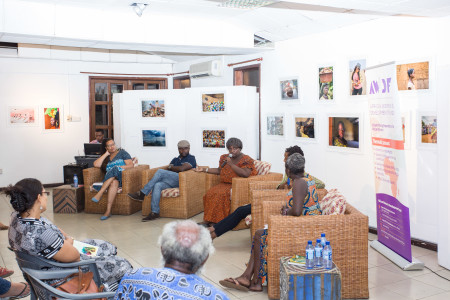
As part of the 2015 African Women Writers Workshop, The African Women’s Development Fund (AWDF) and Uganda Women Writers Association- FEMRITE- held a Public Dialogue on Friday July 31st in downtown Kampala, Uganda. That evening, the workshop participants, 22 African women writers, joined members of Uganda’s literary, art and activist community for a discussion on the status of African women in decision making spaces. The overall theme of the event was ‘African Women & Public Policy: Are We Getting It Right?’
The dialogue was led by a panel of noted African women thinkers including AWDF’s CEO Theo Sowa, Dr Tabitha Mulyampiti, a senior lecturer in the department of women and gender studies at Uganda’s Makerere University, writer and lead workshop facilitator Yewande Omotoso and the workshop participants.
It was a lively debate, which was well attended. Following the event AWDF CEO Theo Sowa gave an interview to the Ugandan radio station Power FM. You can listen to the interview and report on the event below: