
Category: News
We have a vacancy for an Intern
We have a vacancy for an Intern
We’re looking for a dynamic feminist who is passionate about women’s rights in Africa and embraces African women’s diversity and innovation, to join our team as Agency and Resilience Intern (Short-term).
Job Summary
The work of the Agency & Resilience team focuses on strengthening the organisational capacities of grantee partners through (but not limited to) planning and delivering training events. The AR Intern will support the team to plan and coordinate activities related to the unit’s training events. The internship will last for a period of 6 months.
Minimum Qualifications
Bachelor’s degree in Gender, Women’s Rights, Organisational Development, Development/social work or any related discipline.
Excellent written and spoken English and French.
How to Apply:
Qualified and interested persons should send a cover letter via https://awdf.simplicant.com/jobs/48662–agency-and-resilience-intern/detail indicating their relevant skills and experience and CV of not more than 3 pages. Subject line should indicate the position being applied for.
Applications for the vacancy should reach AWDF no later than Friday 28th April 2023. Due to our limited capacity, only short-listed candidates will be contacted for additional information and interviews.
In line with AWDF’s Mission, qualified African women are encouraged to apply.
Capacity Building Consultancy Openings for African Feminists
Capacity Building Consultancy Openings for African Feminists
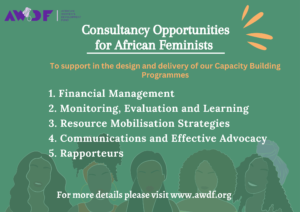
For the last decade AWDF has complemented its grant making support with capacity building activities to ensure that women’s rights organisations who receive grants from AWDF have the right skills sets, support and capacity to sustain their women’s rights work and organisations in Africa. AWDF applies different methodologies including feminist coaching and skills training in its capacity building activities and these have produced effective results over the years.
We are currently planning our Capacity Building training events for the year, and we are looking for high calibre professionals to support in the design and delivery of the following:
- Financial Management: Download TOR here
- Monitoring, Evaluation and Learning: Download TOR here
- Resource Mobilisation Strategies: Download TOR here
- Communications and Effective Advocacy: Download TOR here
- Rapporteurs: (On Hold)
While bilingual (English & French) professionals are preferred for these consultancies, candidates who can deliver the training in either English OR French are encouraged to apply. Fluency in Arabic would be an advantage.
For more details and mode of application, please click on any of the links above and download the Terms of Reference.
CLOSING DATE: 31st MARCH 2023
Call Consultants – Feminist Entities Mapping
Call Consultants – Feminist Entities Mapping
We are looking for consultants to support our programmes teams in mapping and partnering different entities within the movement including: individuals; non-formal/emergent non-traditional actors & collectives; CBOs & NGOs; and national/regional partners & networks working at scale.
AWDF believes that for the African feminist movement to thrive and endure, and be impactful, different types of organising are key. To help us to better serve these movements, we want to deepen our understanding of their key issues, trends, priorities and aspirations and how we can best be responsive to them.
If you are committed to feminist principles, have a good knowledge of the different entities in the African feminist movement and understand the ecosystem in which these entities work, we’d love to hear from you.
Please click here to download the Terms of Reference for more details and mode of application.
Closing date is 16th March 2023
We’re Hiring: Director of Partnerships & Philanthropy
We’re Hiring: Director of Partnerships & Philanthropy
The African Women’s Development Fund is hiring our first ever Director of Partnerships and Philanthropy. To fill this position, we are looking for an African feminist with significant experience in resource mobilisation, donor relations, strategic partnerships and philanthropic advocacy, as well as senior management.
How to Apply:
Qualified and interested persons should send a cover letter indicating their motivation, relevant skills and experience and a CV of not more than 3 pages with application for the position being applied for indicated as the subject line via this link:
https://awdf.simplicant.com/jobs/47615-director-of-partnerships-and-philanthropy/detail .
Applications for the vacancy should reach AWDF by Monday, 27th February, 2023. Due to our limited capacity, only short-listed candidates will be contacted for additional information and interviews. In line with AWDF’s mission, qualified African women are encouraged to apply.
Job Location
AWDF House, Accra – Ghana or work remotely from any African country where you have the legal right to work from.
Awareness to Accountability; 30 years of 16 Days of Activism
Awareness to Accountability; 30 years of 16 Days of Activism
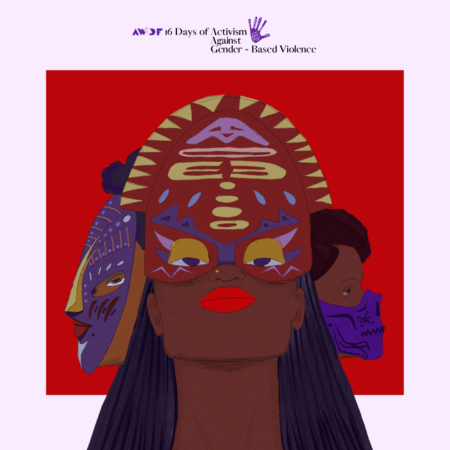
By: Martha Sambe, for African Women’s Development Fund
On April 29th, 2021, a 21-year-old Iniubong Umoren left home in Uyo, Akwa-Ibom, Nigeria, for a job interview. She never returned alive. At 4:29 PM that day, Iniubong’s friend sent out the first of several distressed tweets calling for anyone to help her friend, who she believed was in trouble.
Devastatingly, Iniubong was later found in a shallow grave within the family compound of Uduak Akpan, the young man who was eventually convicted of raping and killing her. Sixteen months later, a judge sentenced Akpan to death by hanging.
According to the World Health Organization (WHO), one in three women worldwide has experienced physical or sexual violence, mostly at the hands of an intimate partner. In sub-Saharan Africa, the prevalence of violence against women (VAW) by an intimate partner is about 33%, described as the highest in the world.
During the initial global response to the COVID-19 pandemic, this violence intensified to such an extent that experts began to speak of the “shadow pandemic”. For example, a study describing VAW across Africa in 2020 reported a 48% increase in East Africa during the lockdown. Similarly, according to the study, the Central African Republic saw an uptick of about 69% in reported injuries to women and a 27% increase in rape. Meanwhile, South African police also recorded a 37% increase in Gender-Based Violence (GBV) cases within the first week of April 2020. And in Nigeria, reported cases increased by 149%, a figure drawn from 23 out of 36 states.
A History of Violence
For 31 years, the world has marked the 16 Days of Activism against Gender-Based Violence campaign from November 25th to December 10th. The campaign has provided a platform for concerted efforts to prevent and eliminate violence against women and girls. However, the origin of the movement goes farther back than is often mentioned. It was originally inspired by events in the Dominican Republic, when revolutionary sisters Patria, Minerva and Maria Teresa Mirabal were killed on 25th November 1960 by the authoritarian regime they opposed.
Twenty years after their deaths, in 1980, the first International Day for the Elimination of Violence against Women in Latin America was declared. Then in June 1991, the Centre for Women’s Global Leadership (CWGL) and participants in the first Women’s Global Institute on Women, Violence and Human Rights called for a global effort against GBV and, in 1999, the United Nations formally declared November 25th the International Day for the Elimination of Violence Against Women worldwide.
The Band-aid Treatment
More than 30 years after the first 16 Days of Activism, the world does not seem much safer for women and girls. According to the UN, crimes of Violence Against Women (VAW) are still the most under-reported, as well as being the least likely to end in convictions.
Nigeria’s conviction rate is evidence of this unfortunate phenomenon. In 2021, out of 5,204 reported cases of VAW, less than 1% of offenders (i.e. fewer than 52 perpetrators) were convicted. South Africa records a similarly low rate as 4,058 cases of GBV were reported in 2020, but only 130 convictions were made.
Needless to say, the speedy and decisive response in Iniubong Umoren’s case is not the norm. It was a rare victory spurred by the viral news of Ini’s disappearance, attracting attention from local and international press. This is not unusual; the more viral a case of VAW goes online, the quicker lawmakers and enforcers tend to act to lay the matter to rest. This trend also played out with the BBC Sex for Grades Documentary; less than a year after it premiered, the Nigerian Senate created and passed legislation against sexual harassment in institutions of higher education.
While these victories should be recognised, strategies for ending GBV need to go beyond reactionary approaches, which work only in rare cases. For example, it is known that GBV occurs due to gender-based inequalities, which often reflect an inherent power imbalance in favour of men, one that characterises many patriarchal cultures worldwide. Consequently, a reactionary approach to ending GBV tackles symptoms rather than the problem of inequality itself.
From Awareness to Accountability
The early years of the 16 Days campaign saw concerted efforts towards raising awareness about GBV. These efforts have proven successful, with the campaign now carried out across 180 countries worldwide, reaching 300 million people. After 27 years of raising awareness, in 2018, the founding organizations declared that subsequent 16 Days of Activism would focus on increasing accountability for VAW and eliminating all forms of discrimination underscoring gender-based violence.
A necessary step towards achieving this is ensuring that GBV is situated within the larger context of gender inequalities, thus providing a basis for a proactive stance. This intervention can look like providing support for the creation, implementation, and strengthening of legal and policy frameworks that address VAW while helping to bridge the gaps between law and practice through the creation of accountability mechanisms. Advocates and governments must strengthen the legal and policy frameworks which address VAW, and bridge the gaps between law and practice by enforcing accountability mechanisms. Since causal factors of VAW are often interconnected, interventions must be multi-institutional and multi-sectoral in their approach. Actors from the health, justice, education and security sectors all have roles to play in creating and implementing prevention-focused interventions.
Such work is already being done on the continent. For example, the ‘1-in-9 Campaign’ demands legal accountability and sustainable structural change through lobbying for the transformation of legal frameworks so that women and girls who report GBV can access justice. In addition, the campaign rightly acknowledges that ending VAW must include ending all other forms of oppression that impact women’s access to equality because all gender-based inequalities come from the same belief that women are subordinate to men.
Similarly, the Kenya Sex Workers Alliance (KESWA) is demanding accountability via a multi-sectoral approach that centres the safety and rights of sex workers. KESWA supports universal access to health services, including HIV services, and raises awareness through focus group discussions, social media campaigns, sensitization meetings and themed talks on gender-based violence. Furthermore, they work with the Kenyan police to influence a change in attitudes and foster accountability within the institutions.
At a regional level, the South African Development Community (SADC) developed a Regional Strategy and Framework of Action for Addressing Gender-Based Violence in 2018. As part of its key strategic actions to prevent GBV and protect survivors, the SADC has agreed to pursue accountability by ensuring that perpetrators are prosecuted and maintaining a culture of zero impunity by strengthening the legal and judicial systems. Similarly, provisions have been made to equip security personnel and increase their accountability for conducting evidence-based investigations and providing quality service delivery in GBV prevention and responses.
Getting it Right
As we commemorate 16 Days of Activism this year, I long for a future where women do not have to take out a few days to campaign against violence. But until then, we must broaden our activism beyond reactionary strategies that achieve justice for specific victims while thousands of others remain silenced. We also must recognize that VAW has a sociocultural basis. Thus, to make women and girls truly safe, we must create effective multi-pronged interventions that tackle inequality and oppression at the root.
Martha Laraba Sambe is a writer, researcher and intersectional feminist who believes none of us is free until we are all free. This article was produced as part of the African Women’s Development Fund’s (AWDF) 16 Days of Activism Against Gender-Based Violence campaign, themed ‘Empowered People Taking Strategic Action to End VAW.’
Songs In The Future: AWDF 2021 Annual Report
Songs In The Future: AWDF 2021 Annual Report
We are thrilled to present AWDF’s 2021 Annual Report – Songs In The Future!
As 2021 waned, the DJs at AWDF belted out a playlist of beautiful compositions from all around the continent. Compositions that inspired us to journey together, recuperate and connect our steps throughout the year’s many layers. We invite you to join in reflecting on the futures sang by the many African feminist groups and activists we worked with in 2021.
African women’s rights and feminist movements were confronted with many manifestations of the patriarchy, and severe backlash. It was important to action our solidarity and utilise our position in various funder and policy spaces to articulate the morphing scope of the problem and what needed to be done.
With almost ten million dollars awarded in grants and donations in 2021, we were able to fund 64 new partners —a more than 11% increase from 2020.
We saw more bills passed into laws as women’s rights organisations shifted policy and practice to create enabling environments for women’s rights and the protection of activists. At the community level, partners celebrated individual behaviour changes as coalitions identified key influencers from groups originally opposed to the movement and negotiated meaningful partnerships with government structures. The campaigns we co-created rallied activist voices and sustained the visibility of major issues affecting African women’s rights on policy and resourcing agendas.
We recollect these experiences and more in a year where the songs of loss coloured the melodies of many places, yet together we rallied power to fuel each other.
Songs In The Future is a look back at the solidarity and strength of African women in their fight for freedom as they peered into an uncertain future with courage, dreams and hope.
You can access the full reports here
Rising in resistance against Fundamentalism: An East African Regional convening of African Feminists
Rising in resistance against Fundamentalism: An East African Regional convening of African Feminists
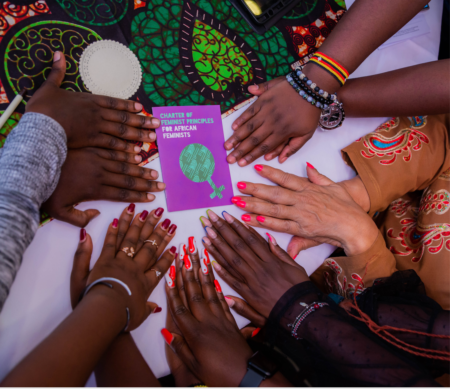
There is sufficient courage, resilient bonds, and wisdom to put up a resistance against the forces threatening our liberty
On a cool September evening, somewhere in Kampala-Uganda, a hall rang with peals of hearty laughter typical of old friends reuniting and the bubbly chatter of new friendships in formation. Wherever the eye rested, stirrings of joy abounded. In one corner, gifts of artisanal soap and scented candles passed from one hand to another, while in another corner, bits of news, personal and national, were traded.
These joyous sights and sounds belonged to a group of sixty African feminists who had come from Sudan, DR Congo, Uganda, Ethiopia, Tanzania, Kenya, and Rwanda to convene for the East African Regional Convening organised under the umbrella of the African Feminist Forum. At this forum, African feminists gathered to spend some time deliberating on strategies to counter the gale of fundamentalism sweeping across the world and with it, bearing seeds of conservative heteronormative patriarchal ideals, rigid homogeneity and fascism.
Fundamentalism often peddled through religion and culture can be defined as extremist and dogmatic interpretations of an ideology rooted in essentialist attitudes around various aspects of identity, like sex, ethnicity, religion, and nationalism. In the presence of perceived threats towards their identity, culture or power, those beset with a longing for the past where they believe “things were better back then” resist change, the advancement of modernity and any aspects of it. Often, this resistance takes place through the mobilization of people of a shared identity who are required to preserve or return to the past by putting up a spirited fight through strict adherence and enforcement of given rules.
Thus in the race towards maintaining homogeneity in regards to sex, gender and ethnicity etc, women’s and girls’ bodies which have long been ideological and political battlegrounds have their autonomy increasingly encroached upon as they are subjected to moral policing.
This year, for instance, we witnessed a surprising move by the United States Supreme Court when it overturned Roe v Wade, a landmark legal decision granting access to abortion to women in the US. This regressive move spells trouble for the rights of women, girls and gender-expansive persons in the USA and beyond, where organizing around sexual and reproductive health and rights will stall or fizzle out.
According to Open Democracy, US-based evangelicals, groups have poured more than $54M in Africa since 2007 to fight against LGBT rights, access to safe abortion, contraceptives and comprehensive sexuality education. This has resulted in some countries passing or attempting to pass discriminatory laws and practices as is exemplified by the anti-Homosexuality Laws in Uganda and now Ghana. In East Africa the Sexual and Reproductive Health and Rights Bill that could protect and facilitate the SRH and rights of all people in the region has stalled due to opposition by religious groups that are supported by Western fundamentalists. In August, 2022, by the Ugandan Minister of Ethics and Integrity in opposition to the bill said, “After all the failed attempts, they decided to sugarcoat it with some popular provisions, but when you assess it, you will find abortion, homosexuality, and these are not our values, this is not our culture, we said we must fight back,” said James Nsaba Buturo, the forum chairperson. A month before this convening, Kenya elected into power a president who is a well known evangelical christian who has given all signs of making religion central to his rule.
Away from religious fundamentalism, we have seen the rise of ethno-nationalist fundamentalism that manifests in increasing xenophobia and racism targeted against “foreigners” as in the case of continuos attacks against migrants in South Africa. In the Global North ethnonationalism continues to prevail in immigration laws intended to keep out foreigners, deportations or the detention of immigrants into modern day concentration camps like in Libya and Israel. The growing fundamentalist agenda is reflected in examples such as Sweden’s Democrat party which was founded by Neo Nazi movements, and the election of Italy’s far right prime minister who are meant to advance fundamentalist agendas.
Under the steerage of feminists of varying identities, the event ran from 25th to 28th September, and featured a profound discussion examining fundamentalism and how it manifests in governance, the economy, and individual spaces. These feminists are committed to the cause and are organising on various fronts; academia, grassroot movements, non-governmental organisations, political leadership among others.
Through its track record of oppression and destruction, fundamentalism as we have come to know it in historical and contemporary times, is indeed a fatal social poison that wounds and kills both the flesh and spirit. There’s never been a better time to take on this sinister force that is chiefly designed to subdue. The zeitgeist demanded that feminists convene to confront this wave of fundamentalism that was causing the rollback of the rights of women, girls, people from the LGBTQIA movement and other marginalised populations.
To infuse the participants with the mojo needed to take on the task of confronting and strategising against fundamentalism, the fiery Kenyan feminist scholar Dr Awino Okech, was elected for the task. Ahead of the reflection, Dr Okech set out to name the creature we were up against and lead us into a study of its anatomy before returning to the furnace to forge a weapon for it. Dr Okech offered much-needed insights on the subject through her keynote speech, pointing out that fundamentalism sits at the intersection of belonging, authoritarianism, and religious fundamentalism and that it takes on different forms in different contexts.
Using historical and contemporary examples at national and global levels, from Germany, India, Brazil and Kenya, Dr Okech explained that fundamentalism which often combines nationalism and religion, is a reaction towards the advance of modernity and also nostalgia for the past. She further pointed out that the advance of fundamentalism manifests in the form of moral panic that culminates in moral policing through surveillance and curtailing of civil liberties.
She shared examples of Iranian women protesting against the veil as part of their broader struggle for transformative justice, the election of a hyper-religious president in Kenya, Italy’s ushering in of a far-right political party and the overturning of Roe Vs Wade as clear indicators of the rise of fundamentalism. She submitted that given the nature of the kind of fundamentalism we are up against, it is only wise that our strategies against it take on a transnational, cross-movement and trans-disciplinary nature in order to defeat it. She encouraged us to stand in solidarity with each other, resisting on others’ behalf whenever their human rights are infringed on, because in preserving and protecting the liberties of others, we do our own. Our chances of survival and triumph over these forces, Dr Awino said, depends on how well we learn from the past. This means that we have to engage with the bodies of knowledge of our feminist ancestors to see the strategies that worked and failed and use that knowledge to forge our way forward.
Dr Okech’s keynote was a primer for the discussions that ensued at various feminist cafes set up on governance, economics and sexual integrity and bodily autonomy against the background of fundamentalism.
Ugandan Feminist scholar and educator, Sarah Mukasa submitted the need to create an ecosystem that responds to the issues at hand while learning from our past, to not lose sight of the bigger goal of social transformation. Professor Sylvia Tamale, a Ugandan feminist scholar and educator, in another rousing speech on decolonizing knowledge, implored feminists to engage vigorously with feminist writings and works and to write and document with equal verve so as to keep us flooding the past and our future with light. In support of this point, Dr. Awino Okech emphasised the importance of building and visibilising African feminist knowledge systems by citing African scholars. She called out young feminists’ inclination towards quoting feminist scholars from the west while ignoring African scholars entirely.
On resisting religious fundamentalism, Theology scholar, Professor Mombo Esther shared her thoughts on her work with the Circle of Concerned Theologians, a group of women theologians that dedicate their lives towards amplifying Pan-African and inter-religious theological perspectives of African women.
After days spent in collective reflection on the work to be done towards combating fundamentalism, the convening came to a close. At this point, the four days had cultivated an understanding that within and amongst us, was sufficient courage, resilient bonds, and wisdom to put up a resistance against the forces threatening our liberty. We felt that no matter how hard the fundamentalist gales blew, we would remain unbowed. In the joyous moments of exchanging words of hope and embracing each other goodbye, the words of Nigerian poet, Ijeoma Umebinyuo came to life:
“You call me sister not because you are my blood but because you understand the kind of tragedies we both have endured to come back into loving ourselves again and again.”
Written by: Mubeezi Tenda
Connect with AWDF at the SVRI Forum!
Connect with AWDF at the SVRI Forum!
Are you attending the SVRI Forum in Mexico this September? We will be thrilled to connect with you!
On September 19 until 23, AWDF will join hundreds of funders, researchers, practitioners to steer debate on the future of violence prevention and redress at the Sexual Violence Research Initiative (SVRI) Forum in Mexico, Cancún. The forum is the largest global, abstract-driven research and advocacy conference on violence against women (VAW). It brings together researchers, funders, practitioners, policymakers, activists, and survivors every two years to connect, learn and share. The forum is also an opportunity to learn about the newest innovations for prevention and responding to VAW in low- and middle-income countries and to meet some of the most influential donors, researchers and practitioners in the fields of VAW.
Our staff delegation will be led by AWDF’s Director of Programmes – Pontso Mafethe, together with a diverse team from our knowledge, grants and operations portfolios.
We are also thrilled to be convening over 20 movement voices from ten countries to actively engage and influence conversations in the space! These include representatives of women’s rights organisations, individual feminist activists and collectives on the continent and in the Middle East (from our Leading from the South programme).
Check us out at the forum by connecting with us at the following events and sessions
Connection highlight one
SVRI and AWDF collaborative donor engagement session on decolonised and ethical funding for VAW and gender equality
Tuesday| Sept 20 | 6:00 – 7:00 PM
Venue: TBD |Translation available: Spanish, English
Connection Highlight two
Dialogic panel: Power and control in research: The High-Income Countries – Low- and Middle-Income Countries Divide
**Chair: Pontso Mafethe, African Women’s Development Fund
Time: 16:30 – 18:00 | Wednesday 21, Sept
Venue: Goya | Translation available: Spanish, English
Connection highlight three
AWDF Grantee partners-led Knowledge circles
Wednesday | Sept 21 | 11:00 AM – 01:00 PM
Venue: TBD |Translation available: French, Arabic, Spanish, English
Connection highlight four
South-feminist led funding: Showcasing the Leading from the South Model
Thursday| Sept 22 | 14:30 – 16:00
Venue: Greco-Dalí |Translation available: Spanish, English
Here is the full programme of the SVRI forum where you will find details of these and other very insightful activities at the forum. Please contact our Knowledge Management Team via knowledge@awdf.org if you have specific questions around AWDF’s engagement at the forum.
Policy and Financing that works for African Women’s Sexual & Reproductive Health Rights
Policy and Financing that works for African Women’s Sexual & Reproductive Health Rights
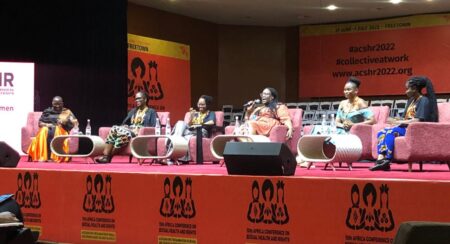
After an incredible week of connection, construction and commitment with hundreds of feminists and sexual rights activists from across Africa, we are excited to share the Call to Action from the 10th Africa Conference on Sexual Health and Rights: ACSHR2022.
It is a collective call on governments, donors, feminist funds, Women Rights Organisations and the private sector to prioritise our recommendations to achieve greater impact in policy and financing outcomes for African Women’s SRHR.
Please download the CALL TO ACTION here, and SHARE!
Stay tuned for more updates and reflections from the conference.
Follow us on Social Media
Instagram: @the_awdf
Twitter: @awdf01
Facebook: AfricanWomensDevelopmentFund
LinkedIn: AfricanWomensDevelopmentFund
PROUD CONTINENT: A celebration of Queer Realities
PROUD CONTINENT: A celebration of Queer Realities
INTRODUCING THE PROUD CONTINENT ZINE
As a feminist organisation, AWDF provides crucial support to women’s movements working to end patriarchy, human rights abuses and gendered violence in Africa. Our core values of respect, diversity, feminist leadership, solidarity and partnership are demonstrated in the material, technical and institutional support that we provide to LBQT+ organisations fighting for the safety and freedoms of marginalised Africans.
This June, we have teamed up with our LBQT+ grantee partners in countries such as Angola, Tanzania and Uganda to highlight the experiences and convictions that shape the work they are doing. Our grantee partners are all courageous and committed individuals who work hard to secure rights, combat stereotypes and ultimately make society more welcoming for queer and trans people. These grantee organisations create safe spaces, provide much-needed healthcare and peer support, and mobilise around pressing issues in order to create a reality where all people are free to enjoy their human rights.
As we highlighted with our #LoveAndFreedomAfrica campaign last year, queer and trans people in Africa experience high and sometimes extreme levels of social isolation, physical and sexual violence, discrimination in workplaces and places of learning, and human rights abuses at the hands of the state and private actors. Trauma and suffering are however not the entire story of queer and trans life, and with the #AfriPROUD campaign we aim to highlight the complexity, beauty and courage that underpins the lives of our African LBQT+ sisters and siblings.
Pride Month is here and we see this globally recognised celebration as an opportunity to focus on LBQT+ Africans, while also reinforcing how crucial it is that we all act urgently to protect the rights and freedoms of our sisters and siblings.
We have compiled this Zine to spotlight the activism, resilience, and courage of Africans whose sexual orientation, gender identity, and social performance transcend conservative norms.
Proud Continent – June 2022 (English) by Square HQ