
Category: News
Consultancy Opportunity: Resource Mobilisation Strategy
Consultancy Opportunity: Resource Mobilisation Strategy
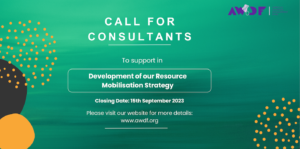
The African Women’s Development Fund has started implementing our new ten-year (2023-2033) strategic framework, Lemlem, to guide our efforts to advance gender equality and gender justice for girls, women, and gender-diverse people across Africa. At its core, Lemlem focuses on resourcing, nurturing, and strengthening African women, feminist groups, organisations and movements to achieve transformative change. A key strategic priority within Lemlem is to grow and manage AWDF’s financial resources to sustain our ambitions and progress towards financial security. AWDF aims to particularly focus on generating and attracting the type of funding that will give us the flexibility we need to better resource, amplify, and sustain our movement partners – especially long-term, flexible, and unrestricted funding.
To meet this ambition, AWDF is recruiting a consultant (or teams of consultants) to act as a Resource Mobilisation Accelerator – a Resource Mobilisation strategist and expert who can assist the team in ensuring our resource mobilisation strategy, donor relationship management, practices and competencies are aligned with our new strategic vision. The Resource Mobilisation Accelerator’s work will run over a period of six months, and include an accompaniment program for key staff at AWDF around donor relationship management.
For more information and mode of application, please download the Terms of Reference here
Closing date is Friday 15th September 2023
We have a vacancy for a Programme Officer
We have a vacancy for a Programme Officer
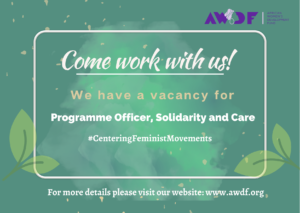
We are hiring to fill a vacancy for the position of Programme Officer, Solidarity and Care. To fill this position, we are looking for a highly motivated person who is innovative, passionate about women’s rights in Africa, excited about African feminisms and embraces African women’s rich diversity.
As part of our new strategy, AWDF is building on our approach of strengthening the movement and funded partners to a more transformative and de-colonised approach which gives feminist and women’s rights activists, organisations and collectives in Africa the ownership and space to make transformative choices and impact their communities across the continent.
The Programme Officer is responsible for supporting the implementation of AWDF’s Solidarity and Care strategy to strengthen and uphold African women’s and feminist organisations and movements. The role will work under the leadership of the Programme Specialist – Solidarity and Care. The Solidarity and Care unit follows a cross-cluster operational model and the post-holder will therefore work with and be supported by various clusters, units and teams across the Programmes Department.
If you have experience in contributing to a programme and portfolio of work with identified entities, particularly individual activists in a strategic, inclusive, feminist, trust-based, collaborative and responsive approach for longer-term support, we’d love to hear from you.
How to Apply:
For more information on the role, and also on the application process, please visit the Application Portal here
Remember to include the following:
- A cover letter of not more than 2 pages to the Human Resources Manager, explaining their interest and excitement in applying for the position to work for AWDF; and highlighting their experience and competencies as they relate to the specific areas of duties indicated in the vacancy to demonstrate a good fit for the role.
- A CV of not more than 3 pages outlining their educational qualifications and employment records with key achievements on relevant positions held.
Applications for the vacancy should reach AWDF no later than Thursday 10th August 2023. Due to our limited capacity, only short-listed candidates will be contacted for additional information and interviews.
In line with AWDF’s Mission, qualified African women are encouraged to apply.
Consultancy Opportunity: Annual Report Writing
Consultancy Opportunity: Annual Report Writing

Are you an adept storyteller and experienced in report writing?
AWDF seeks the expertise of an Annual Report Writing Consultant with a remarkable storytelling ability to compile, structure, and narrate the organisation’s Annual Report for the fiscal year 2022. The consultant will infuse life into our accomplishments, struggles, and hopes, making the report a captivating testament to the collective efforts of the AWDF community.
The consultant’s responsibilities will include the following:
- Immerse themselves in AWDF’s rich tapestry by reviewing project reports, financial statements, and other relevant materials.
- Embark on a journey of discovery by conducting interviews or meetings with key staff, grantees, and partners, capturing the essence of their experiences.
- Collaborate with AWDF’s Communications and Programme teams, blending data to create a seamless and compelling narrative.
- Craft the report’s structure, ensuring each chapter unfolds like a new chapter in a captivating book.
- Write the report’s content in a way that demonstrates our impact, grounded in human interest stories and lived realities.
Work with the designer to integrate infographics, charts, and visuals to underscore the impact of our collective journey visually.
For more details please download the Terms of Reference here
Submissions must be received on or before July 24, 2023.
Qualified African women and gender-diverse candidates, including those identifying as women, are encouraged to apply.
Exciting Vacancies for Funded Initiative Coordinators
Exciting Vacancies for Funded Initiative Coordinators
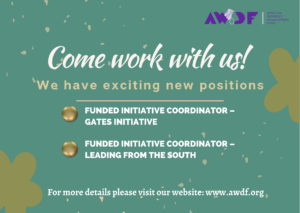
We are looking for two highly motivated individuals who are excited about African feminisms and embrace African women’s diversity, to join our team as Funded Initiative Coordinators.
- Funded Initiative Coordinator, Leading From the South
Are you ready to develop, implement and manage a diverse portfolio under the Leading from the South (LFS) Initiative, to ensure that the team goals and set standards are met, in addition to providing initiative level monitoring, impact and learning and evaluation support to the LFS funded partners? If yes, then apply for the position of Funded Initiative Coordinator – Leading from the South Initiative
This role will be central to AWDF’s effort to cultivate, maintain and strengthen AWDF’s relationships with existing and new partners in feminist and social justice movements, the philanthropic sector and international development. The role holder will also be key to the execution of initiatives and activities to advance AWDF’s philanthropic advocacy and influencing agenda – working closely with the Director for Partnerships and Philanthropy (who they will report to), Programme Manager -Resourcing (in a matrix management arrangement), the CEO and the Director of Programmes.
Applications for the Leading From the South Coordinator must be sent to the application portal via this link: https://awdf.simplicant.com/jobs/49633-funded-initiative-coordinator-leading-from-the-south/detail
2. Funded Initiative Coordinator, Gates Initiative
A member of AWDF’s newly-created Partnerships and Philanthropy team, the Funded Initiative Coordinator – Gates Initiative will be central to AWDF’s effort to cultivate, maintain and strengthen AWDF’s relationships with existing and new partners in feminist and social justice movements, the philanthropic sector and international development. She/They will also be key to the execution of initiatives and activities to advance AWDF’s philanthropic advocacy and influencing agenda – working closely with the Director for Partnerships and Philanthropy (who they will report to), Programme Manager -Resourcing (in a matrix management arrangement), the CEO and the Director of Programmes. The Funded Initiative Coordinator – Gates Initiative will also support the development of donor reports and proposals, and other donor relations work.
Applications for the Gates Initiative Coordinator must be sent to the application portal via this link: https://awdf.simplicant.com/jobs/49634-funded-initiative-coordinator-gates-initiative/detail
Applications for both positions must comprise the following:
- A CV of not more than 3 pages, outlining your educational qualifications, employment records with key achievements
- A cover letter of not more than 2 pages, explaining your interest and excitement in applying to work with AWDF.
Applications should reach AWDF no later than Thursday 27th July 2023. Due to our limited capacity, only short-listed candidates will be contacted for additional information and interviews.
In line with AWDF’s Mission, qualified African women are encouraged to apply.
Consultancy: End of Project Evaluation
Consultancy: End of Project Evaluation
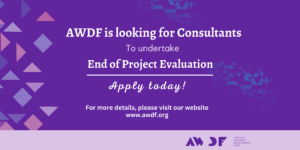
Are you committed to feminist values? Are you experienced in conducting evaluations and assessments of donor supported projects aimed at transforming gender relations and inequality? We’d love to hear from you.
AWDF is undertaking end of project evaluations to access and document the achieved results over the period of two Comic Relief grants including changes realised, lessons learnt, identify challenges and make recommendations.
We are looking for a consultant or team of consultants to undertake either one of the following assignments:
End of Project Evaluation Comic Relief’s Shaping Africa’s Futures Project
In January 2021, AWDF received a grant from Comic Relief, an international UK charity organisation under a project titled “African Women Shaping Africa’s Futures“. This grant covers a two-year period and is aimed at supporting Women’s spaces and organisations to effectively engage at the political, legal, economic and social levels to address the challenges confronting women’s rights and gender inequality caused by patriarchal power systems and intersecting systems of discrimination.
Please download the Terms of Reference for Shaping Africa’s Futures Project here
End of Project Evaluation Comic Relief’s Leadership and Governance Project- Phase II
This grant, also funded by Comic Relief, is aimed at strengthening leadership and governance capacities of African Women’s Rights Organisations. It seeks to support the execution of various leadership activities to be implemented in Sub-Saharan Africa.
Please download the Terms of Reference for the Leadership and Governance Project here
How to Apply
To apply, please send the following to consultants@awdf.org
- A concept note demonstrating your understanding of the TOR and your proposed approach
- The CVs of all team members
- Your technical and financial/budget proposals
- One example of a relevant evaluation report that the consultant/s has undertaken recently
- A Cover email – Email subject header: Application: XXXXX Consultancy which sets out what excites you about this piece of work and why you’re applying.
Closing Date: 14th July 2023
We are inviting Applications for Grants!
We are inviting Applications for Grants!
THIS CALL FOR APPLICATIONS WAS CLOSED ON on 8th August 2023.
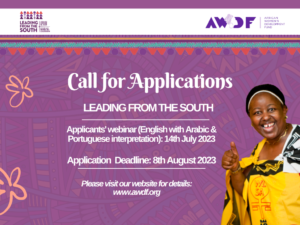
Are you a feminist or women’s rights organisation working in Iraq, Jordan, Lebanon, Palestine or Yemen, the Horn of Africa, the Sahel Region, French speaking Africa, or in Portuguese or Arabic speaking country? AWDF is a Pan African organisation and while we recognise the significant needs of women, girls and gender diverse people everywhere we work, for this cycle we are prioritising applications for work in French speaking countries.
Are you a women led organisation that has been formally registered for at least three years (before June 2020)? AWDF defines a woman-led organisation as an organisation whose Board Chair and Chief Executive/Director are both women or non-binary, and where at least 70% of the board and staff members of the organisation are women or non-binary.
If yes, AWDF invites you to submit an application today.
What, When and How?
For this round of grant making, AWDF will award grants for an amount between USD20,000 per year to USD500,000 per year. We are able to make grants for up to 20 months in this cycle, and you can apply for one of the following three types of grants:
- Pamoja: you can apply for a maximum of US$500,000 per annum for 20 months
- Ananse: you can apply for a maximum of US$200,000 per annum for 20 months
- Yalla: you can apply for a maximum of US$50,000 per annum for up to 20 months
AWDF expects to receive hundreds of applications for funding. In this cycle we anticipate awarding the following number of each type of grant:
- Three (3) Pamoja grants
- Six (6) Ananse grants
- Eleven (11) Yalla grants
You can apply for up to 50% of your verified 2022 income. For example, if your confirmed income for 2022 was US$600,000 you can apply for a maximum of up to USD300,000 per year for 20 months. If your confirmed income for 2022 was $40,000, you can apply for a maximum of up to $20,000 per year for 20 months.
The deadline for submitting your applications is 11.59pm GMT on 8th August 2023.
02: 59 AM EAT on the 9th of August 2023 – Eastern Africa Time
01: 59 AM SAST on the 9th of August 2023 – South Africa Standard Time
Next Steps
If you are interested in hearing more about the AWDF application process and would like to join one of our potential applicant webinars, please register here. The French applicants’ webinar (with interpretation in English) will be held on Thursday 13th July 2023 at 10.00am GMT, and the English applicants’ webinar (with Arabic and Portuguese interpretation) will be held on Friday July 14th 2023 at 10.00am GMT.
If you wish to submit an application, please complete the application process online. Guidance for the online platform can be accessed here
Read more about this Call for Applications here.
Successful applicants will hear from us in December 2023.
Important Links:
ONLINE APPLICATION PORTAL
ONLINE APPLICATION GUIDANCE DOCUMENT
WEBINAR REGISTRATION LINK
FREQUENTLY ASKED QUESTIONS
Advancing Feminist organising at the Women Deliver Conference 2023
Advancing Feminist organising at the Women Deliver Conference 2023
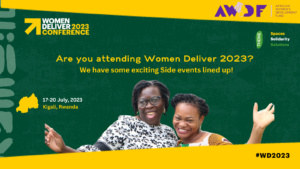
Will you be at the July 17-20 Women Deliver Conference in Kigali? Come Connect with us.
AWDF will be in solidarity with gender equality and feminist actors attending the conference online and in-person. Our 47-member delegation includes 34 African feminists and women rights actors from 18 countries and 13 staff members.
The Women Deliver Conference is one of the largest multi-sectoral convenings to advance gender equality and brings together grassroots advocates, youth, civil society, governments, multilateral organisations, and the private sector, with a deliberate representation of communities facing systemic discrimination around the world. You can read more about this year’s conference here.
The 2023 Women Deliver Conference in Kigali is the first to be held on the African continent and an opportunity for AWDF to promote and highlight African feminist voices within the space, centre evidence and define approaches that work to promote and sustain gender equality gains. It will also be an opportunity for AWDF to continue to reintroduce ourselves to our partners and constituents as we launch our new strategic framework and direction for the next ten years.
AWDF staff attending will be representing a number of our priority areas of work including Partnerships and Philanthropy, Knowledge and Voice, Resourcing and Movement Building.
We invite you to find and connect with the work and voices of the diverse pool of partners we are sponsoring at the exhibition booth and in the various sessions we are co-hosting at the conference. Here is a summary.
African Feminist Perspectives on Wellbeing: Cultural Meanings, Identities and Innovations
A side event to introduce a guide on a feminist response to trauma, developed jointly with the Stephen Lewis Foundation.
Date: July 18, 2023 | Time: 11:30-13:00 hrs CAT
Venue: Kigali Convention Centre Room AD-12.1 |Translation available:
Prevention, Support and Accountability: Combatting Sexual Violence in West Africa
A concurrent session to present learning from the work of our partners under the Kasa! initiative (funded by the Ford Foundation and Open Society Foundations).
Date: July 19, 2023 | Time: 15:30-17:00 hrs CAT
Venue: Kigali Convention Centre Translation available:
You can find the full programme for the Women Deliver Conference here. Please contact events@awdf.org if you have specific questions around AWDF’s engagement at the conference.
We have an opening for a Finance Officer
We have an opening for a Finance Officer
Do you have experience in financial management and are you ready to develop your competencies and contribute to strengthening the financial health of AWDF? Do you have strong analytical and accounting skills? Are you able to provide timely and accurate financial reports and procedures including cash management, payroll, budgeting and financial disbursement? Do you have experience in carrying out effective due diligence for grantee partners?
If this is you, apply for the position of FINANCE OFFICER.
Job Summary
Reporting to the Finance Manager, the Finance Officer is required to support the achievement of the financial management objectives of the organisation in line with the organisational strategy. The Finance Officer will be responsible for the financial operations of the organisation and ensure timely and accurate financial report and practises including cash management, payroll, participating in audits, budgeting, transaction monitoring and financial disbursement. As part of the specific duties described below, the Finance Officer will have additional responsibility for due diligence work related to programmes and operational portfolios.
To apply, please follow this link
Closing date for application: Monday, 12th June 2023
Exciting vacancies for African Feminists!
Exciting vacancies for African Feminists!
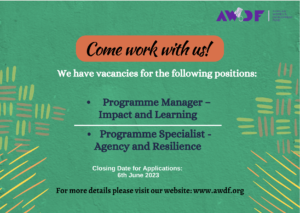
The African Women’s Development Fund is inviting applications for two vacancies in our Programmes team. If you’re a highly motivated and innovative individual who is passionate about women’s rights in Africa, excited about African feminisms and embrace African women’s diversity, we’d love to hear from you. We have openings for the following positions:
Programme Manager – Impact and Learning: Responsible for leading and supporting the overall implementation of the AWDF impact and learning strategy. The role will design and implement processes and systems that embed evidence-based decision making and the ability to understand, learn and adapt to increase AWDF’s collective impact. The role drives and champions strategic and organisational learning, monitoring and evaluation working in collaboration across teams. It will also lead all aspects of the Impact and Learning function including budgeting/financial management, leadership and staff development, policy development and strategic planning.
Please follow this link to apply for the position of Programme Manager – Impact and Learning
Programme Specialist – Agency and Resilience: Working in close collaboration with colleagues in the “Nurturing” cluster, the A&R Specialist will focus on unlocking the agency of African women’s rights and feminist activists, leaders, organisations, collectives and movements so they flourish and are impactful. The role will be responsible for leading the re-imagining and implementation of AWDF’s new strategy work with African women’s rights and feminist organisations, collectives and movements working for gender justice in Africa.
Please follow this link to apply for the position of Programme Specialist – Agency and Resilience
Closing Date for applications is 6th June 2023
The AWDF Story: An African Feminist Journey
The AWDF Story: An African Feminist Journey
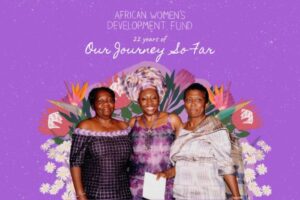
More than two decades after the birth of Africa’s first women’s rights and feminist grantmaking organisation, the African Women’s Development Fund is taking a look back at where we have been in order to chart the way forward into our future.
It gives us great joy to share with you the story of our Journey, which draws on the motivations, memories and wisdoms of many people. Our founders, staff past and present, grantee partners, donor partners and friends have all lent their voices to weave this beautiful narrative of how far we have come.
Since the mid-1990s when Joana Foster, Hilda Tadria and Bisi Adeleye-Fayemi first came together to ideate a women’s fund with African women at the centre, AWDF has remained committed to supporting African feminist movements because we know the power that they hold.
We’re proud of our journey and our impact in the last two decades, and we’re looking forward to more years of African feminist magic.
Follow the #AWDFjourney on our website and on Instagram, Twitter and LinkedIn as we share more about the story of our origins and growth, and share your own recollections of AWDF under the hashtag.