
Author: African Women's Development Fund
Bi-Annual Call for Applications / Appel à Candidatures Bi-Annuel
Bi-Annual Call for Applications / Appel à Candidatures Bi-Annuel
[tp lang=”en” not_in=”fr”]

TO APPLY IN ENGLISH, CLICK HERE
POUR POSTULER EN FRANCAIS, CLIQUEZ ICI
Is your organisation an African feminist/ women’s rights organisation with cutting edge ideas for advancing women’s rights and creating systemic change? Is your organisation led and majority staffed by women, and registered on the African continent? If yes, then you can apply for the AWDF call for applications in any of the three thematic areas listed below:
- ECONOMIC SECURITY & JUSTICE
- Defending women’s economic rights and justice including mobilising women in rural contexts, urban economies, and/or in non-traditional work
- Building ideas and models around women’s economic futures
- Defending women’s land, property and inheritance rights
- Securing women’s housing rights, particularly in the context of urbanisation
- Advancing climate and environmental justice.
- BODY & HEALTH RIGHTS
- Ending violence against women in all forms through prevention and/or response.
- Advancing the sexual and reproductive health and rights of women and girls, including on issues of sexual orientation, reproductive choice
- Promoting women’s emotional well-being and mental health
- Prevention and management of issues around women and HIV/AIDS
- Building awareness and feminist responses to the rise of non-communicable diseases (including cancers, diseases of lifestyle and nutrition).
- LEADERSHIP, PARTICIPATION & PEACE
- Promoting women’s leadership, meaningful participation in decision making including building feminist leadership for social, political and economic change
- Advancing diverse women’s participation in governance and decision-making at all levels
- Defending democratic operating space for women’s rights organisations and defenders
- Promoting women’s human security and peace in all contexts
[/tp]
[tp lang=”fr” not_in=”en”]
APPEL À CANDIDATURE BI-ANNUEL
Etes-vous une organisation féministe/de défense des droits des femmes africaine, ayant des idées de pointe pour faire avancer les droits des femmes et créer un changement systémique? Estes-vous une organisation dirigée par les femmes et la majorité du personnel sont des femmes et enregistrée sur le continent africain ? Si oui, vous pouvez présenter une demande dans l’un des trois domaines thématiques suivants:
- DROITS A LA SECURITE ET JUSTICE ECONOMIQUE
- Défendre les droits à la justice économique notamment en mobilisant les femmes dans les contextes ruraux, les économies urbaines et/ou dans le travail non traditionnel
- Développer des idées et des modèles autour de l’avenir économique des femmes
- Défendre les droits des femmes à la terre, aux biens et à la succession.
- Garantir les droits des femmes au logement, surtout dans le contexte de l’urbanisation
- Faire progresser la justice climatique et environnementale.
- DROITS A L’AUTONOMIE CORPORELLE ET A LA SANTE
- Eliminer toutes formes de violences faites aux femmes par la prévention et/ou l’intervention
- Promouvoir la santé et les droits sexuels et reproductifs des femmes et filles, notamment en ce qui concerne l’orientation sexuelle et le choix en matière de procréation.
- Promouvoir le bien-être émotionnel et la santé mentale des femmes
- Prévention et gestion des questions relatives aux femmes et au VIH/SIDA
- Mettre en place des réponses féministes et des programmes de sensibilisation sur l’augmentation des maladies non transmissibles (y compris cancers, maladies liées au mode de vie et à la nutrition)
- LEADERSHIP, PARTICIPATION ET PAIX
- Promouvoir le leadership des femmes et leur participation significative dans les processus de prise de décision y compris le renforcement de leadership féministe en vue d’un changement social, politique et économique
- Promouvoir la participation des femmes de divers horizons à la gouvernance et au processus de prise de décision a tous les niveaux
- Défendre un espace de fonctionnement démocratique pour les organisations et défenseures des droits des femmes
- Promouvoir la sécurité humaine et la paix des femmes dans tous les contextes
POUR POSTULER EN FRANCAIS, CLIQUEZ ICI
[/tp]
Bi-Lingual Communications Assistant (Short term contract)
Bi-Lingual Communications Assistant (Short term contract)

AWDF requires the services of a Bi-Lingual Communications Assistant for a short term contract. The consultant must have at least two years of experience in the field of public information, online marketing or similar environment. The assignment shall be for a period of 6 months.
Competencies:
Fluency (written and spoken) in English and French
Knowledge of graphic design will be an asset
Excellent communication skills – written and oral
Good knowledge of key social media platforms (including Twitter, Facebook, Instagram)
Ability to prioritise work to meet goals and objectives within acceptable time frame
Sound knowledge of women’s rights issues
For more details about this position and how to apply; click here
Deadline: 28th February 2020
Call for Proposals: Audit of AWDF Information Technology (IT) Infrastructure
Call for Proposals: Audit of AWDF Information Technology (IT) Infrastructure
- About AWDF
The African Women’s Development Fund was established in June 2000, as an Africa-wide philanthropic, grant making initiative to support the realisation and fulfilment of African women’s rights through funding of autonomous women’s organisations on the continent. AWDF believes that if women and women’s organisations are empowered with skills, information, sustainable livelihoods, opportunities to fulfil their potential, plus the capacity and space to make transformatory choices, then we will have vibrant, healthy and inclusive communities. To achieve this, AWDF mobilises financial, human and material resources to support local, national, and regional initiatives for transformation led by African women. AWDF is mandated to fund in all 54 African countries.
AWDF’s current strategic plan “Shaping the Future” (2017-2021) focuses the organisations work around investments to build the best possible future for women in Africa. As an organisation AWDF is committed to changing the narrative around Africa women, and highlighting African women’s agency, expertise, leadership and ability to transform societies towards justice.
- Background
The African Women’s Development Fund (AWDF) recognises the role effective information technology (IT) plays in the development of any business. To ensure that it has an IT infrastructure that is supportive of its current and future business activities and promotes safety of its data, AWDF is looking for an IT expert who would audit its current IT capacity and guide the organisation through modernisation of its systems and approaches.
- Purpose of the Assignment
The overall goal of the IT expert through this assignment is to;
Audit AWDF’s current IT operations, policies and procedures.
This process is aimed at understanding AWDF’s current IT strengths and weaknesses to map out where the opportunities for growth are. The IT audit will;
- Examine and evaluate the organisation’s information technology infrastructure
- Evaluate the systemsand processes in place for data security and business continuity
- Determine whether the current IT controls protect AWDF’s assets and ensure data integrity in line with the organisation’s overall goals.
- Determine risks to AWDF’s information assets, and help identify methods to minimise those risks.
- Examine whether the organisation’s informationmanagement processes are in compliance with current IT-specific laws, policies and standards.
- Determine any inefficiencies in IT systems and provide associated recommendations.
- Diagnose challenges relating to the operation of all software, computer equipment, peripherals, operating systems and the networking environment and provide relevant advice.
- Advise on way forward to protect the organisation’s data
- Submit a comprehensive report on the assignment detailing strengths, issues identified and recommendations to address weaknesses identified.
- Develop a draft IT strategy and policy for AWDF
For the entire TOR please click here
Applying for a Grant? What to Expect!
Applying for a Grant? What to Expect!
[tp lang=”en” not_in=”fr”]
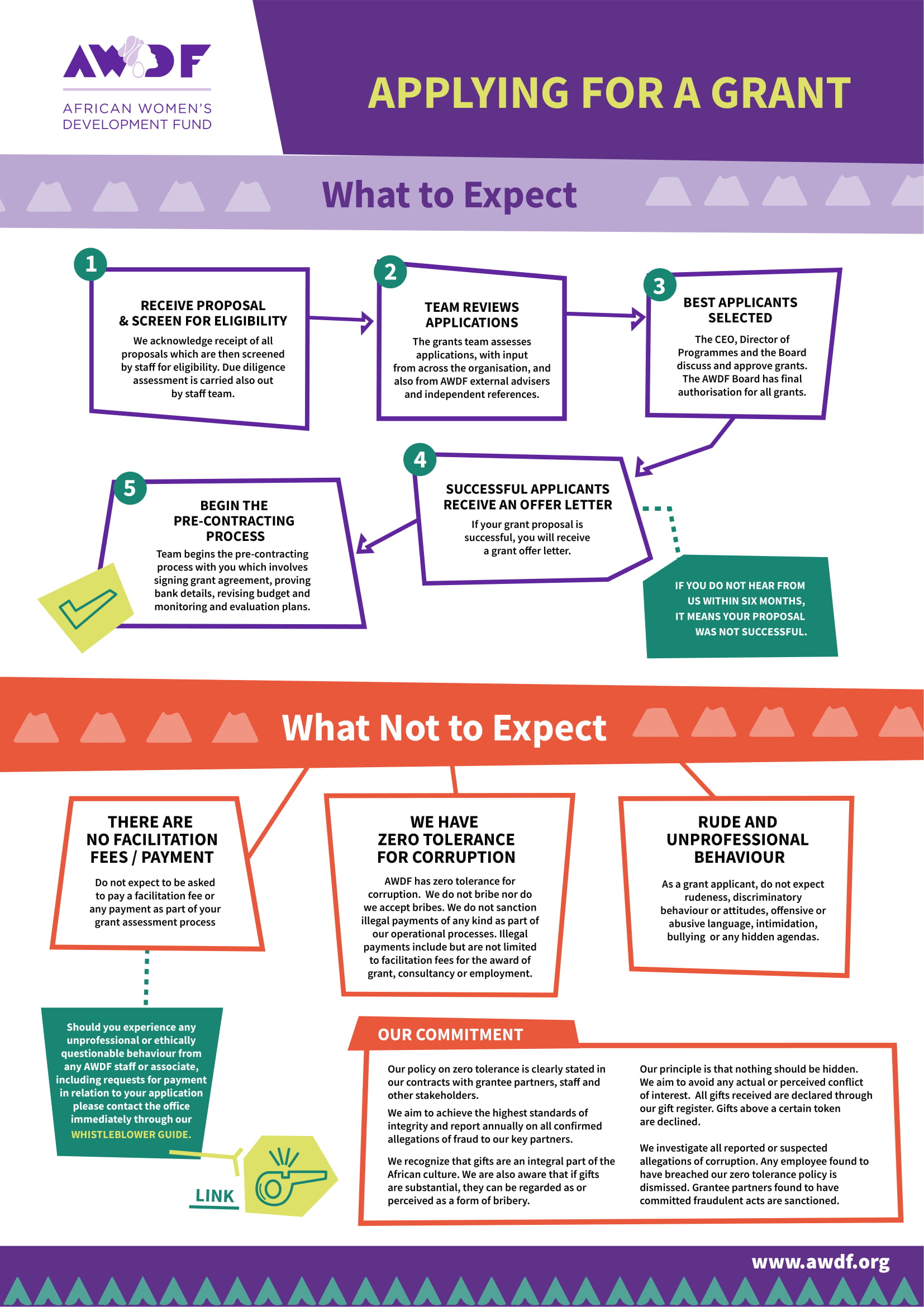
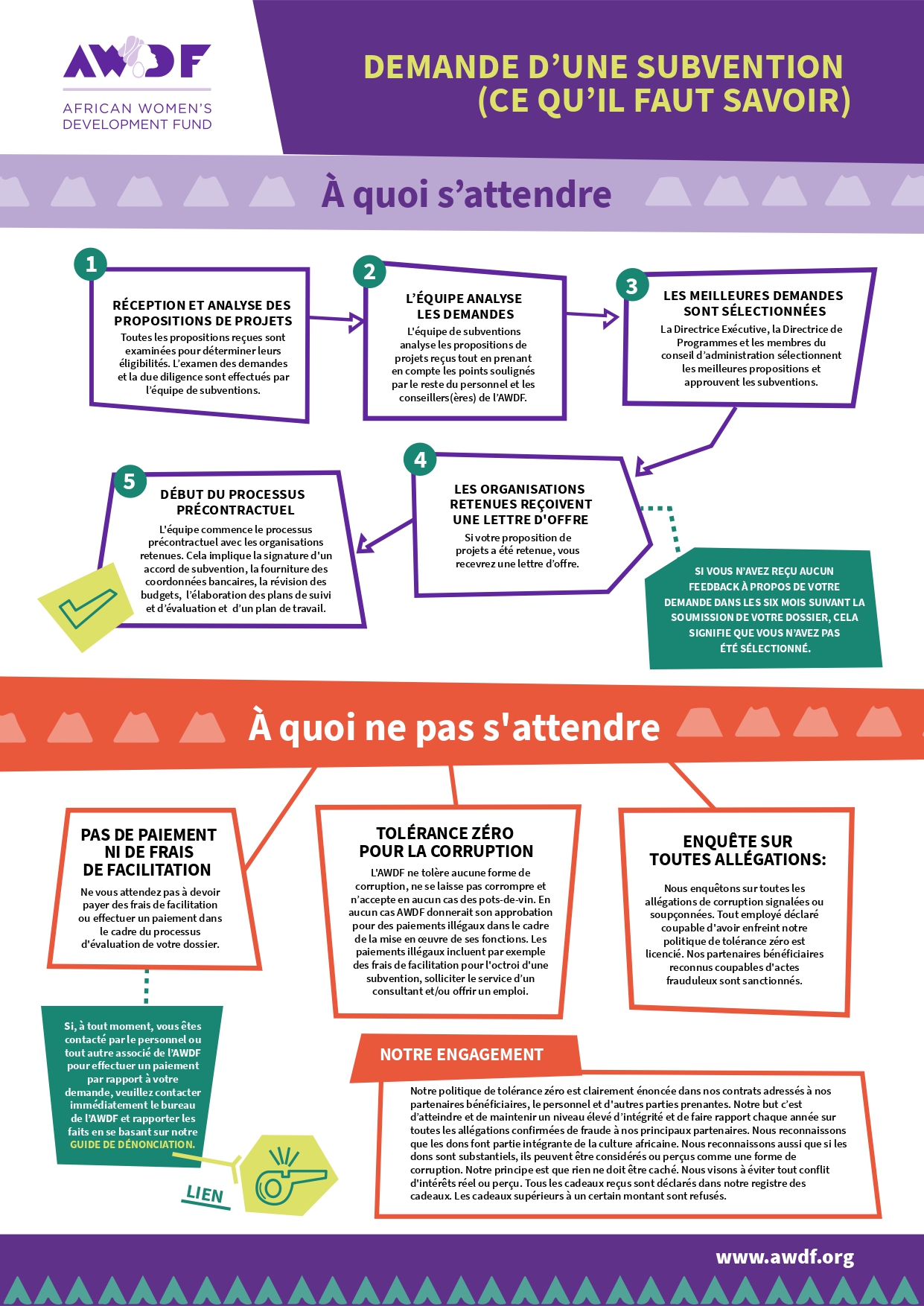
At AWDF, grant making is a courteous, caring, professional and transparent process that reflects our feminist values of respect, inclusive diversity, stewardship and professionalism, integrity and transparency.
OUR WHISTLEBLOWING SYSTEM is aimed at preventing, detecting and investigating fraud, corruption, misconduct and malpractice. It encourages staff and other partners to raise concerns about possible fraudulent or corrupt behaviour rather than overlook them for fear of retaliation.
READ OUR WHISTLEBLOWER POLICY HERE
[/tp]
[tp lang=”fr” not_in=”en”]
[/tp]
Creating Safe Spaces: Experiences of Ugandan women in the informal sector
Creating Safe Spaces: Experiences of Ugandan women in the informal sector
To mark 16 Days of Activism this year, AWDF and her grantee partners are lending a voice to support the global campaign on ratification and implementation of the new ILO Convention 190 and recommendation 206 to end gender based violence in the world of work.
Under the thematic area of Body and Health Rights, AWDF has supported a number of women’s rights organisations in Africa to mobilise for the protection of women’s rights and an end to violence in the informal economy and in domestic work.
African women are the backbone of African economies, performing labour to sustain themselves, their families, communities and countries. However, this labour often takes place in precarious conditions, with low pay, lack of recognition or protection, and frequent violations of women workers’ human rights.
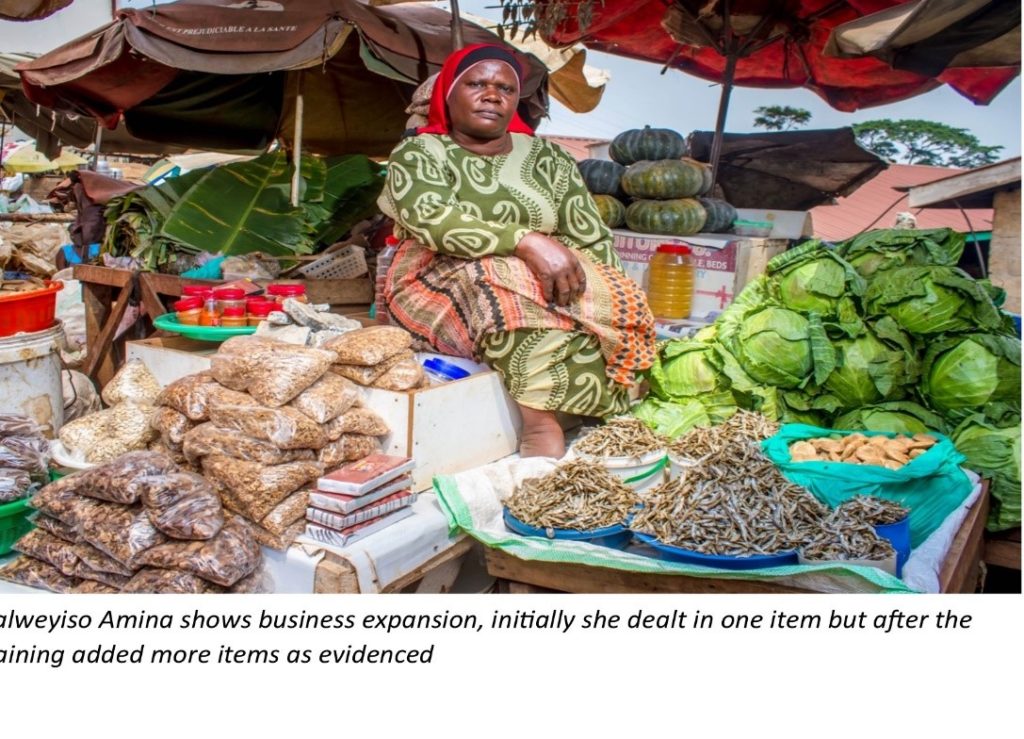
The Institute for Social Transformation, Uganda with the support of AWDF is working to strengthen the voices, visibility, and collective organising power of women in four selected markets in Uganda.
Informal markets are of high interest to politicians and government officials, who derive easy money and support and therefore influence decisions such as who occupies leadership positions in such spaces. Women cannot easily occupy the most influential positions (e.g., Chairpersonship) because they are perceived to be incapable or temperamental.
The intervention by IST resulted from a research conducted in 2016 which revealed that there is no clear regulatory framework for informal markets in Uganda. This has exposed market women to violence and exploitation and yet they are the majority market occupants (80%). The study also revealed that 59% of market women interviewed had experienced some form of violence with the most prevalent form being physical violence at 47%.
IST empowered over 300 market women within the four selected markets with capacity support and mentorship which provided market women with relevant knowledge in managing their businesses and also to advocate for favourable local government market policies and working environment. Hear their testimonies:
“After the training I received from IST, I was able to educate 9 women and together we formed a savings group that contributes 5,000 Shs per day per member for purposes of accumulating capital for each other through cash rounds.” Naura Miriam- Nakawa Market
“Before the training I sold tomatoes and was satisfied with the sales but after the training, I realised the need to expand the business so I used some of the profits from the tomato business to enrol for training in liquid soap making. Today I am a happy person, I am not scared even if the price of tomatoes goes down because I know I have a backup income thanks to IST,” said a market entrepreneur from Kalerwe freedom market.
“The training has enabled me to gain confidence to speak to customers and to confront market authorities if I feel I am not being treated fairly. Previously, I would just sell the items quietly but today while the customer buys, I keep telling them about why they should buy from me, and I even ask them for their contact so I can follow up to check if they liked the product,” Hellen, a market entrepreneur from Busia market.
By: Rose Buabeng, Programme Officer for Anglophone Africa, AWDF
Grantee Profile: 1-in-9 Campaign – Renewed Focus on the Other Eight
Grantee Profile: 1-in-9 Campaign – Renewed Focus on the Other Eight
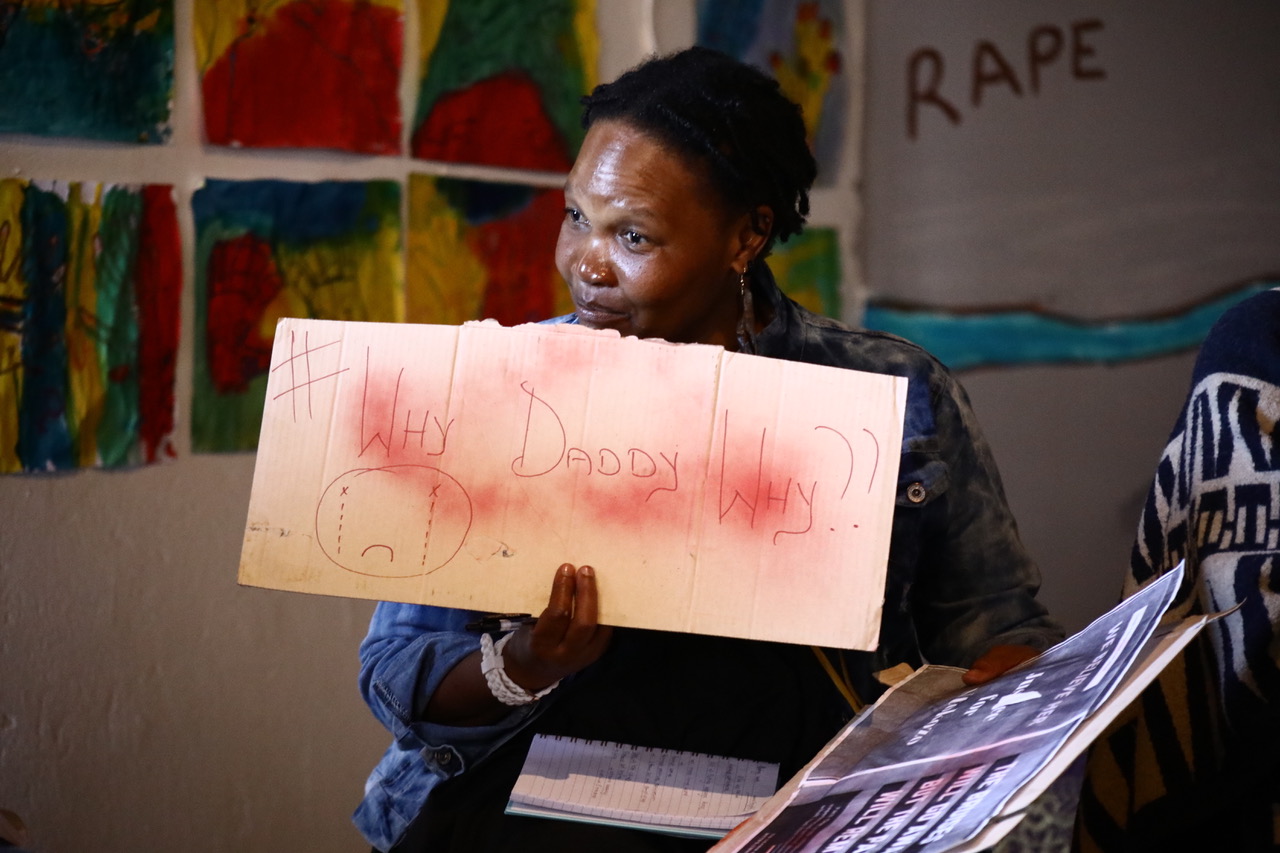
The year was 2006. HIV-activist Fezekile Ntsukela Kuzwayo, known to the public only as Khwezi, faced off against Jacob Zuma, then the deputy-president of South Africa, in court. She had accused him of rape. She stood her ground amidst death threats from Zuma’s supporters, harassment from the ANC Women’s League and widespread torment from the ruling party. She was not alone in her stand. The 1-in-9 Campaign was born during this particularly turbulent, triggering time in South Africa. Zuma, who would go on to become President of South Africa, was acquitted on the charges against him. The organisation, however, continued to support survivors of sexual violence in navigating the social landscape and the criminal justice system. According to popularly cited statistics, one in three women will experience sexual violence in her lifetime. According to the South African Medical Research Council, only one in nine rapes are reported to authorities. It was, initially, the latter group that the organisation supported.
Mpumi Mathabela is the 1-in-9 Campaign coordinator. She says despite the impact they were making through their work within the criminal justice system, there came a day when they realised that that was not enough. “Our name is a statistic from that time period – the time of Zuma and Khwezi – and it was a work that was incredibly impactful. We got to a point where when people did not see us outside court they would call and ask where we were.” More needed to be done.
“Only one in nine women report their rape to the police. So one woman reports. One woman we go to court with. One woman we push for the justice system to do its job. One woman. Just one in nine.”
Sheshakes her head. “But what about the other eight…” The question hangs in the air as the magnitude of the statement sinks in.
“What happens to the other eight? Are they silent?”
The answer, she says, is of course not. “They are simply speaking out in their own ways. We have progressed from working with that one in the criminal justice system to branching out to the other eight too. This is our shift. We are reintroducing and redefining feminist movement building, but we are not just focusing on the one woman who makes it to court anymore.”
To read the rest of this incredible profile and see how 1 in 9 is helping impact the lives of survivors, click here.
Gertrude Bibi ANNOH-QUARSHIE – Director of Operations
Gertrude Bibi ANNOH-QUARSHIE – Director of Operations
[tp lang=”en” not_in=”fr”]
Gertrude Bibi Annoh-Quarshie is currently the Director of Operations at AWDF. She is in charge of leading and directing the operations, finance, human resource and administrative functions of AWDF to ensure they are of the highest quality. She will be responsible for designing, developing and implementing short to long term strategies aimed at optimising AWDF’s general support systems and complex financial management systems.
She is a chartered certified accountant with over 16 years of experience in audit, finance, accounting and administration in not-for profit as well as for profit organisations. Since joining AWDF in 2007, she has contributed to strengthening the processes, policies, systems and structures that ensure that AWDF remains a credible and sustainable organisation. She authored a publication on good practice in financial management for women’s rights organisations.
She is a Fellow of the Association of Chartered Certified Accountants (ACCA) of the United Kingdom, and the Institute of Chartered Accountants Ghana (ICAG). She has a B.S. degree and an Executive MBA in Finance from the University of Ghana. She currently sits on the board of ISIS-WICCE/WIPC a regional feminist organisation with a mission to ignite women’s leadership, amplify their voices and deepen their activism in re-creating peace.
Gertrude is passionate about women’s rights and the pursuit of dignity, equality, respect and justice for African women and girls. Integrity and ethical leadership are at the forefront of her personal and professional values, influencing her day-to-day decision making and actions.
[/tp]
[tp lang=”fr” not_in=”en”]
Gertrude Bibi Annoh-Quarshie est actuellement directrice des opérations de l’AWDF. Elle est chargée de diriger et d’orienter les opérations, les finances, les ressources humaines et les fonctions administratives de l’AWDF afin de garantir leur qualité optimale. Elle sera responsable de la conception, du développement et de la mise en œuvre de stratégies à court et à long terme visant à optimiser les systèmes de soutien général et les systèmes complexes de gestion financière de l’AWDF.
Elle est comptable agréée et possède plus de 16 ans d’expérience en audit, finance, comptabilité et administration dans des organisations à but non lucratif et à but lucratif. Depuis qu’elle a rejoint l’AWDF en 2007, elle a contribué à renforcer les processus, les politiques, les systèmes et les structures qui garantissent que l’AWDF reste une organisation crédible et durable. Elle est l’auteur d’une publication sur les bonnes pratiques en matière de gestion financière pour les organisations de défense des droits des femmes.
Elle est membre de l’ Association of Chartered Certified Accountants (ACCA) du Royaume-Uni et de l’Institute of Chartered Accountants Ghana (ICAG). Elle est titulaire d’une licence et d’un Executive MBA en finance de l’Université du Ghana. Elle siège actuellement au conseil d’administration de l’ISIS-WICCE/WIPC, une organisation féministe régionale dont la mission est de stimuler le leadership des femmes, d’amplifier leurs voix et d’approfondir leur militantisme pour recréer la paix.
Gertrude est passionnée par les droits des femmes et la poursuite de la dignité, de l’égalité, du respect et de la justice pour les femmes et les filles africaines. L’intégrité et le leadership éthique sont au premier plan de ses valeurs personnelles et professionnelles, influençant sa prise de décision et ses actions au quotidien.
[/tp]
Meet our New Director of Operations: Gertrude
Meet our New Director of Operations: Gertrude
[tp lang=”en” not_in=”fr”]
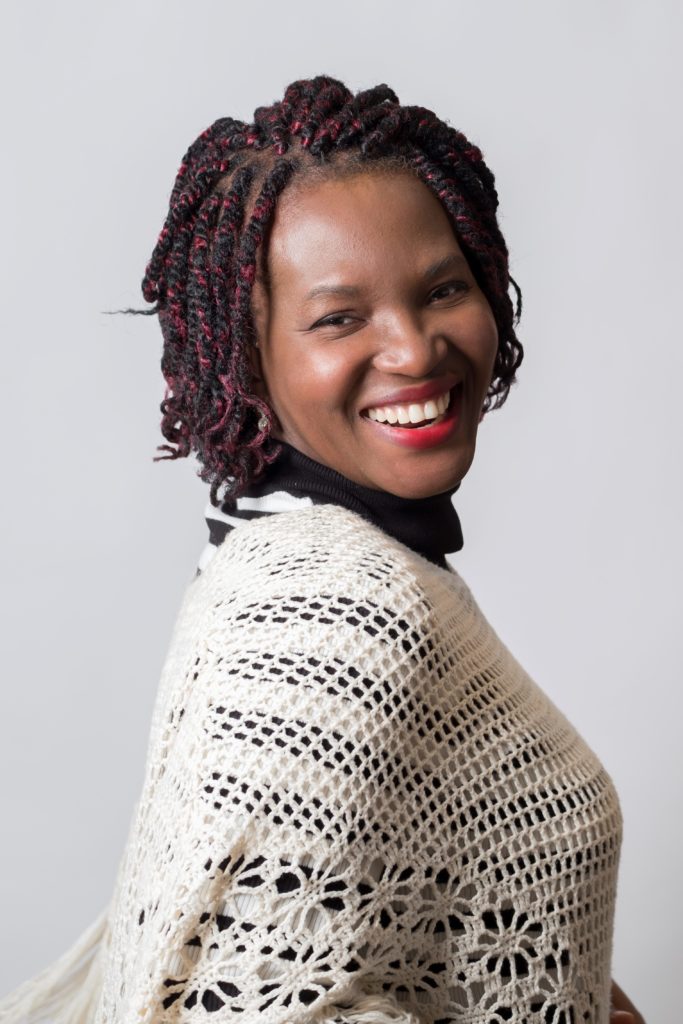
Gertrude Bibi Annoh-Quarshie, affectionately called Bibi has been appointed the Director of Operations Effective August 2019. Until this appointment, she was the Finance Manager of AWDF, overseeing the financial planning, review, monitoring, reporting and risk management functions of the organisation.
As Director of Operations, Gertrude says she is excited about the opportunity to be leading and directing the finance, human resource and administrative functions of AWDF to ensure that they are of the highest quality. She will be responsible for designing, developing and implementing short and long term strategies aimed at optimising AWDF’s general support systems and complex financial management systems.
She is a feminist, passionate about women’s rights and the pursuit of dignity, equality, respect and justice for African women and girls. Integrity and ethical leadership are at the forefront of her personal and professional values, influencing her day-to-day decision making and actions.
Bibi has over 15 years of experience in strategic finance, leadership and management. She is a Chartered Accountant and has an MBA in Finance.
[/tp]
[tp lang=”fr” not_in=”en”]
En août 2019, Gertrude Bibi Annoh-Quarshie, affectueusement appelée Bibi, a été nommée Directrice des Opérations. Avant ce poste, elle était responsable des finances de l’AWDF, supervisant les fonctions de planification financière, d’examen, de suivi, de rapport et de gestion des risques de l’organisation.
En tant que directrice des opérations, Gertrude se dit enthousiasmée par l’opportunité de superviser les activités financières, administratives et celles liées aux ressources humaines de l’AWDF afin de s’assurer qu’elles sont de la plus haute qualité. Elle sera responsable de la conception, de l’élaboration et de la mise en œuvre des stratégies à court et à long terme visant à optimiser les systèmes d’appui et les systèmes complexes de gestion financière de l’AWDF.
Elle est une féministe, passionnée par les droits des femmes et la poursuite de la dignité, de l’égalité, du respect et de la justice pour les femmes et les filles africaines. L’intégrité et le leadership éthique occupent la première place dans ses valeurs personnelles et professionnelles influençant ainsi donc ses décisions et ses actions quotidiennes.
Bibi a plus de 15 ans d’expérience en finance stratégique, leadership et gestion. Elle est comptable agréée et détient un MBA en finance.[/tp]
Evidence Based Prevention of Violence Against Women Convening Report: Building African Feminist Momentum
Evidence Based Prevention of Violence Against Women Convening Report: Building African Feminist Momentum
The rates of violence against women have reached pandemic levels across the world. It is estimated that 1 in 3 ever-partnered women above the age of 15 have, at some point in their lives, experienced some form of physical or sexual interpersonal violence. In some parts of Africa, the prevalence rate is almost double that of the global average at 65.6%¹. The far-reaching physical, emotional and economic impact of this violence on the lives of African women cannot be overstated. However now, more than ever before, bringing violence against women to an end is a tangible possibility.
At this critical moment, there has been a shift to focus on evidence-based prevention of this violence against
women with programmes producing quantifiable results that reflect the magnitude of their impact in this area.
African feminists – and the political lens with which they approach the issues – have been essential to prevention work, pioneering efforts to bring violence fuelled by gender inequality and patriarchal power to an end. With international interest in this field growing, AWDF saw the need to convene African practitioners and donors to look at ways of galvanising the efforts of African feminists operating at every level to advance the work and even more firmly establish African feminism as the centre.
To read the rest of the report click this link.
Grantee Profile: The Sunrise Campaign; How female support and empowerment let us grow
Grantee Profile: The Sunrise Campaign; How female support and empowerment let us grow
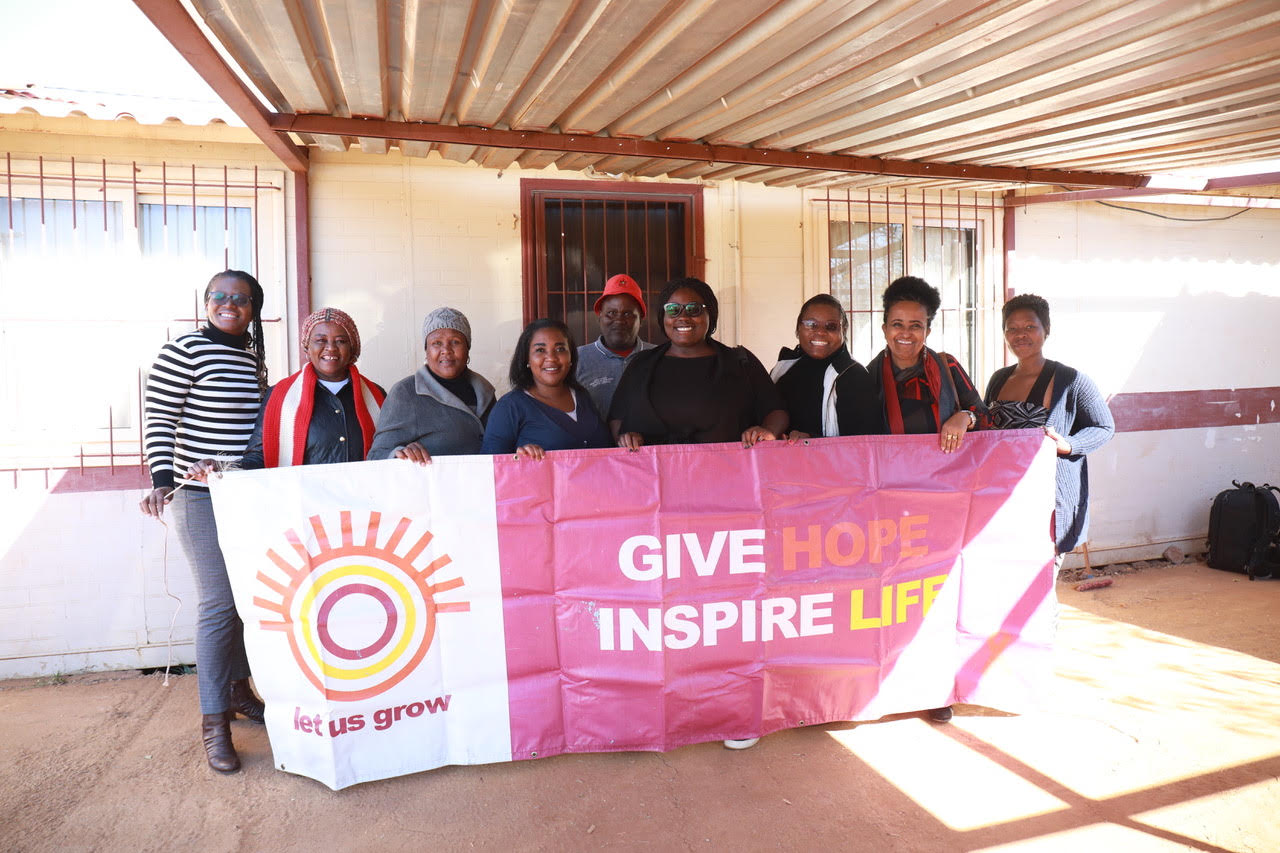
Children in well-worn school uniforms play on the dirt road that runs past the small, red-brick structure on the corner of an unnamed street in Orange Farm, about 45km south of Johannesburg in South Africa’s Gauteng province. Established in 1988, Orange Farm is one of South Africa’s youngest township, with the original inhabitants consisting predominantly of laid-off farm workers from the surrounding area. Later, as the township became more established, people migrated from Soweto to take up residence in Orange Farm. Many of the people who settled here were unemployed or marginalised in some manner.
This is the context from which Gender Links’ partner organisation Let Us Grow operates the Sunrise Campaign, a community-run empowerment programme for women in the area. Let Us Grow provides support and networking, training and activities for women who have experienced domestic abuse, sexual violence or stigma due to their status as HIV-positive. Many women have experienced all three. The organisation began as a support group for women living with HIV, but has since expanded to include a large network of female entrepreneurs, home- based care workers and survivors of violence and abuse. Each one is set on changing her world into a place of equality, safety and autonomy, free of fear, abuse and discrimination.
At the heart of Let Us Grow is 71-year-old Rose Thamae, who started the organisation in 1996 at a time when women’s issues were not on the table – services or support for people living with HIV was non-existent. The organisation has since evolved into a community of support, empowerment and hope for the women of the area.