
Category: Publications
Rapport de programmation axé sur les résultats en français – Atelier BURKINA Faso
Rapport de programmation axé sur les résultats en français – Atelier BURKINA Faso
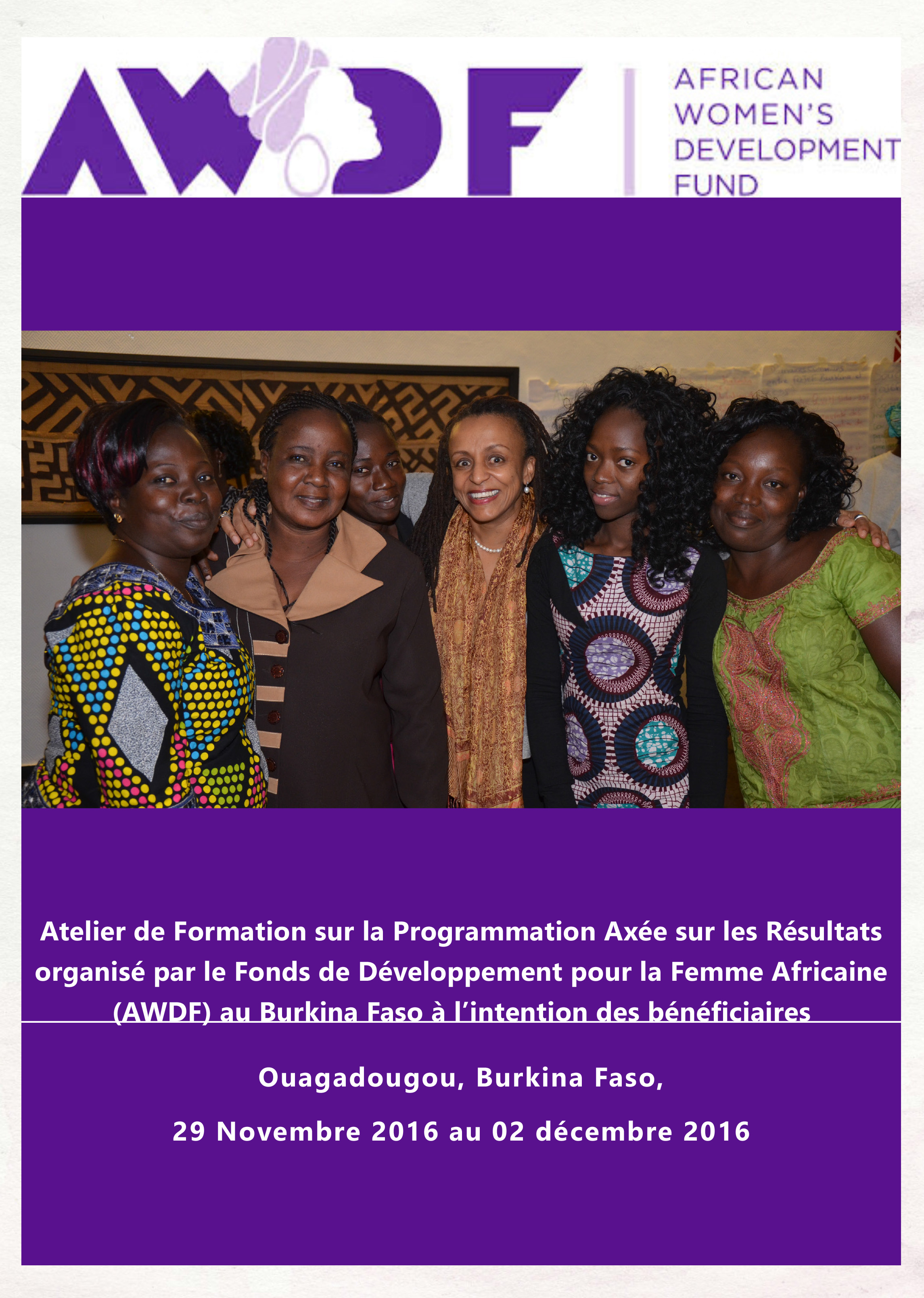
L ’objectif de l’atelier de trois (3) jours sur la Programmation axée sur les résultats (RBP) est d’apporter un appui aux bénéficiaires du Fonds de Développement pour la Femme Africaine (AWDF) dans les domaines de l’application du RBP dans leurs organisations et de la conception de leurs programmes. Au total, 17 participantes ont pris part à l’atelier, deux membres de l’équipe de l’AWDF, un interprète et une animatrice. La liste des participantes et le programme figurent en annexe. Le présent rapport est structuré comme suit: 1) Résumé du contenu de l’atelier; 2) Observations et commentaires du formateur sur l’atelier; et 3) Recommandations et suggestions aux fins du suivi.
Results Based Programming Report in French -Burkina Faso Workshop
Arts Culture and Convening: Report
Arts Culture and Convening: Report
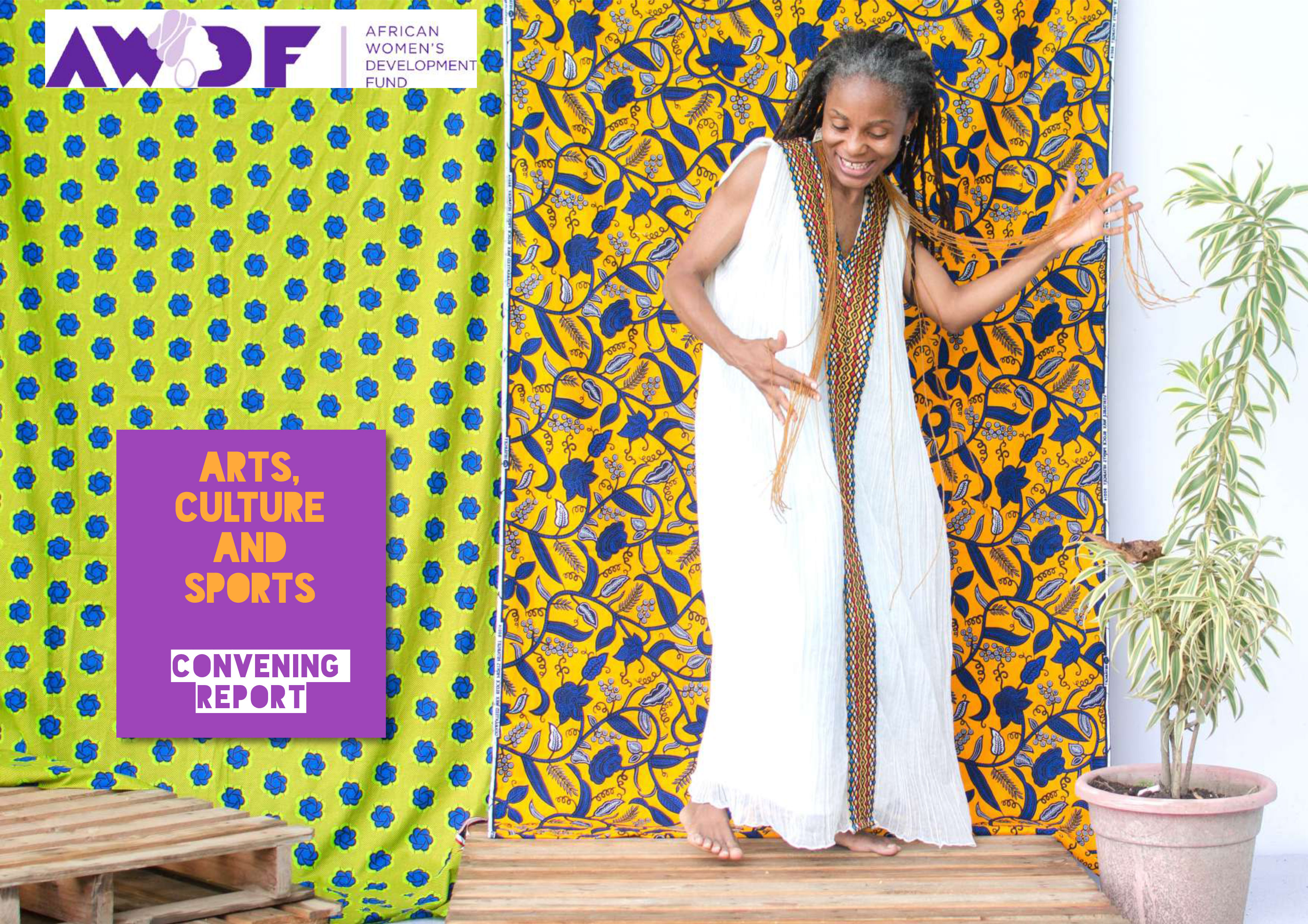
The culture industries of our world have historically been dominated by men and the African continent is no exception.
Women’s engagement in arts, cultural production and sports has led to the transmission of radical ideas, beliefs and attitudes. Women’s participation in cultural economies, also speaks to the immense value and contributions of women and invigorated connections and possibilities for communities across the continent and world. Through arts and sports, women have challenged and broken stereotypes, amplified the demands of women’s and feminist movements, raised resources, and spread messages of social change. Arts, culture and sports are critical sites for social transformation and movement building.
In spite of this work, women practitioners in arts, cultural production and sports face persistent restraints from intimidation, harassment, and theft of work to isolation, immobility, burnout and limited access to networks of care, support, and resources of sustainability. By working through a lens of intersectionality, African women are in a key position to speak out against multiple oppressions – gender, sexuality, disability, race, class, ethnicity, geography, etc. – within their fields of work.
Now more than ever, women practitioners are in a unique place to enable deeper engagement with and mobilisation of new constituencies of people, particularly young women.
Read more about this incredible convening which brought together artists from all over the continent to rethink artistic space, activist work and the intersections of the two.
Health and Safety Manual
Health and Safety Manual
This guide is for African Women’s Development Fund (AWDF) grantees and other women’s rights organisations working in agri and food processing. Its goal is to provide important information on food health and safety practices that you can put into practice. When you do this, your business will get a good name. More people will want to be your customers. Your business will grow and you will earn income for your livelihoods.
We all use, process and sell food in our own different ways. But there are certain rules about food safety that apply to us all. We must make sure we manage our businesses in a safe way so that we don’t have injuries. And so our customers get healthy food.
This guide:
• explains how food gets contaminated
• tells you what signs to look out for
• shows how to prevent food you work with from making people sick
• offers tips and check lists to help you manage health and safety at work
• offers some activity ideas and ways to share this important information.
Find the entire guide here: Health & Safety Manual
Annual Resource Mobilisation Strategy and Development Bootcamp Report: 2015
Annual Resource Mobilisation Strategy and Development Bootcamp Report: 2015
Since 2013, the African Women’s Development Fund (AWDF) has been organising an Annual Resource Mobilisation Strategy Development Boot camp. During the boot camp, AWDF’s grantees are supported onsite to develop their Resource Mobilisation Strategies. The event which is now one of AWDF’s flagship capacity building activities has become popular with fundraisers within AWDF’s grantees as a critical step in developing their organisational financial sustainability. In September 2015, 15 fundraisers from 15 organisations from South Africa, Botswana, Malawi, Zambia, Zimbabwe, Kenya, Ghana and Uganda participated in this year’s 4-day boot camp in Johannesburg, South Africa. This brings the total number of AWDF grantees who have participated in the annual boot camp to 56. All the 56 organisations now have Resource Mobilisation Strategies which they developed during the respective annual bootcamps.
You can find the full report below.
BASELINE SURVEY REPORT: AMPLIFYING THE VOICES OF GIRLS AND YOUNG WOMEN IN GOVERNANCE.
BASELINE SURVEY REPORT: AMPLIFYING THE VOICES OF GIRLS AND YOUNG WOMEN IN GOVERNANCE.
By Regional Network Of The Children and Young People Trust (RNCYPT) with support from African Women’s Development Fund (AWDF)
The Amplifying the Voices of Girls and Young Women in Governance project is a ten month African Women’s Development Fund (AWDF) funded initiative that is implemented by Regional Network of the Children and Young People Trust (RNCYPT). The project began in December 2015, and the baseline study was conducted in January-February 2016, by means of Questionnaire and focus groups discussions; and covered targeted project areas that are Chinhoyi, Chitungwiza, Kadoma, Mvurwi and Raffingora.
Unlocking the Doors. Feminist Insights for Inclusion in Governance, Peace and Security
Unlocking the Doors. Feminist Insights for Inclusion in Governance, Peace and Security
By: Dr. Awino Okech
This is the third in a series of three African Women’s Development Fund (AWDF) primers entitled Feminist Perspectives on Governance, Peace and Security. The primers are intended to:
1. Offer a review of the major debates on women, governance, peace and security in Africa.
2. Review and analyse women’s movements’ interventions in governance, peace and security.
3. Offer a set of policy and advocacy priorities based on political and practical realities.
4. Benefit women’s rights activists, organisations and people in government at the frontline of local and national mobilization initiatives seeking to enhance women’s leadership.
5. Assist in building alliances and structuring support across various institutions working towards enhancing women’s political participation.
This is the third primer in the series. It analyses the successes and gaps in women’s movements’ approaches to the intersections between governance and the security complex. These insights are based on AWDF’s analysis of some of the major challenges confronting movement building in the areas of governance, peace and security. With these primers, our objective is to re position feminist politics as a fundamental expression of accountability to our cause and constituencies, and to provide an opportunity for advancing individual and collective learning.
Statecraft and Pursuing Women’s Rights in Africa
Statecraft and Pursuing Women’s Rights in Africa
By: Dr. Awino Okech
This is the first in a series of three African Women’s Development Fund (AWDF) primers entitled Feminist Perspectives on Governance, Peace and Security. The primers are intended to:
1. Offer a review of the major debates on women, governance, peace and security in Africa.
2. Review and analyse women’s movements’ interventions in governance, peace and security.
3. Offer a set of policy and advocacy priorities based on political and practical realities.
4. Benefit women’s rights activists, organisations and people in government at the front line of local and national mobilisation initiatives seeking to enhance women’s leadership.
5. Assist in building alliances and structuring support across various institutions working towards enhancing women’s political participation.
This particular primer maps key areas of feminist analysis and intervention in governance. Based on existing research on the major factors that hinder women’s political participation, emphasis is placed on electoral systems, political parties, quotas and national constitutional mechanisms. These are also areas where the impact of the women’s rights movement has been felt. This primer therefore assesses the ways in which women’s participation in governance has been assured, the challenges arising from these approaches, and lessons therein. This primer is intended to benefit women’s rights activists and organisations at the frontline of local and national mobilisation initiatives that seek to enhance women’s leadership. We hope the primer is useful for building alliances and structuring support across various institutions working towards enhancing women’s political participation.
Health and Reproductive Rights Portfolio: A look back at the last 14 years of thematic grantmaking and recommendations for moving forward
Health and Reproductive Rights Portfolio: A look back at the last 14 years of thematic grantmaking and recommendations for moving forward
In an effort to ensure that the HRR thematic area remains relevant to women’s needs and reflect current and emerging issues that affect health and reproductive rights of women in Africa, AWDF commissioned an independent consultant (Ms. Everjoice J. Win) to conduct an evaluation of the thematic HRR area.
This report is an abridged version of the findings from that assessment. To obtain a full copy of the evaluation, please contact Ms. Zeytuna Abdella Feyissa-Azasoo, the M&E Specialist at AWDF. The overall objectives of the HRR evaluation were:
To document and assess the work of AWDF in this thematic area, examining the relevance of selected priorities;
To understand major challenges that have contributed to low patronage of the thematic area and suggest improvements;
To identify current and emerging HRR issues of importance to African women.
Grants Making for Women’s Rights: Lessons Learnt.
Grants Making for Women’s Rights: Lessons Learnt.
This report is an Abridged Evaluation of AWDF’s work. It focuses on the Projects completed under Comic Relief grant.
The purpose of the evaluation was to evaluate the project performance, identify good practices and draw out lessons that can be applied in future interventions. As the Comic Relief grant supported AWDF’s Strategic Plan, the evaluation looked at AWDF’s main areas of work and assessed the role of the Comic Relief grant within which the AWDF initiatives were conducted. The evaluation coincided with AWDF’s Strategic Plan midway point. Findings from the evaluation were also used to inform AWDF’s subsequent decision-making processes.
Forward with Health & Reproductive Rights in Africa : An Evaluation
Forward with Health & Reproductive Rights in Africa : An Evaluation
The AWDF convened a round table meeting with some
of our grantees and partners on 30 June 2015 in
Arusha, Tanzania. We met to discuss the evaluation of
our Health and Reproductive Rights (HRR) Portfolio,
which was completed in October 2014. The evaluation
gave us the opportunity to review the progress and
challenges in civil society efforts to advance women’s
sexual and reproductive health and rights (SRHR).
Following the evaluation, the objective of the meeting
was to identify strategic interventions to help scale up
and sustain our impact on the ground. We also wanted
to identify more effective ways to influence policies
around (SRHR) at local, national and regional levels.
This report contains the key findings of the convening.