
Category: News
Surviving COVID-19: Why we need to listen to African women’s organisations
Surviving COVID-19: Why we need to listen to African women’s organisations
Written By : Jessica Horn
As the threat of COVID19 emerged into full global view, African women’s rights organisations started to raise red flags around what effective responses needed to consider-but would likely leave out. They were prepared. Not with the practicalities of hand sanitisers, virtual work arrangements and food distribution plans, but with the familiarity of what crisis means for women, and the knowledge that if we fail to take into account women’s needs, we are not going to survive this.
Generalised catastrophe may well be the “new normal” for the privileged, but it has been the backdrop of African women’s organising for generations. In the two decades of The African Women’s Development Fund’s operations, our grantees have worked to try to get one step ahead of epidemics such as HIV/AIDS and Ebola, to mobilise to end war in their countries and communities, and pick up the social, political and economic pieces in its aftermath. Beyond headline disasters, grantees have also worked persistently on the quieter but no less deadly threats of economic collapse and everyday economic precarity, and the reality that the patriarchal violence against us as women costs us our emotional and economic wellbeing, and sometimes also costs us our lives.
So it is not surprising that as COVID19 started to touch the continent, AWDF grantees were already outlining a political agenda for the response, warning of possible consequences if we fail to be attentive to the fact that health crises are always gendered. In the words of a press statement issued by the Nigerian Feminist Forum, “it is imperative that we ensure that gender-sensitive responses are implemented, so that the cumulative effect of the current crises are not paid by women, girls and, the most marginalised in IDP camps, rural and urban shanty towns, [the] disabled”. Staff of Southern African advocacy platform Genderlinks flagged in a Mail and Guardian article, that women constitute a majority of health sector workers and domestic workers in South Africa, and also carers in the family- all forms of care labour that increase the risk of exposure to the COVID19. This is a similar truth across the African continent.
As lockdowns and social distancing began to be proposed as a disease control measure, African feminists spoke up to raise concern about the implications and the difficulties, in particular for the most marginalised. In a think piece on social distancing OluTimehin Adegbeye, journalist at The Correspondent and graduate of AWDF’s African Women Writer’s Workshop reflects that for a city like Lagos, “the idea of social distancing is not just alien to us, it is impossible for social and economic reasons too.” Where a majority live in cramped physical conditions, survive through high-contact economic activities like petty trade, and rely on each other for help and shelter, the idea of just staying indoors is simply not viable.
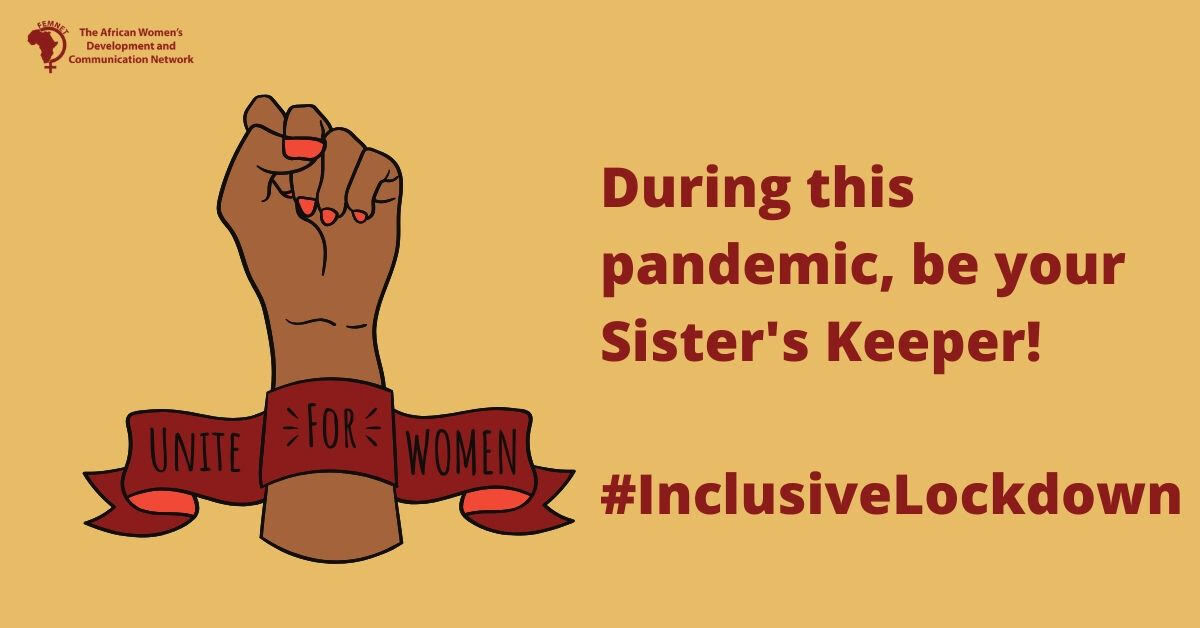
Of equal concern is the patriarchal truth that homes are often not safe for women or girls, and indeed for Lesbian, Bisexual and Transgender women being asked to stay in closer proximity to homophobic and transphobic family members. Grantees like Rape Crisis Cape Town have acted fast on this understanding, expanding their hotline services in anticipation of an increase in violence as women are locked down with their abusive partners. There is also important work to track and make visible new challenges posed by lockdowns for different communities of women. Regional feminist advocacy platform FEMNET have invited African women to share lockdown concerns on Twitter using the hashtag #inclusivelockdown – an ongoing social media discussion that has surfaced real crisis for women with disabilities in particular.
The gendered threats posed by lockdowns and curfews have also come from state authorities. At the start of the COVID19 lockdown in Uganda for example, a number of women’s organisations including grantees Strategic Initiatives for Women in the Horn of Africa (SIHA) and Mentoring and Empowerment Programme for Young Women (MEMPROW) raised the alarm about physical attacks on women street vendors after a Presidential directive around trading in street markets.
In broader view, the COVID19 pandemic shines a global spotlight on the deficits of widespread privatisation of health services across Africa. As Crystal Simeoni, Economic Justice Lead at FEMNET, argues “healthcare requires proper investment horizontally in a way only public sector can provide. It means a holistic approach to healthcare that provides for safe water to wash hands to stop the spread of the disease, it requires doctors that are decently paid and work in safe conditions as well as research that is well-resourced”.
As the pandemic progresses, we remain committed to supporting this agile African feminist response to crisis, aware too that the insights shared by our grantees in this pandemic moment are also setting the compass towards the structural change that needs to be prioritised once the immediate health threat is over.
Jessica Horn is Director of Programmes at AWDF. She tweets @stillsherises
Blog – Pandémie de Covid-19: le moment de renforcer notre sororité en tant que féministes/activistes
Blog – Pandémie de Covid-19: le moment de renforcer notre sororité en tant que féministes/activistes

Ecrit par Ameyo Dekoleadenu – Assistante en Communication, AWDF
Date: 7 avril 2020
Le monde vit actuellement un moment terrible, un moment de chaos total, où nous nous posons diverses questions sur notre futur en tant qu’êtres humains, et aussi sur le futur économique de nos pays. Nous allons au lit chaque jour espérant avoir un lendemain meilleur et nous nous levons réalisant que nos espérances n’aboutissent à rien, sinon un choc total.
La pandémie de Covid-19 n’épargne personne. Ce virus qui ne connaît ni genre, ni nationalité, ni statut social, ce virus non discriminatoire nous laisse ébahi par ses effets négatifs sur l’être humain ainsi que le système économique. Pour nous en tant que féministes/activistes, c’est un moment de réflexion, un moment où nous devons nous poser beaucoup de questions sur nos stratégies de sororité.
A toutes les femmes qui ne vivent qu’au jour le jour et qui, à cause des mesures prises par leurs gouvernements sont en confinement et/ou en quarantaine; à toutes les femmes qui n’ont aucun abri sinon la maison de leurs violeurs et qui n’ont aucun choix que de rester dans ses relations abusives en ce moment terrible; à toutes les organisations de défense des droits des femmes dans le monde et plus spécifiquement en Afrique francophone qui ne cessent d’aider les femmes vulnérables en ces moments de chaos, recevez mes mots d’encouragement. Je nous exhorte en tant que féministes/activistes à nous soutenir les unes les autres d’une manière ou d’une autre dans ce moment terrible. Rappelons-nous surtout que notre sororité ne prend tout son sens et ne devient une réalité que lorsque nous la mettons en pratique. La distance ne doit pas être une barrière entre nous et ne doit en aucun cas nous empêcher de passer des appels téléphoniques juste pour nous encourager les unes les autres et aussi nous informer de la situation que vit l’autre afin de savoir comment lui venir en aide.
Ma prière c’est de voir la fin de cette pandémie le plus tôt possible. Pendant que les experts s’acharnent à trouver une solution durable à ce fléau, protégeons-nous et n’oublions pas de suivre les mesures conseillées par l’Organisation Mondiale de la Santé (OMS).
COVID-19 : Message of Solidarity / COVID-19 : Message de Solidarité
COVID-19 : Message of Solidarity / COVID-19 : Message de Solidarité
[tp lang=”en” not_in=”fr”]

In the wake of the COVID-19 pandemic, the African Women’s Development Fund (AWDF) is fully aware of the repercussions on lives across the continent. We are sending out this message of solidarity to all our partners whose lives have been disrupted as a result of lock-down or restrictions in freedom of movement, and those who may have been directly exposed to the virus.
At AWDF we are taking measures to ensure that our staff and grantee partners stay safe and are not exposed to undue risks. The Senior Management Team is in regular contact on this, is following official health advice, and is also responding to needs as they emerge and as the nature of the health emergency itself changes.
For a start, all AWDF events, capacity building trainings, and site visits have been suspended until the end of May when we will review the situation.
As a feminist organisation, we emphasise the need for flexibility and recognise that these disruptions can have an adverse impact on grantee activities that are currently running. We encourage grantees whose work is being affected by this crisis to get in touch with their grants officers at AWDF to discuss options.
As we witnessed through the work of our brave grantees in the Mano River region responding to the Ebola outbreak, we know that African women’s collective action is a crucial and often overlooked frontline of response to health emergencies at community level. We stand as always in solidarity with these efforts, and encourage us to retain this spirit of collective solidarity particularly as COVID-19 may require of us to self-isolate and practice social distancing.
We’re in this together.
[tp lang=”en” not_in=”fr”]
[/tp]
[tp lang=”fr” not_in=”en”]
À la suite de la pandémie COVID-19, le Fonds Africain pour le Développement de la Femme (AWDF) est pleinement conscient des répercussions du virus sur les vies à travers le continent. Nous adressons donc ce message de solidarité à tous nos partenaires dont la vie a été perturbée en raison du confinement, des restrictions à la liberté de circulation et/ou à ceux qui ont été infectés par le virus.
À l’AWDF, nous prenons des mesures pour nous assurer que notre personnel et nos partenaires bénéficiaires soient en sécurité et ne s’exposent pas indûment aux risques. L’équipe de gestion est vraiment concerné par ce sujet, suit les conseils sanitaires officiels et répond activement à tout besoin au fur et à mesure que l’état d’urgence change.
Pour l’instant, tous les événements de l’AWDF tels que les formations sur le renforcement des capacités et les visites de terrains ont été suspendus jusqu’à la fin du mois de mai 2020, date à laquelle nous ferons le point sur la situation.
En tant qu’une organisation féministe, nous insistons sur le besoin de flexibilité et reconnaissons que ces perturbations peuvent avoir un impact négatif sur les activités en cours. Nous encourageons donc les bénéficiaires dont le travail a été affecté par cette crise à prendre contact avec leurs responsables de subventions à l’AWDF pour discuter des options.
Comme nous l’avions témoigné nous même à travers le travail de nos courageuses bénéficiaires dans la région du fleuve Mano en réponse à la pandémie Ebola, nous savons que l’action collective des femmes africaines est très importante et cruciale durant cette période mais souvent négligée aux urgences sanitaires aux niveaux communautaires. Nous sommes fières et apprécions ces efforts et nous sommes appelés à conserver cet esprit de solidarité collective surtout en ce moment ou COVID-19 pourrait nous obliger à s’isoler et à pratiquer la distance sociale.
Sachez que nous partageons vos peines.
[/tp]
Call for Consultants: Graphic Designer
Call for Consultants: Graphic Designer
OBJECTIVES OF THE CONSULTANCY
The main objective of the assignment is to design and layout the AWDF 2019 Annual report which covers major activities undertaken in 2019 across the organisation and key financial and statistical data about the organisation. The assignment includes providing a strong, visually appealing and dynamic graphic layout of the 15 page report, capturing AWDF’s brand and essence. The consultant will produce a web-ready (pdf) document for AWDF’s 2019 Annual Report, and submit the design concept and key design assets (fonts, key graphic elements) for future usage.
SCOPE OF WORK
The tasks of the consultant include:
• Initial discussion with AWDF team on annual theme and direction of design
• Draft concept for the design of the AWDF 2019 Annual Report including at least 2 options for design approach and colour scheme
• Design and layout 1 Annual Report document (approx. 15 pages of word text with hyperlinks, images, and tables/ infographics
• Conduct adjustments/edits based on review by AWDF staff and guide editors.
• Submission of final web-ready version (PDF) and the core graphic elements (fonts, illustrations and other design elements developed).
DURATION OF THE ASSIGNMENT
The designer shall be required to submit the final design within 3 weeks of the assignment starting.
Deadline: 27 March 2020.
To apply, please click here
Call for Consultants- Annual Report Writer
Call for Consultants- Annual Report Writer

OBJECTIVES OF THE CONSULTANCY
AWDF is seeking to engage a consultant to write the AWDF 2019 Annual report which covers major activities undertaken in 2019 across the organisation along with key financial and statistical data. The assignment includes providing a strong, visually appealing and dynamic graphic layout of the 15 page report, capturing AWDF’s brand and essence.
CONSULTANTS PROFILE
The consultant should have:
•University degree in the Humanities, Social Sciences or field relevant to the work
• Proven experience in report writing evidenced by at least one sample of work
• Demonstrated research skills and excellent writing skills in English
• Knowledge of women’s rights in Africa is essential; experience of producing reports for African women’s organisations is a plus
• Excellent interpersonal skills and flexible attitude
• Proven ability to work to tight deadlines
• Commitment to AWDF’s values of feminist leadership, accountability, diversity, respect and solidarity.
Qualified African women candidates are encouraged to apply
Submissions must be received no later than 23 March 2020.
To Apply, please click here
Feminist Foreign Policy: A multilateral approach to women’s rights / Politique Etrangère Féministe: Une approche multilatérale des droits des femmes
Feminist Foreign Policy: A multilateral approach to women’s rights / Politique Etrangère Féministe: Une approche multilatérale des droits des femmes
[tp lang=”en” not_in=”fr”]
As the world marks the 25th Anniversary of the Beijing Declaration and Platform for Action, a growing number of feminists inside and outside of government are pioneering new approaches to policy that are tailored to address the issues of the day and advance new ground in the global quest for gender equality and the fulfilment of women’s human rights.
Today’s most pressing issues, and the solutions that are envisioned, are not radically different from those addressed at Beijing. The context, however, has changed. Despite measurable progress in girls’ education, maternal health and, increasingly, the repeal of discriminatory laws, there are new and dynamic challenges that threaten to reverse progress and rollback rights.
At this moment of increased nationalism, populism and misogyny, it is time to call out backlash and call in new allies and champions for gender equality and women’s human rights, using all the tools at our disposal. Feminist foreign policy is one tool that shows promise for taking a much-needed, intersectional and often multilateral approach to women’s rights, simultaneously addressing urgent issues such as climate change, peace and security, inclusive growth, global health and poverty alleviation.
Read more here
[/tp]
[tp lang=”fr” not_in=”en”
Alors que le monde célèbre le 25e anniversaire de la Déclaration et du Programme d’action de Pékin, un nombre croissant de féministes, tant parmi les gouvernements qu’à l’extérieur, sont à l’avant-garde de nouvelles approches politiques conçues pour répondre aux problèmes et faire des avancées dans la quête mondiale pour l’égalité des genres et la réalisation des droits fondamentaux des femmes.
Les problèmes actuels les plus urgents et les solutions envisagées ne sont pas radicalement différents de ceux traités à la conférence de Pékin. Cependant, le contexte a changé. Malgré des progrès mesurables dans certains domaines, tels que l’éducation des filles, la santé maternelle et, de plus en plus, l’abrogation des lois discriminatoires, nous faisons aujourd’hui face à de nouveaux défis qui menacent d’annuler les progrès accomplis et de faire reculer les droits.
En cette époque où le nationalisme, le populisme et la misogynie s’accroissent, il est temps de dénoncer les réactions hostiles et de chercher de nouveaux/elles alliés/es et défenseurs/euses de l’égalité des genres et des droits fondamentaux des femmes, en utilisant tous les outils à notre disposition. Alors que les défenseurs/euses de la justice de genre du monde entier se préparent à honorer l’héritage de Pékin et à lancer la prochaine génération d’engagements pour faire progresser l’égalité des genres, la politique étrangère féministe est un outil qui semble prometteur pour l’adoption d’une approche nécessaire, intersectionnelle et souvent multilatérale des droits des femmes, abordant simultanément les questions pressantes, telles que le changement climatique, la paix et la sécurité, la croissance inclusive, la santé mondiale et la réduction de la pauvreté.
En savoir plus? Cliquez ici
Call for Consultants – Short term contract / Recherche de consultants(es) – Contrat à courte durée
Call for Consultants – Short term contract / Recherche de consultants(es) – Contrat à courte durée
BACKGROUND TO THE CONSULTANCY
As part of our capacity building and donor advocacy roles, AWDF has embarked on a process to encourage African women’s funds, allied philanthropic actors, and the African women’s organisations that we support to engage with the growing field of knowledge production and programme development and implementation around evidence-based prevention of violence against women. In partnership with Raising Voices we have produced a primer for African women’s organisations that helps explain the key research, evidence and the language used to frame evidence-based prevention of violence against women.
As follow up to this we are now looking to develop a guide to knowledge production and evidence generation for African women’s rights organisations. Through this initiative we aim to help increase African women’s organisations ability to contribute to the citable literature around evidence-based prevention of violence against women, grounded in an African feminist politics.
LOCATION
- This consultancy is desk based and will not involve travel
DURATION OF THE ASSIGNMENT
- The assignment shall be for up to 12 working days including submission of final document.
Qualified African women candidates are encouraged to apply.
Submissions must be received no later than 23rd March 2020
For details on mode of application, please click here
Bi-Lingual Communications Assistant (Short term contract)
Bi-Lingual Communications Assistant (Short term contract)

AWDF requires the services of a Bi-Lingual Communications Assistant for a short term contract. The consultant must have at least two years of experience in the field of public information, online marketing or similar environment. The assignment shall be for a period of 6 months.
Competencies:
Fluency (written and spoken) in English and French
Knowledge of graphic design will be an asset
Excellent communication skills – written and oral
Good knowledge of key social media platforms (including Twitter, Facebook, Instagram)
Ability to prioritise work to meet goals and objectives within acceptable time frame
Sound knowledge of women’s rights issues
For more details about this position and how to apply; click here
Deadline: 28th February 2020
Call for Proposals: Audit of AWDF Information Technology (IT) Infrastructure
Call for Proposals: Audit of AWDF Information Technology (IT) Infrastructure
- About AWDF
The African Women’s Development Fund was established in June 2000, as an Africa-wide philanthropic, grant making initiative to support the realisation and fulfilment of African women’s rights through funding of autonomous women’s organisations on the continent. AWDF believes that if women and women’s organisations are empowered with skills, information, sustainable livelihoods, opportunities to fulfil their potential, plus the capacity and space to make transformatory choices, then we will have vibrant, healthy and inclusive communities. To achieve this, AWDF mobilises financial, human and material resources to support local, national, and regional initiatives for transformation led by African women. AWDF is mandated to fund in all 54 African countries.
AWDF’s current strategic plan “Shaping the Future” (2017-2021) focuses the organisations work around investments to build the best possible future for women in Africa. As an organisation AWDF is committed to changing the narrative around Africa women, and highlighting African women’s agency, expertise, leadership and ability to transform societies towards justice.
- Background
The African Women’s Development Fund (AWDF) recognises the role effective information technology (IT) plays in the development of any business. To ensure that it has an IT infrastructure that is supportive of its current and future business activities and promotes safety of its data, AWDF is looking for an IT expert who would audit its current IT capacity and guide the organisation through modernisation of its systems and approaches.
- Purpose of the Assignment
The overall goal of the IT expert through this assignment is to;
Audit AWDF’s current IT operations, policies and procedures.
This process is aimed at understanding AWDF’s current IT strengths and weaknesses to map out where the opportunities for growth are. The IT audit will;
- Examine and evaluate the organisation’s information technology infrastructure
- Evaluate the systemsand processes in place for data security and business continuity
- Determine whether the current IT controls protect AWDF’s assets and ensure data integrity in line with the organisation’s overall goals.
- Determine risks to AWDF’s information assets, and help identify methods to minimise those risks.
- Examine whether the organisation’s informationmanagement processes are in compliance with current IT-specific laws, policies and standards.
- Determine any inefficiencies in IT systems and provide associated recommendations.
- Diagnose challenges relating to the operation of all software, computer equipment, peripherals, operating systems and the networking environment and provide relevant advice.
- Advise on way forward to protect the organisation’s data
- Submit a comprehensive report on the assignment detailing strengths, issues identified and recommendations to address weaknesses identified.
- Develop a draft IT strategy and policy for AWDF
For the entire TOR please click here
Applying for a Grant? What to Expect!
Applying for a Grant? What to Expect!
[tp lang=”en” not_in=”fr”]
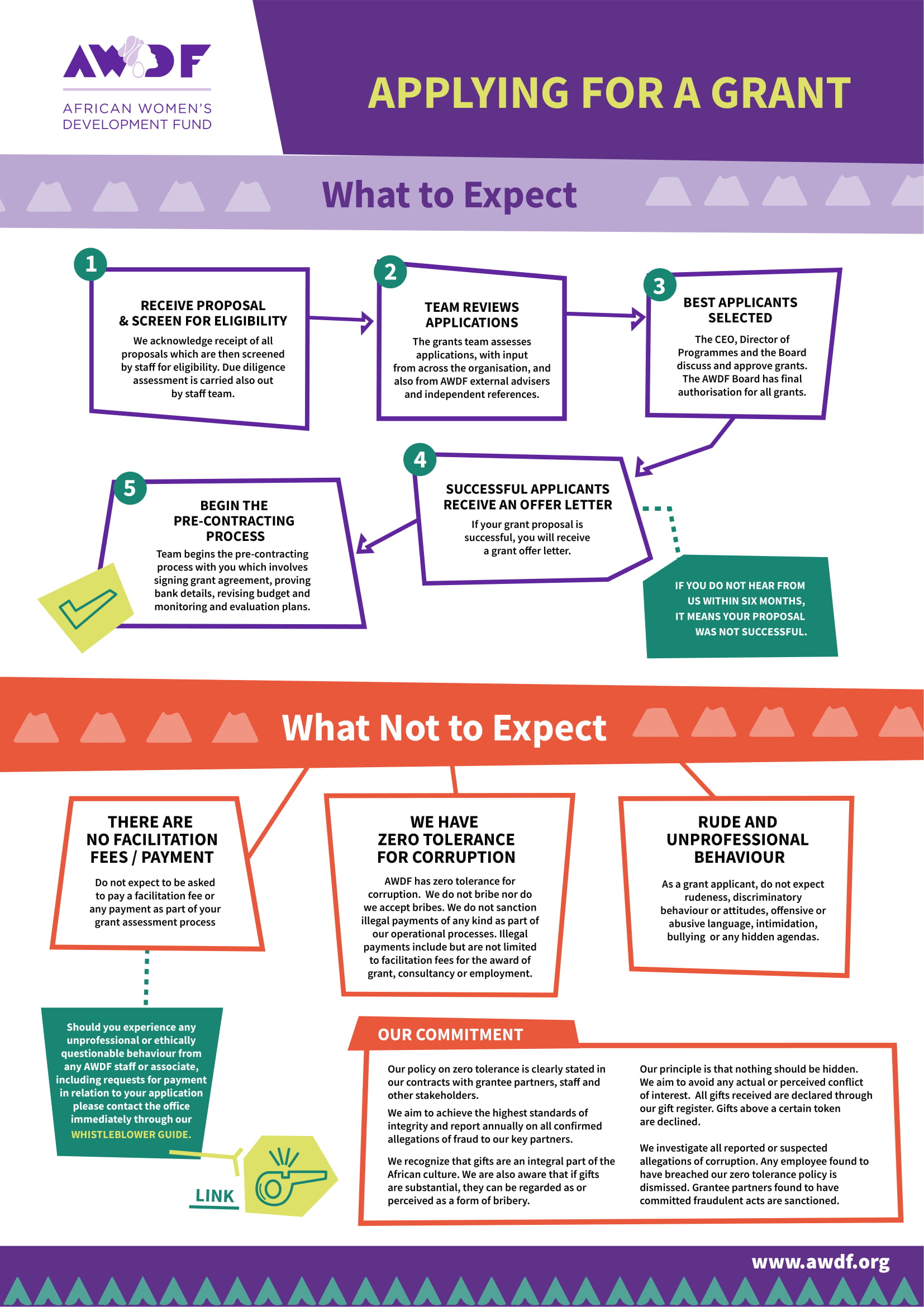
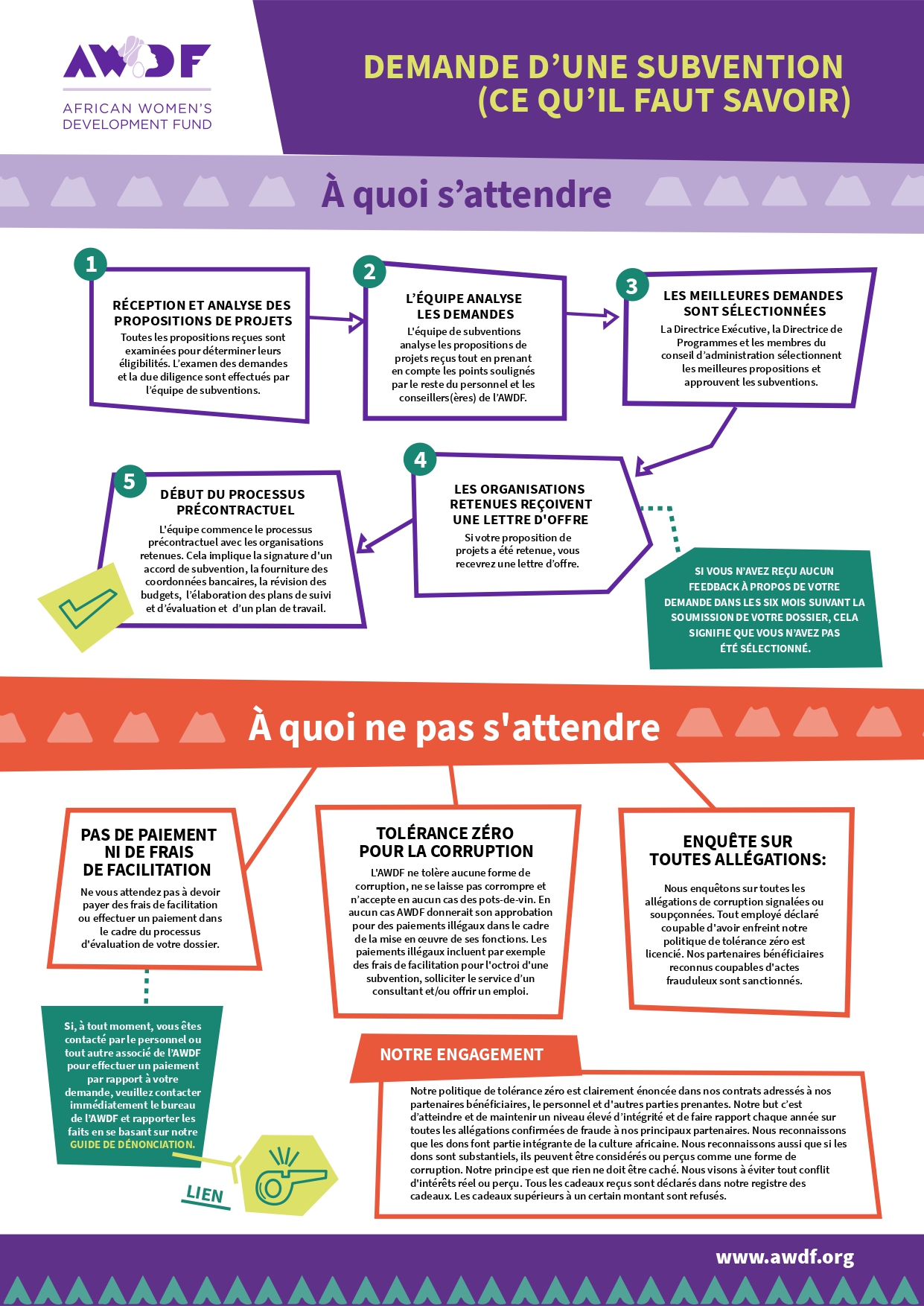
At AWDF, grant making is a courteous, caring, professional and transparent process that reflects our feminist values of respect, inclusive diversity, stewardship and professionalism, integrity and transparency.
OUR WHISTLEBLOWING SYSTEM is aimed at preventing, detecting and investigating fraud, corruption, misconduct and malpractice. It encourages staff and other partners to raise concerns about possible fraudulent or corrupt behaviour rather than overlook them for fear of retaliation.
READ OUR WHISTLEBLOWER POLICY HERE
[/tp]
[tp lang=”fr” not_in=”en”]
[/tp]