
Category: News
Recruitment of Trainers for Online Humanitarian Capacity Strengthening Trainings – Apply by 2nd October 2026
Recruitment of Trainers for Online Humanitarian Capacity Strengthening Trainings – Apply by 2nd October 2026
The African Women’s Development Fund (AWDF) is strengthening its institutional readiness and capacity to engage effectively with humanitarian funding and support feminist and women’s rights organisations responding to crises across Africa. Women’s rights and feminist organisations are often among the first and most trusted actors responding to crises within their communities. Their proximity to affected populations, contextual knowledge, relationships of trust and networks of care enable them to provide locally grounded and responsive support. However, many organisations face barriers to accessing, managing and implementing humanitarian funding, including limited humanitarian technical knowledge, complex donor requirements, safeguarding obligations, security and duty-of-care considerations, monitoring, evaluation and learning requirements, and financial management and accountability standards.
Purpose of the Assignment
The purpose of this assignment is to engage trainers to design and facilitate participatory, practical, feminist and context-sensitive online humanitarian capacity-strengthening sessions for
AWDF partners and staff. The trainers will be expected to adapt the content to the different learning needs of the two participant groups and ensure that the sessions are relevant to the realities of feminist and women’s rights organisations operating in crisis-affected contexts.
Scope of Work
The selected trainer or training team will be responsible for the following:
Develop practical and accessible training materials, including presentations, case studies, scenarios, exercises, worksheets, tools and reference materials.
Delivery of Partner Training ( The partner training will comprise three online sessions delivered over a two-month period)
Delivery of Staff Training (The staff training will comprise three online sessions delivered over a two-month period)
How to Apply
Interested institutions may submit a proposal to consultancy@awdf.org by 2nd October 2026. Proposals should comprise the following;
A technical proposal (maximum 5 pages) outlining the consultant’s understanding of the assignment, proposed methodology and facilitation approach, work plan, and how they intend to deliver the required scope of work and expected outcomes.
A detailed financial proposal presenting the proposed budget for the assignment, with a clear breakdown of all anticipated costs.
Profile/CV of the consultant/s, highlighting relevant expertise and experience in individual and organisational capacity strengthening and delivery of similar assignments.
Read full details in the Terms of Reference.
Financing the Storm: Why Philanthropy Must Adapt to the Reality of Resistance
Financing the Storm: Why Philanthropy Must Adapt to the Reality of Resistance
By: Lola M. Silva
Philanthropy is an industry designed for an imagined world of quiet weather. It operates on the comforting assumption of stability, wrapping itself in the neat geometries of the planning cycle: the pristine project proposal, the static metric, and the corporate illusion that deep social transformation can be scheduled, tracked, and delivered across a predictable three-year calendar. We sit in room after room writing out programmatic goals with a performative certainty that stops at the glass windows of our boardrooms, designing reporting templates to project a narrative of steady, uncomplicated progress over time.
But out in the streets, that logic is an absolute fiction. Across the continent, the realities inhabited by queer feminist organizers are never linear; they are shifting, defensive, and violently volatile. Public sentiment can turn overnight on a single malicious headline. Legal protections that took a generation to settle can vanish with the stroke of a politician’s pen before sunset. In a flash, a community space that was a sanctuary on a Tuesday becomes a target on a Wednesday morning.
To build funding structures around the requirement of a straight line isn’t just an administrative mismatch, it is a betrayal of the conditions under which our people are forced to survive.
The Ground Shifting Beneath the Feet
When your environment is constantly moving, you do not have the luxury of following a fixed work plan. Movement leadership in this climate is a jagged, hyper-vigilant process of navigating sudden storms and rewriting your navigation map in real time.
Look at what unfolded in The Gambia. Grassroots organizers spent decades in slow, agonizingly patient community dialogues, sitting on woven mats with village elders, religious leaders, and ex-circumcisers to gently untangle the painful social knots around FGM. When a legislative ban was finally written into law, it felt like history clearing its throat. It was a monument of collective relief. Yet, only a few years later, that very victory was dragged back into the political theater of the National Assembly, weaponized by political actors to settle electoral debts.
The women who had bled for that law could not pause their resistance to wait for a quarterly budget reallocation or an institutional sign-off from a distant donor. They had to pivot within hours, mobilizing to defend a reality that moved infinitely faster than philanthropy’s bureaucratic wheels. The text on the paper remained unchanged, but the soil beneath it had completely turned.
The Panic in the Afternoon
This structural failure becomes a literal matter of life and death when we look at the immediate risks our movements face every single day. In Nigeria, teams like TIERs and CHEVS operate in an environment where state-sanctioned hostility shapes how a person walks, speaks, and breathes. A situation shatters without warning. A coordinated online network doxes an activist, and within an afternoon, their private life, home address, and face are viral.
In those moments, there is no “project milestone” to execute. There is only the frantic packing of a single bag, the desperate hunt for a vehicle, and the terrifying knowledge that street violence or an arbitrary arrest is closing in.
The same exhausting paradox repeats across the borders in Kenya and Côte d’Ivoire. A single inflammatory comment from a politician or a digital disinformation campaign can spike the threat level for local groups in an instant. When networks like GALCK or Alternative Côte d’Ivoire have to move with frantic speed to evacuate an organizer, find a safe house, or pay an emergency medical bill, they are running on an unwritten survival instinct born of absolute necessity. These are raw, human emergencies that require immediate, unquestioning trust and immediate resources.
Yet, traditional funding continues to treat these human crises as logistical anomalies. Most capital remains locked inside rigid, predefined checkboxes. If a group needs to divert funds from an “advocacy workshop” to pay for an emergency legal defense or a secure relocation, they are forced to wait out a slow bureaucratic chain of permissions, waiting weeks for a signature from an offshore office while the window for safety slams shut on the ground. When human skin is on the line, these institutional pauses carry a devastating human cost.
Trust as Infrastructure
If we are going to sustain these movements over time, so that the people leading them do not burn out or disappear into the shadows, we have to radically transform how we resource them. This means moving past the transactional language of grantmaking and leaning into the deep political practice of flexible, unrestricted solidarity, championed by regional mechanisms like ISDAO’s Respond Fund.
When a local collective is trusted with capital that isn’t shackled to a static line item, it can finally breathe. It can absorb a sudden shock, fund an emergency escape route, or quietly sustain the networks of collective care, mental health support, and holistic healing that traditional donors routinely dismiss as secondary luxuries. Flexible funding isn’t an efficiency mechanism; it is the literal infrastructure of survival.
This transformation requires us to completely dismantle how we measure what we call “impact.” Traditional philanthropy demands a clean story of expansion and visible metrics. But in a context of fierce backlash, progress doesn’t look like growth. Sometimes, progress looks like holding the line. Sometimes, a successful outcome is simply ensuring that a trans-led collective survives another month in Abidjan, or that a young girl in a rural Gambian village remains protected from a knife. This quiet, defensive labor is entirely invisible to a standard monitoring framework, but it is the baseline of our liberation.
Dismantling the Boardroom Illusion
Rethinking this structure means surrendering the colonial urge to manage African resistance from distant boardrooms. It means acknowledging that the brilliant organizers working in Mombasa, Lagos, or Serrekunda possess a sophisticated, localized expertise that no program officer could ever replicate. They are the ones who know exactly when to step into the public light to claim their dignity, and when to retreat into the necessary protection of the underground.
Accountability must be rewritten. It should be grounded in reciprocal trust, shared learning, and our capacity to respond to our people in real time, not in our blind adherence to a rigid proposal written a year ago in a different political climate.
The structural crisis we face today isn’t that our movements don’t know how to navigate a storm. The crisis is that our funding systems are still trying to pretend it isn’t raining. Closing this gap is not a technical adjustment to a grant manual; it is a profound political reckoning. It is time for philanthropy to stop demanding that movements adapt to its institutional comfort zone, and finally adapt its systems to the volatile reality of the resistance it claims to serve.
This article was written by Lola M Sylvia . It is part of the Komboa Consortium thought leadership series.
AWDF welcomes new Director of Partnerships and Voice
AWDF welcomes new Director of Partnerships and Voice
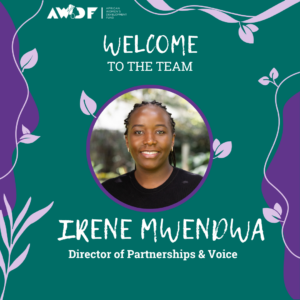
Our team is excited to welcome Irene Mwendwa, as our new Director of Partnerships and Voice. Irene is a lawyer committed to building the partnerships, institutions, and collective power needed to advance African women’s leadership and solidarity. She has a particular interest in how African women and feminist movements can shape the policies, institutions, and technologies that determine their lives and futures.
As the Director of the Partnerships and Voice portfolio, Irene joins the team with a vision to strengthen partnerships and collective power of African women’s rights organizations and feminist movements and enhance feminist approaches to resource mobilisation and philanthropy. ‘I am particularly interested in connecting movements, funders and allies in ways that shift power and enable African women to set the agenda for the futures they want,’ she says.
She believes we should never simply inherit the world we are given. “We have a responsibility to reshape it and to ensure African women have the power, voice and solidarity to shape what comes next,”
Asked which influential African feminist leader she would love to have dinner with, she notes Amina Mama.” I would discuss the evolution of African feminist solidarity, thought and movements and how we can sustain feminist organising as we navigate changing political, economic and technological realities. I’d be especially curious to hear her thoughts on how younger generations can build on the intellectual and organising traditions of African feminism while creating new forms of solidarity and collective power,” she concluded.
Join us as we welcome Irene to the AWDF team and community. We look forward to a fruitful journey with her.
Share your congratulatory and well wishes messages HERE.
Call for evaluation consultants for No to Backlash: Supporting the Collective Resistance of Feminist and Women’s Movements in Africa
Call for evaluation consultants for No to Backlash: Supporting the Collective Resistance of Feminist and Women’s Movements in Africa
The African Women’s Development Fund (AWDF), Urgent Action Fund – Africa (UAF-Africa), and Fonds pour les Femmes Congolaise (FFC) seek an external, independent, and diverse African feminist evaluation consultancy team to conduct a final programme evaluation of its work carried out as part of the No to Backlash: Supporting the Collective Resistance of Feminist and Women’s Movements in Africa initiative. Lessons learned from the evaluation will inform and improve the development of future programming, grant-making support to our partners, advocacy strategy and stakeholder engagement. The evaluation inception phase will start in August 2026, with the final report submitted on 23rd October 2026.
About the project
The “No to Backlash” project is a multi-country initiative implemented across ten African countries by a consortium of three feminist funds: AWDF, UAF-Africa, and the Congolese Women’s Fund, with funding from French Ministry of Europe and Foreign Affairs (MEAE) . The project responds to the growing threat of anti-gender and anti-rights movements in Africa by funding, strengthening, and connecting feminist organisations and movements to better resist backlash and advance gender justice. The full project presentation has been attached in the Terms of Reference (TOR).
Objectives of Assignment
Retrospective Objectives
– To produce a consolidated assessment of all activities carried out throughout the “No to Backlash” FEF project, covering all three consortium partners and all ten target countries.
– To assess the extent to which the project has achieved its stated objectives and produced the expected results, based on the evaluation questions defined in Section 4, and by reference to the indicators and targets established in the original project presentation report.
Forward-Looking Objectives
– To identify and document key lessons learned from the design and implementation of the project, including what worked well, what did not, and why, to inform future feminist fund programming in Africa.
– To formulate actionable recommendations for AWDF, UAF-Africa, the Congolese Women’s Fund, and MEAE regarding: (i) the potential consolidation, replication, or scale-up of effective project mechanisms; (ii) the design of future similar initiatives targeting anti-gender and anti-rights backlash in Africa; and (iii) strategies to strengthen the sustainability of results achieved, including the durability of partnerships and networks built.
– To generate knowledge and evidence on the role of feminist funds in countering anti-rights movements in Africa that can be shared with the broader feminist philanthropy and development community.
Timeline
The consultancy will run from August -October 2026, with key milestones including:
| Stage / Task | Planned Date or Duration |
|---|---|
| Deadline for submission of applications | 24th August 2026-11:59 PM UTC |
| Shortlisting and Selection of consultant(s) | 31st August 2026 |
| Kickoff COPIL meeting | 4th September 2026 |
| Submission of framework / scoping document | 11th September 2026 |
| Validation of framework document | 17th September 2026 |
| Data collection and field activities | 17th to 30th September 2026 |
| Submission of provisional analysis report | 9th October 2026 |
| COPIL meeting on provisional report | 14th October 2026 |
| Submission of the final report and summary sheet matrix | 23rd October 2026 |
| COPIL meeting on final report | 29th October 2026 |
Budget
The maximum budget available for this evaluation is 40 000 EUR, excluding tax.
How to Apply
Interested consultants should submit their application to consultants@awdf.org no later than 24 August 2026 at 11:59 PM GMT.
The application must include:
– A technical proposal (maximum 15 pages) presenting: an understanding of the project context and evaluation objectives; the proposed methodological approach, including a description of all data collection tools; a plan for field missions and stakeholder consultations; and a provisional implementation timetable;
– A provisional breakdown of the number of working days per phase, using the financial annex template (Annex 1);
– The CVs of all consultants proposed to carry out the work, clearly indicating relevant expertise in: feminist movement-building and gender justice; evaluation of development and/or civil society projects; African contexts, particularly French-speaking Africa; and any relevant thematic expertise (anti-rights movements, digital security, philanthropic funding mechanisms);
– Bank details, quote/invoice reference, and any other documents required for contractual engagement.
Enquiries
For any questions regarding this Terms of Reference, please contact: impactconsultant@awdf.org
Read full details in the Terms of Reference provided in English and French HERE
AWDF reserves the right to request clarifications from shortlisted applicants prior to making a final selection. The selected service provider will be notified, and a contract will be issued in accordance with AWDF’s procurement procedures.
Announcement: We are taking a break 17-21 August.
Announcement: We are taking a break 17-21 August.
In a world that rarely slows down, rest is an act of care, sustainability and resistance.
From 17- 21 August 2026, the African Women’s Development Fund team will be taking an intentional organisational pause to recharge and rejuvenate. During this period , our offices will be closed and the team will be unavailable.
We will resume on Monday 24 August 2026, refreshed and ready to continue resourcing and nurturing movements and advancing our collective vision of a world rooted in gender justice
We look forward to reconnecting with you soon.
Consultancy opportunity for feminist psychosocial practitioner. Apply by 7 August
Consultancy opportunity for feminist psychosocial practitioner. Apply by 7 August
The African Women’s Development Fund (AWDF) is seeking a psychosocial accompaniment team to accompany a cohort of ten (10) feminist leaders participating in the twelve-month Feminist Leadership and Governance Strengthening Programme.
This consultancy forms part of Leadership and Governance Strengthening Programme, AWDF is supporting feminist organizations in Lusophone Africa through leadership coaching, organizational accompaniment, governance strengthening and collective learning. Recognizing that transformative leadership is sustained through both institutional resilience and individual wellbeing, AWDF is integrating a psychosocial accompaniment component into the programme.
Scope of Work
The selected consultant will provide:
-Participant Accompaniment
Provide confidential one-on-one psychosocial accompaniment to programme participants throughout the programme.
-Respond to referrals from leadership coaches where participants require specialized psychosocial support.
-Offer appropriate referrals to external services where additional support may be required.
Collective Learning and Wellbeing
-Participate in programme convenings, including the Inception Forum, selected learning sessions and the Closing Forum.
-Provide immediate psychosocial accompaniment during programme activities where emotionally significant issues arise.
-Design and facilitate periodic wellbeing and collective care sessions for programme participants.
-Support participants to develop individual and collective wellbeing practices that contribute to sustainable leadership.
Programme Support
-Advise the programme team and leadership coaches on approaches for creating psychologically safer and more supportive learning spaces.
-Collaborate with leadership coaches while maintaining appropriate professional boundaries and participant confidentiality.
-Contribute to reflective learning and adaptive programme implementation through periodic debrief sessions with the programme team.
How to Apply
Interested consultants should submit their application to consultants@awdf.org no later than 7 August 2026.
Read full details in the Terms Of Reference in English and in Portuguese
Join our team. We have three exciting positions. Apply by 31 July.
Join our team. We have three exciting positions. Apply by 31 July.
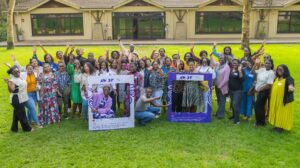
Are you ready to be part of a passionate, diverse, and dedicated team working to support and strengthen feminist organisations and movements in pursuit of gender justice and social transformation in Africa?
African Women’s Development Fund is thrilled to announce three exciting vacancies that could be the career opportunity you are looking for.
The Senior Programme Officer (SPO)- Bilingual.
About the role:
The Senior Programme Officer (SPO) provides strategic leadership for a portfolio of feminist actors and initiatives, leading grantmaking, partner engagement and accompaniment, learning and knowledge generation, and portfolio management. The role is responsible for shaping, implementing, and continuously evolving AWDF’s resourcing approaches to ensure they are feminist, responsive, trust-based, and grounded in the lived realities of partners and feminist movements across the continent, while contributing to organisational and sector-wide thought leadership on feminist resourcing and movement strengthening.
For more information and mode of application for the Senior Programme Officer (SPO), please visit the APPLICATION PORTAL HERE
Executive Manager
About the role:
The Executive Manager’s role is to provide support to AWDF’s CEO, executive leadership and senior management functions to ensure and facilitate effective priority-setting, decision-making, cross-department integration and organisation-wide collaboration, in pursuit of organizational goals and outcomes. The Executive Manager will support the CEO in coordinating collaboration across the AWDF leadership and management team. Working closely with the CEO, the Director of Programmes, Director of Operations and the Director of Partnerships & Voice, she/they will coordinate selected organisation-wide planning-related processes and initiatives. She/they will also oversee the Executive Office team’s work to ensure the CEO can focus her time and energy on top priorities and strategic objectives. In addition, the Executive Manager will work with the CEO in facilitating the strategic and effective engagement of the Board of Directors. The Executive Manager will directly supervise the Executive Assistant.
For more information and mode of application for the Senior Programme Officer (SPO), please visit the APPLICATION PORTAL HERE
Resource Mobilisation and Donor Partnerships Specialist
About this role
A member of AWDF’s Partnerships and Voice team, the Resource Mobilisation and Donor Engagement Specialist drives AWDF’s fundraising and resource mobilisation efforts, leading the development and stewardship of donor partnerships that sustain and grow the organisation’s financial base. The role provides specialist expertise and end-to-end leadership of resource mobilisation processes, from donor prospecting and proposal development through to reporting and relationship management, in support of the Director of Partnerships and Voice, and the Executive Leadership Team.
The role is the primary operational lead for AWDF’s donor engagement work, managing a portfolio of existing and new donor relationships and ensuring that fundraising processes are proactive, values-aligned and coordinated across the organisation. Working under the leadership of the Director of Partnerships and Voice, the Resource Mobilisation and Donor Engagement Specialist anchors the day-to-day delivery of AWDF’s resource mobilisation agenda.
The role manages the Partnerships Officer and works in close collaboration with colleagues across the Partnerships and Voice and Programmes teams team and the wider organisation to ensure coherence, quality and impact in all donor-facing work.
For more information and mode of application for the Resource Mobilisation and Donor Partnerships Specialist Officer (SPO), please visit the APPLICATION PORTAL HERE
***********************************************
How to Apply:
For all three positions qualified and interested persons should send:
A cover letter of not more than 2 pages to the Human Resources Manager explaining their interest and excitement in applying for the position to work for AWDF; and highlighting their experience and competencies as they relate to the specific areas of duties indicated in the vacancy to demonstrate a good fit for the role.
A CV of not more than 3 pages outlining their educational qualifications and employment records with key achievements on relevant positions held.
Applications for the vacancies should reach AWDF no later than Friday, 31st July 2026. Due to our limited capacity, only short-listed candidates will be contacted for additional information and interviews.
Call for Bilingual Leadership Coaches to Support Feminist Organisations in Portuguese speaking Africa
Call for Bilingual Leadership Coaches to Support Feminist Organisations in Portuguese speaking Africa
The African Women’s Development Fund (AWDF) is seeking two experienced bilingual (Portuguese and English) leadership coaches to accompany feminist organisations and leaders across Portuguese-speaking Africa on a transformative one-year leadership and organisational development journey.
This consultancy forms part of a programme designed to strengthen organisational governance, institutional effectiveness and feminist leadership across five feminist organisations in Portuguese-speaking Africa. Through an integrated approach, the programme will support a cohort of ten leaders while strengthening the institutions they lead.
Scope of Work
The selected coaches will:
-Participate in programme inception, baseline assessments and organisational capacity assessments.
-Co-design tailored coaching plans for assigned organisations.
-Provide regular one-on-one leadership coaching to organisational leaders.
-Support governance strengthening, including facilitating one board governance session for each assigned organisation.
-Contribute to programme-wide learning spaces, including the Inception and Closing Forums.
-Document progress, key learning and recommendations throughout the coaching process.
Who should Apply
We welcome applications from experienced conusltants who demonstrate:
-Fluency in Portuguese and English (written and spoken).
-Proven experience in executive, leadership and organisational coaching.
-Strong expertise in organisational development and governance strengthening.
-Strong grounding in intersectional feminist principles and gender justice.
-Deep understanding of feminist organising within Portuguese Speaking Africa.
-Experience facilitating participatory and adult learning processes.
-Strong coaching, facilitation and relationship-building skills.
-Experience working within African feminist networks—particularly in Portuguese Speaking Africa as well as familiarity with trauma-informed, wellbeing-centred and collective care approaches will be considered an advantage.
Timeline
The consultancy will run over one year, with key milestones including:
- Inception Forum: August 2026
- Leadership coaching and Governance strengthening: Throughout the programme
- Closing Forum: At the end of the project
Specific implementation dates will be agreed with the selected consultants.
How to Apply
Interested consultants should submit their application to consultants@awdf.org no later than 31 July 2026.
Read full details in the Terms Of Reference English and in Portuguese
IMPORTANT NOTICE: Outdated Opportunity Circulating
IMPORTANT NOTICE: Outdated Opportunity Circulating
The African Women’s Development Fund have noticed a post currently circulating on LinkedIn that shares a link from our website dating back to 2023 and encourages individuals to apply for an old opportunity.
Please be advised that this posting is completely outdated, and that specific grant application window has long been closed.
To protect your time and personal information, please keep the following in mind:
- Check the Dates: Always verify the original publication date of any link or opportunity shared by third-party accounts.
- Apply Safely: We strongly recommend against submitting personal data or applications through unverified links or unofficial channels.
- Source of Truth: All active job openings, grants, and official opportunities are only hosted and updated live on our official website at https://awdf.org/.
Thank you to our vigilant community for bringing this to our attention. If you encounter any suspicious or misleading posts regarding our organization, please feel free to DM us directly or send an email to awdf@awdf.org.
Consultancy opportunity to Strengthen Documentation and Impact Storytelling Across Africa. Apply by 17 July
Consultancy opportunity to Strengthen Documentation and Impact Storytelling Across Africa. Apply by 17 July
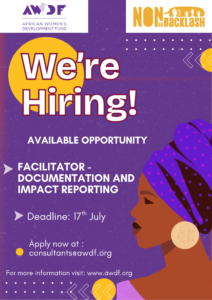
The African Women’s Development Fund (AWDF) is seeking an experienced consultant to design and facilitate virtual MEL capacity-strengthening sessions for partners implementing the No to Backlash project across Africa.
This consultancy offers an opportunity to strengthen feminist organisations’ capacity to document, communicate, and demonstrate the impact of their work while contributing to collective learning and movement-building.
Assignment Duration
The consultancy will be undertaken over 14 working days, with the virtual sessions taking place during the last week of July 2026.
How to Apply
Interested consultants should submit:
- A technical proposal (document or slide deck) outlining the proposed approach and a costed work plan.
- A financial proposal, including the consulting daily rate and bank details.
- A current CV.
- A cover letter highlighting relevant experience and facilitation expertise.
Applications should be sent to consultants@awdf.org with the subject line: “Application for Submissions”
Deadline: Thursday, 17 July 2026, 11:59 PM GMT.
If you are passionate about strengthening feminist movements through learning, evidence, and impact storytelling, we encourage you to apply and contribute to advancing collective resistance to anti-rights and anti-gender movements across Africa.
Read more about this role on Terms of Reference