
Category: News
It is not the time to freeze- AWDF CEO, Francoise Moudouthe speaks at Philea Forum
It is not the time to freeze- AWDF CEO, Francoise Moudouthe speaks at Philea Forum
Francoise Moudouthe CEO of the The African Women’s Development Fund recently challenged the philanthropic sector to rethink its role in today’s crisis driven world. Speaking during the opening plenary of the recently ended Philea Forum 2025, Moudouthe observed the contrast between how the philanthropy sector and feminist movements are navigating the current ongoing crises differently. She observed philanthropy’s sense of “panic” and contrasted it with the resilience and adaptability of African feminist movements who are approaching this moment from a distinctly different approach that,
“...we’ve been here before, We’ve experienced this loss of life, loss of rights, loss of resource, loss of allyship. We’ve survived it and we’ve built back and we’ll do it again…”
Drawing from African feminist movements’ experiences, she shares what it takes to meet this moment using three transformative lessons from the movement that she believes philanthropy can learn from African feminists. She notes that philanthropy needs to centre justice – social and gender justice are the foundations for the change we want to see. Secondly, to centre movements as they are best placed to make justice happen and lastly to undertake feminist philanthropy
Watch more from Moudouthe’s submission at the Philea Forum 2025 below
For more information about the Forum visit philea.eu
Celebrating Arielle Enninful: A Heartfelt Thank You
Celebrating Arielle Enninful: A Heartfelt Thank You
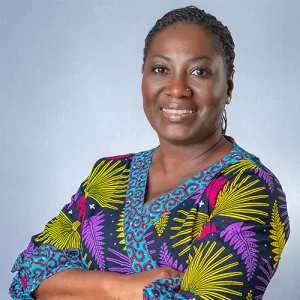
Celebrating Arielle Enninful: A Heartfelt Thank You
After nine exceptional years on the AWDF Board, we bid farewell to Arielle Enninful as she steps down from her role as Board Treasurer. Her dedication, expertise, and unwavering commitment have been instrumental in the growth and impact of AWDF.
As Board Treasurer, Arielle provided meticulous financial oversight and maintained the highest standards of governance and transparency. Beyond her fiduciary responsibilities, she has been a strategic advisor whose insights have guided critical organisational decisions and shaped AWDF’s evolution.
Françoise Moudouthe, CEO
“Arielle has been an exceptional partner in AWDF’s journey. Her financial expertise provided the solid foundation we needed to grow our impact, but it was her strategic insights and genuine care for our mission that made her truly invaluable. She didn’t just manage our finances—she helped us navigate critical decisions with wisdom and integrity.”
Taaka Awori, Board Chair:
“In nine years of service, Arielle exemplified everything we hope for in a Board member. Her meticulous attention to governance, combined with her thoughtful contributions to our strategic direction, made every Board meeting more productive. She brought both professional excellence and authentic commitment to our shared vision.”
Dr. Hilda Tadria, Founder:
“Arielle understood from day one what AWDF stands for and what we’re trying to achieve. Watching her steward our resources with such care while never losing sight of the communities we serve has been truly inspiring. She’s helped ensure that our financial foundation is as strong as our mission. She brought grace and a great smile, both of which I hope to match one day.”
Gertrude Bibi Annoh-Quarshie, Director of Operations :
“On behalf of the entire operations team. I would like to extend our heartfelt gratitude to Arielle for 9 years of strategic guidance, commitment and care. Arielle’s listening, collaborative approach, and financial acumen made even the most complex investment, budget, and financial management discussions seamless and productive. She found ways to support our programmatic goals while maintaining fiscal responsibility. Arielle’s leadership style has left a lasting impression that will continue to inspire us.”
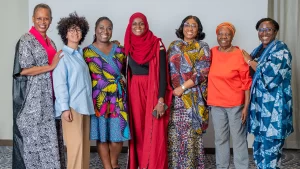
As Arielle’s Board tenure comes to a close, she will continue to be part of the AWDF community. The strong financial foundation and governance framework she helped establish will continue supporting our work for years to come.
We extend our heartfelt gratitude to Arielle for her extraordinary service and wish her continued success in all future endeavours.
#Spotlight: Femme Forte Uganda preserving feminist histories through digital innovation.
#Spotlight: Femme Forte Uganda preserving feminist histories through digital innovation.
This year, with support from African Women’s Development Fund, Femme Forte Uganda unveiled the Virtual Museum of African Feminists — an interactive digital platform that documents, preserves, and celebrates African feminist histories, thought, and resistance.
Femme Forte described this as a “historic and deeply personal launch. The museum emerged as a bold response to shrinking civic space, erasure of feminist narratives, and the silencing of gender- diverse communities across the continent.
The virtual museum has drawn widespread attention from mainstream and new media. Dubbed by Ugandan media as “Uganda’s feminist digital museum” and hailed as a “groundbreaking virtual museum” this spaces marks the “dawn of a new era”. It curates archival materials, storytelling, activist histories, and visual content that reflect the depth and diversity of African feminist organising.
Answering why anyone would want to visit a feminist museum, in her speech, Penelope Sanyu, then Chief Stewardess of the Femme Forte, noted that “the simple answer is because history has always done a good job at erasing the genius labour, and stories of women”.
The Virtual Museum of African Feminists is designed as both a memory project and a tool for education, it enables women, queer, and gender-diverse persons to reclaim voice and visibility on their terms. By reimagining digital museums as civic and political spaces, Femme Forte is expanding how feminist knowledge is produced, preserved, and accessed. This initiative offers a model for how digital platforms can resist erasure while affirming the lived realities and resistance of African feminists.
African feminist stories deserve to be told and this is a powerful tribute to the voices, struggles, and victories of African feminist icons.
Watch the launch HERE
Step inside the museum here
Reclaiming the Narrative: Feminist Communication as Political Practice
Reclaiming the Narrative: Feminist Communication as Political Practice
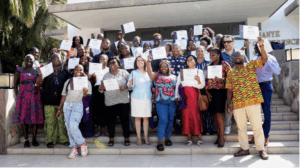
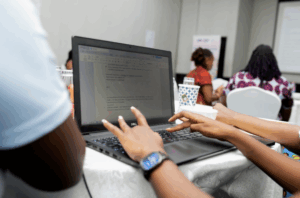
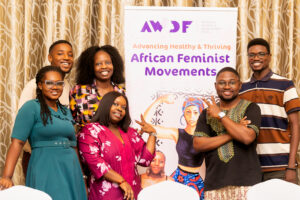
In feminist organising, we have often been asked to document the fight, narrate the work, and “give voice” to those unheard. But what if communication is not simply the storytelling of activism what if it is the activism itself? That was the central question sometimes spoken, sometimes lived during the feminist gathering held in Accra in May 2025. It was not a traditional convening. It was a space of reckoning: with language, with strategy, with the politics of representation. It brought together feminists from Africa not to learn how to better communicate for impact, but to radically reimagine what feminist communication is, can be, and must refuse to be.
🎥 Watch the video that captures these voices, silences, and acts of redefinition here:
Communication as a Site of Structural Violence
One of the most potent revelations from the convening is that communication, as practiced within development systems, is not neutral. It is a site of structural and epistemic violence.
The feminists gathered in Accra did not discuss communication merely as the final layer of a project. They dissected how the words we are asked to use empowerment, awareness, beneficiaries, impact stories do not simply describe the world. They shape what counts as legitimate knowledge. They delimit who gets to speak, and on what terms.
Participants exposed how this language is often inherited from colonial structures and donor expectations. It flattens complexity, sanitises struggle, and turns resistance into palatable narratives for funding cycles. In this context, to say “we are fighting” becomes “we are raising awareness.” To say “we are healing” becomes “we are building resilience.”
The violence of this translation is real. It erases the very people and processes it claims to support.
What Accra made clear is that every word carries ideology and feminist organisers must remain vigilant, constantly renegotiating the terrain of language.
The Politics of Naming and Renaming
Faced with imposed vocabularies, the women at the convening did more than critique they actively re-authored. They turned to ancestral languages and culturally embedded concepts as a way of reclaiming voice.
Words like tchologo (power), yaté (strength), or gbèlè (truth) surfaced repeatedly in discussions. These were not symbolic gestures of cultural pride. They were tactical. These words are embedded in contexts of resistance, in embodied histories, in epistemologies that predate colonial imposition.
What happens when feminists speak from these words instead of about them?
In Accra, we saw a linguistic insurrection. Feminists refused to use the vocabulary of those who have historically silenced them. Instead, they turned language into a weapon not of division, but of collective clarity. This is not just semantic. It is political. Because to name is to claim history, claim struggle, claim futurity.
Visibility as a Trap
A central tension that emerged in the convening and which is powerfully visible in the video is the contradiction between visibility and voice. In the age of social media metrics and donor reporting, visibility has become a currency. But for whom? And at what cost?
Several participants questioned whether visibility, as currently practised, serves the movement or dilutes it. The logic of virality often rewards simplicity, speed, and relatability which leaves little room for contradiction, pain, or radical imagination.
In Accra, communication was not used to perform empowerment. It was used to hold contradiction, to carry silences, to document fracture. That kind of communication doesn’t trend. It doesn’t neatly align with hashtags. But it transforms. It listens instead of amplifies. It builds relationships rather than audiences.
This shift reframes communication not as a bridge between movements and the world but as the fabric of the movement itself.
Storytelling as Feminist Infrastructure
The role of storytelling in feminist movements is widely acknowledged, yet rarely theorised with the depth it deserves. In Accra, storytelling was not treated as a decorative output it functioned as method, memory, and movement.
Participants described how, in their organising, stories are far more than narratives: they are ways of transmitting intergenerational knowledge, of healing collective wounds, of resisting silence under regimes of repression. Stories allow feminists to build political memory in spaces where official records are absent, censored, or violently erased.
In this sense, storytelling is not “creative content.” It becomes infrastructure. It is how strategies are shaped, how histories are carried, how survival is sustained.
Importantly, these narratives are not always meant for public consumption. Some feminist stories must travel in hushed tones, encoded messages, or private networks. They circulate underground, resisting the extractive gaze. The documentary produced from the convening recognises this. It honours what must remain unsaid not by showing everything, but by refusing the compulsion to expose it all. It reminds us that feminist storytelling carries its own ethics of discretion, intimacy, and protection.
Feminist Media as Refusal
Alongside these reflections, the convening articulated a subtle but sharp critique of mainstream media logics. Feminist communication, participants insisted, must not replicate the formats and rhythms of extractive journalism or branded storytelling.
Instead of offering clarity at all costs, feminist media can embrace non-linearity, hold space for ambiguity, and move at the pace of trust. It may resist translation. It may choose opacity. Not everything must be immediately understandable especially to systems that have historically consumed and commodified feminist voices for institutional gain.
In this refusal to simplify, to smooth, or to explain, lies a powerful act of resistance. Feminist media does not always aim to be useful. Sometimes, it exists to disorient, to haunt, to protect.
The documentary itself reflects this ethos. It does not narrate the convening through a voiceover. It does not insert easy lessons. Instead, it evokes. It feels. It unsettles. Through its atmosphere, its silences, its unrushed rhythm, it invites the viewer to unlearn the demand for resolution and to witness on different terms. In doing so, it rejects surveillance and spectacle, and joins a long tradition of feminist media that resists not only what is said, but how it must be said.
Rethinking Resources and Recognition
If feminist communication is infrastructure, then it must be resourced as such. And yet, participants described communications teams being underfunded, isolated, and last in line for organisational support.
This devaluation is not accidental. It reflects a broader refusal to see voice, memory, and imagination as strategic.
What Accra offers both in practice and in theory is a call to reverse this logic. To treat communication not as a way of “disseminating” change, but as making it. To invest in the people who hold the stories, who shape the discourse, who refuse the easy narrative in favour of a truer one.
We Speak, Therefore We Fight
The video that emerged from the Accra gathering does not simply document what happened. It extends it. It holds the texture of a political moment a moment where African feminists refused to be tools of someone else’s message. A moment where they reclaimed time, language, narrative, and voice.
What this convening proved is that communication when treated as feminist practice becomes something else entirely. Not a deliverable. Not a campaign. But a mode of existence. A form of resistance. A method of care.
To communicate, in this way, is to organise. To remember. To insist.
And in a world that constantly tries to silence, flatten, or consume feminist voices, this insistence is everything.
Bintou Mariam Traoré is a Communication officer , AWDF. This blog is a personal reflection of the Advocacy and Communications training that took place in Accra, Ghana.
End the impunity: Standing together against conflict related sexual violence in Africa
End the impunity: Standing together against conflict related sexual violence in Africa
International day for the elimination of sexual violence in conflict
Across Africa, from Sudan, South Sudan, Liberia, Rwanda, Sierra Leone to the Democratic Republic of Congo, armed conflicts are marked by gross forms of sexual violence including mass rapes, sexual slavery, abduction for sex, and child and forced marriages. These atrocities disproportionately affect women, girls and gender-diverse people, with devastating impacts that go far beyond the duration of the conflict.
Join Us for A Critical Conversation
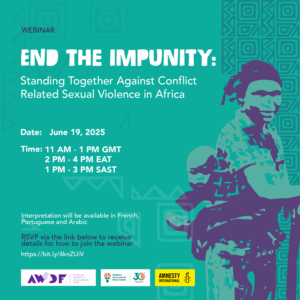
In commemoration of the International Day Against Sexual Violence in Conflict, AWDF is partnering with women’s rights defenders, frontline activists and organisations to draw the attention of funders, the global community, researchers and policy makers. This webinar will shine a light on the need for survivor protection and sustained advocacy, reparations for survivors and solidarity in the quest to end sexual violence in Africa’s conflict zones.
Date: June 19, 2025
Time: 11 am GMT| 1pm SAST| 2pm EAT
The webinar is aligned with the African Union’s 2025 theme, “Justice for Africans and People of African Descent through Reparations,” which addresses the continent’s ongoing conflicts rooted in colonial legacies; and the 25th anniversary of UN Security Council Resolution 1325 on Women, Peace, and Security, particularly relevant as Africa continues to face conflict-related sexual violence, where violence is used as a weapon of war.
Interpretation will be available in French, Portuguese and Arabic.
Let us break the silence. Stand in solidarity with women, girls and gender-diverse persons in conflict.
Consultancy Opportunity: Leadership and Governance Programme Coaches
Consultancy Opportunity: Leadership and Governance Programme Coaches
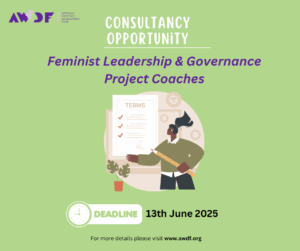
The African Women’s Development Fund seeks the services of four experienced coaches to provide individualised and organisational coaching to selected organisations over a one year period. These coaches will support our work on the Feminist Leadership and Governance project which aims to strengthen organisational systems and culture at the board level; improve the delivery of quality services at the organizational level; and develop the leadership capacity of individual women leaders within five French-speaking feminist countries. Two representatives from each country will participate in the coaching program, totaling 10 participants.
The selected coaches will play a vital role in supporting the organisations and individuals to achieve the project’s expected outcomes and personal growth with a specific focus on navigating the complexities of working within African feminist spaces. Once confirmed, the four coaches will work with issue-specific facilitators who will be brought in from time to time to engage with individual leaders, especially, collectively. These include keynote speakers, knowledgeable individuals on critical issues like affecting the wellness of leaders and organisations such as anti-rights organising, feminist political education and consciousness.
What’s involved:
Each coach will be responsible for:
- Participating in the baseline assessment process for their assigned organizations and individuals.
- Contributing to the due diligence/capacity needs assessment to identify organizational gaps and inform tailored coaching content.
- Providing regular individual coaching sessions to representatives from assigned organizations, focusing on leadership development, management skills, communication, and navigating the specific challenges and opportunities related to their work in African feminist spaces.
- Providing governance strengthening activities for the boards of assigned organizations, including observation, review, support services, training, and advice. This will include one dedicated governance board training session per organization
- Facilitate the Inception and grand finale forum
Application Process
Interested consultants should submit:
- A technical proposal outlining their understanding of the assignment, methodology, and work plan.
- A financial proposal with a detailed budget.
- A CV or profile highlighting relevant experience.
Applications should be submitted to consultants@awdf.org by 13th June 2025
Read more in HERE…
Join our Funding Application Webinars
Join our Funding Application Webinars
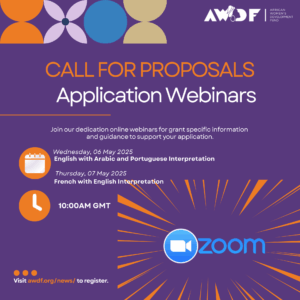
Join our dedicated webinars to receive comprehensive information and guidance on the application process, eligibility criteria, and expert tips to inform your applications.
Scheduled sessions:
6 May, 2025 | 10:00 am GMT: English webinar with Arabic and Portuguese interpretations.
Register – https://bit.ly/3GFmqo4
7 May, 2025 | 10:00 am GMT: French webinar with English interpretation
Register – https://bit.ly/3YEddD1
More on our current funding cycle here.
Programme Assistant Intern– Portuguese speaking
Programme Assistant Intern– Portuguese speaking
Are you a Portuguese-speaking feminist passionate about advancing gender justice across Africa?
Are you ready to be part of a vibrant Pan-African team supporting powerful feminist movements and organisations working to create long-lasting social transformation?
The African Women’s Development Fund (AWDF) is thrilled to announce an exciting internship opportunity that could be your next big step.
About the Role
AWDF is looking for a Programme Assistant Intern (Portuguese-speaking) to join our team on a short-term basis. You will work closely with the Programmes and Grantmaking teams to support our engagement with feminist partners—particularly in Portuguese-speaking African countries.
Your responsibilities will include coordinating grant-related tasks, facilitating communication with grantee partners, supporting programme officers, and assisting with mapping and outreach efforts in Lusophone regions.
Internship Duration
18 months, full-time (Monday to Friday), based at the AWDF office in East Legon, Accra, Ghana.
This is more than an internship—it’s an opportunity to contribute to meaningful change across Africa by supporting the people and organisations at the forefront of gender justice.
Apply Now
Send in your application no later than Wednesday, 14th May 2025.
Due to limited capacity, only shortlisted candidates will be contacted.
Join us, and help write the next chapter of feminist solidarity and social transformation in Africa.
AWDF launches Call for proposals to support feminist and gender justice movements in Africa, closing 27 May
AWDF launches Call for proposals to support feminist and gender justice movements in Africa, closing 27 May
Our world is shifting, philanthropy faces unprecedented challenges, and attacks on gender justice are growing by the day. While the African Women’s Development Fund (AWDF) has felt these impacts alongside many of you, we choose to respond, as feminists always have, with greater purpose. Pushing to the best of our abilities, in the face of the growing limitations, all while remaining in community with African feminists and movement actors.
We are excited to announce the launch of our call for proposals set to amplify and continue the necessary, bold and radical gender justice and social transformation work being initiated and led by movement actors. This funding opportunity is specifically tailored to support nascent, grassroots organisations, unregistered groups and movements in Africa who are often left out of funding opportunities. It affirms our unwavering commitment to resource, accompany African women’s rights organisations and feminist movements led by women, girls and gender-diverse people in ways that allow them to sustain transformative work.
The Call in Focus
For this funding cycle, we have tailored five (5) funding grants targeting different movement actors working on gender justice and social transformation. The available grant opportunities include:
Inua Grants – This grant will support initiatives that strengthen the voice, agency and leadership of women, girls and gender-diverse persons to lead actions that contribute to gender justice.
Siza Grants – This crisis response grant provides flexible funding to small grassroots and unregistered groups in building sustainable solutions in crisis and conflict areas.
Matla Grants – This grant will support delivery of essential services to women, girls and gender diverse persons experiencing violence, backlash and/or discrimination.
Zimba Grants – This grant will support capacity strengthening and movement building in French-speaking Africa.
Economic Justice Grant – This grant will resource organisations to dismantle the barriers to economic justice and equality for African women, girls and gender diverse persons.
Key Dates
From 28 April to 27 May 2025, we are accepting applications in English or French and strongly encourage applicants from Portuguese and Arabic speaking countries to submit their applications in English or French.

Collective Action Against Sexual Violence: KASA! Initiative Partners’ Covening in Northern Ghana
Collective Action Against Sexual Violence: KASA! Initiative Partners’ Covening in Northern Ghana
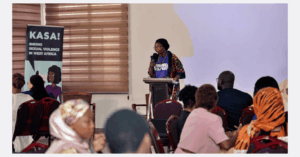
Tamale,: In Ghana, like many other countries, sexual violence remains a particularly prevailing and complex issue often shrouded in silence. Nearly one in four women in Ghana between the ages of 15 and 49 experience some form of violence during their lifetime.
To support the ongoing efforts to address sexual violence, the African Women’s Development Fund (AWDF) under its KASA! Initiative and in partnership with Savannah Women Integrated Development Agency (SWIDA) under the powerful theme “Dreaming, Speaking Out, and Acting Collectively Towards a World Free of Sexual Violence” gathered grantees, partners, and advocates for a transformative convening at the Modern City Hotel. The event, held on Wednesday, March 26, 2025, brought together voices from civil society, government, traditional leadership, and digital activism to strategise on ending sexual violence in communities across Ghana and beyond.
The convening emphasised three critical priorities: the need for collective action, amplifying survivor voices, and strengthening institutional responses to sexual violence.
Setting the tone of the convening, Hajia Alima Sagito-Saeed, the Executive Director of SWIDA emphasised the need for unified efforts to dismantle systems that perpetuate sexual violence.
“This convening is not just about dialogue; it is about action. We must dream boldly, speak unapologetically, and act decisively to protect women’s rights,” she stated.
She highlighted SWIDA’s grassroots initiatives, including community education programs and survivor support networks, which empower women to break the silence around sexual violence.
In her opening remarks, Gifty Ayebea Adem, AWDF Programme Officer highlighted the initiative’s work in empowering survivors and strengthening community-led responses to sexual violence.
“Sexual Violence continues to rob lives, dreams and dignity across societies and we cannot continue to watch on. We recognize that sexual violence is shrouded in silence often due to social, cultural and religious norm practices. This impedes prevention and response,” stated Gifty Ayebea Adem.
Stressing the importance of grassroots mobilisation, Gifty highlighted: “When women and girls are safe, our communities thrive. KASA is committed to ensuring that no survivor stands alone. We also hope to foster stronger partnership among us and to see inspiring post-convening interventions.”
KASA, which means “speak out,” was launched by AWDF with the Ford Foundation and Open Society West Africa with a seed fund of $3,750,000.00 to support sexual violence interventions in Africa. The KASA initiative has supported 45 organisations in Ghana, Senegal and Nigeria, implementing various interventions to combat sexual violence.
Hajia Alhassan Bushira, representing the Ministry of Gender, Children, and Social Protection, commended the organizers and reinforced the government’s role in policy implementation and legal frameworks. She underscored the importance of engaging men and boys in prevention efforts: “We have to engage the male groups, because sometimes they feel they have the right to abuse women, and they say this out of ignorance so when you engage them at the community level, I think we will be making a headway.”
Traditional leaders, particularly in Northern Ghana, play a vital role in challenging harmful cultural practices. Queen Mother Bridgetwurche Barichisu Mankir reiterated the critical role of traditional leaders in addressing sexual violence. “Culture should not be an excuse for abuse,” she asserted. She shared how queen mothers in Northern Ghana are working to end harmful practices such as child marriage and advocate for survivor-centered justice.
Beyond the physical spaces, the digital landscape offers both opportunities and challenges in combating sexual violence. Social media influencer Addy Kehinde Hussanat explained how online platforms can amplify survivor voices while calling for stronger protections against online gender-based violence. She noted: “By sharing stories, we challenge victim-blaming narratives and hold perpetrators accountable.”
Hussanat also acknowledged the risks of online harassment and called for stronger protections for women who speak out. “We need tech companies and policymakers to take online gender-based violence as seriously as physical violence.”
The highlight of the program was during the two-part panel discussions where panelists demanded policy reforms and traditional leader engagement to combat impunity for perpetrators.
The panelists agreed that ending sexual violence requires a multi-stakeholder approach. Key recommendations included:
- Ensuring laws against sexual violence are enforced with accessible justice for survivors
- Engaging men, boys, religious and traditional leaders as allies in prevention
- Promoting women’s financial independence to reduce vulnerability to abuse
- Leveraging digital platforms for awareness while combating online harassment
- Expanding psychological support services for survivors
AWDF reaffirmed the organisation’s commitment to funding women-led and feminist movements across the continent and prioritising their leadership as they drive the most impactful change.
This is a commissioned article by Agnes A. Attoh (Ewurama), a Journalist based in Ghana.