
Category: News
Bisi Adeleye Fayemi: A trailblazer in Humanitarian Leadership
Bisi Adeleye Fayemi: A trailblazer in Humanitarian Leadership
[tp lang=”en” not_in=”fr”]
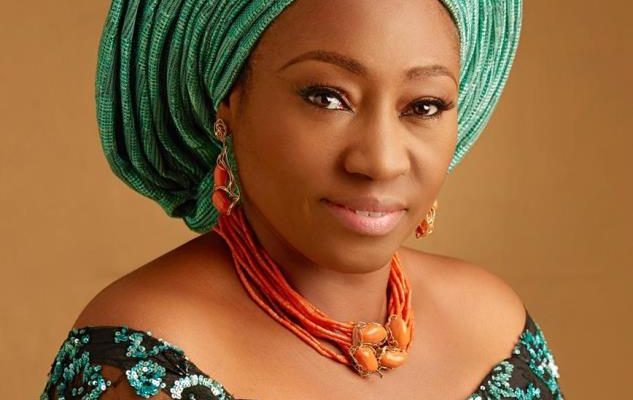
When we think of African women, we think of strength, resilience, courage and sisterhood, of making the impossible possible as they spearhead change across the continent.
Bisi Adeleye Fayemi, co-founder of the African Women’s Development Fund and First Lady of Ekiti State in Nigeria, has just been awarded the 2018 Zik Leadership Prize for Humanitarian Leadership in Lagos Nigeria.
Bisi, who served as the first Executive Director of the African Women’s Development Fund from 2001-2010 is well known for her activism in defending and promoting women’s rights. She has vast experience as a Gender Specialist, Social Entrepreneur, Policy Advocate, Politician, Social Change Philanthropy Practitioner, Communications Specialist and Social Sector expert. Bisi is also one of the founders of the African Feminist Forum (AFF).
Bisi runs Above Whispers, an online platform which provides a forum to engage in discussions on various issues including social justice, women’s rights, politics, development, financial security, health, entrepreneurship, popular culture, faith, parenting, relationships.
[/tp]
[tp lang=”fr” not_in=”en”]
Chaque fois que nous pensons aux femmes africaines, nous pensons à la force, à la résilience, au courage et à la sororité. Nous pensons à celles qui font de l’impossible une réalité et sont au-devant du changement à travers le continent.
Bisi Adeleye Fayemi, cofondatrice du Fonds Africain pour le Développement de la Femme (AWDF), Première Dame de l’État d’Ekiti au Nigéria, vient de recevoir le Prix du leadership Zik 2018 pour le leadership humanitaire à Lagos, au Nigéria.
Bisi, qui a été la première Directrice Exécutive du Fonds Africain pour le Développement de la Femme (AWDF) de 2001 à 2010, est bien connue pour son activisme dans la défense et la promotion des droits des femmes. Elle possède une vaste expérience en tant que spécialiste sur les questions de genre, entrepreneur social, défenseuse des politiques, politicienne, philanthrope, spécialiste en communications et experte du secteur social. Bisi est également l’une des fondatrices du Forum Féministe Africain (AFF).
Bisi a créé Above Whispers, un site internet qui engage beaucoup de personnes sur divers sujets tels que la justice sociale, les droits des femmes, la politique, le développement, la sécurité financière, la santé, l’entrepreneuriat, la culture populaire, la foi, l’éducation des enfants et les relations.
[/tp]
The Bread and Butter Series: Growth for Whom? A Pan African Feminist Reflection on Macro Level Economic Policies
The Bread and Butter Series: Growth for Whom? A Pan African Feminist Reflection on Macro Level Economic Policies
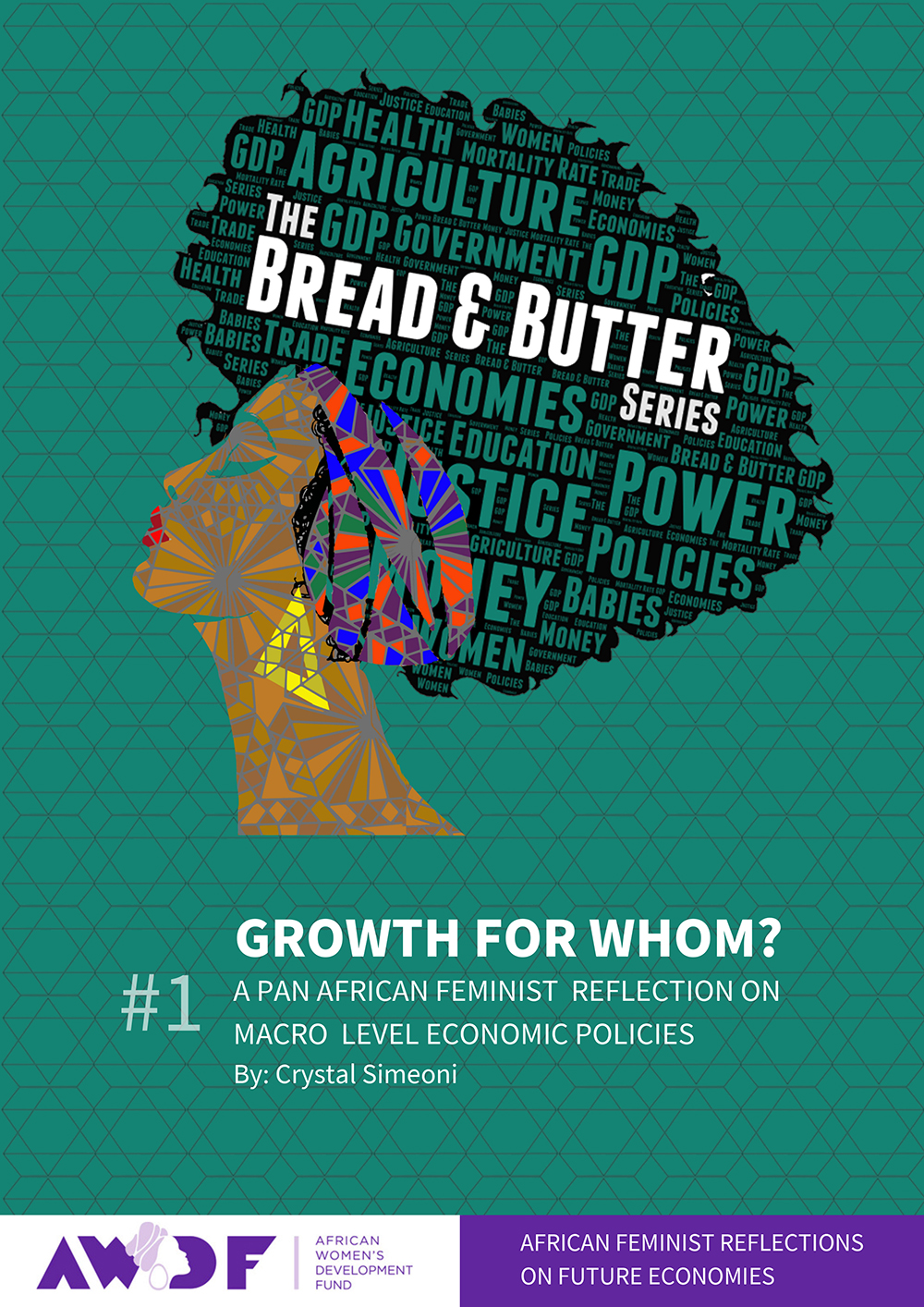
The first article in our Bread and Butter series was written by Crystal Simeoni from the African Women’s Development and Communication Network (FEMNET), convenors of the African Feminist Macroeconomics Academy. The article provides a feminist reflection on current neoliberal macro level economic policies in Africa and how they affect women’s lives. The writer argues that current definitions of women’s economic empowerment are too narrow to offer impactful strategies. This follows from increasing analyses that, in as much as Africa’s economies grow, so does inequality between her people. Simeoni argues that current neoliberal macroeconomic frameworks will continue to exacerbate the problem.
Please click HERE to read the article.
Call for Consultants: Bilingual Feminist Grantmaking Consultant
Call for Consultants: Bilingual Feminist Grantmaking Consultant
[tp lang=”en” not_in=”fr”]
AWDF works in two major languages, English and French. AWDF is looking for a bilingual feminist grantmaking consultant to serve as Temporary Cover for its Francophone grantmaking portfolio for a period of 8 weeks. The consultant will report to the Grants Manager, and will work in close collaboration with Grants Programme Officers and administrators, Programme specialists, the Director of Programmes, as well as other members of the AWDF team.
The role is primarily Grant Management and includes the following:
- Review French applications and recommend credible organisations that promote AWDF’s mission, prepare a summary docket for management consideration
- Conduct due diligence on selected women’s rights organisations when needed
- Review grantee reports and provide feedback and recommendations to the Grants and Finance teams
- Provide translation from French into English and English into French concerning grants as needed
- Any other task in keeping with the role as assigned by Supervisor
How to apply
Qualified candidates should please send a cover letter, a CV of not more than 3 pages and indication of two referees by email to jobs@africlub.net/awdf.
Deadline for submission: April 24th 2019
Please find the full Job Decription Here Francophone Consultant
[/tp]
[tp lang=”fr” not_in=”en”]
Les deux langues officielles utilisées à l’AWDF sont l’anglais et le français. AWDF est donc à la recherche d’un (e) consultant (e) féministe bilingue avec une connaissance approfondie en octroi de subventions et qui pourrait travailler sur notre portefeuille de subventions des pays francophones. La durée de ce poste est de 8 semaines. Le/la consultant(e) fera rapport et sera supervisé(e) par le chef du département de subventions. Elle/il travaillera en étroite collaboration avec les responsables et administratrices de programmes de subventions, les spécialistes de programmes, la Directrice de Programmes ainsi que d’autres membres de l’équipe AWDF.
Le rôle est principalement la gestion du portefeuille de subventions qui comprend les éléments suivants:
- Examiner les demandes de subventions en français et recommander des organisations crédibles qui défendent la mission de l’AWDF, faire un résumé de toutes les demandes et les présenter à l’équipe de gestion pour leur considération.
- Faire des vérifications nécessaires sur les organisations de femmes sélectionnées
- Examiner les rapports des bénéficiaires et fournir des commentaires et des recommandations à l’équipe subventions et finance.
- Faire la traduction des documents de subventions du français vers l’anglais et vice versa
- Exécuter toute autre tâche confiée par son superviseur
Comment postuler ?
Les candidats (es) qualifiés (es) doivent envoyer une lettre de motivation, un CV (pas plus de 3 pages) et les détails de deux références professionnelles qui peuvent être utiles à leurs candidatures par email à jobs@africlub.net/awdf.
Les dossiers de candidatures doivent être envoyés au plus tard le 24 avril 2019
TELECHARGEZ ICI LE TERME DE REFERENCE
[/tp]
Consultancy opportunity: Scoping on evidence-based VAW prevention
Consultancy opportunity: Scoping on evidence-based VAW prevention
As part of our capacity building and donor advocacy roles, AWDF is embarking on a process to encourage African women’s funds, allied philanthropic actors, and the African women’s organisations that we support to engage with the growing field of knowledge production and programme development and implementation around evidence-based prevention of violence against women. This initiative has a particular focus on intimate partner violence but will also consider other forms of violence and both evidence generation and programming around them.
The aim of this consultancy is to produce a report mapping key donors, women’s organisations, researchers and other actors in the African region working on evidence-based prevention of violence against women. Although intimate partner violence as focus, we will also look at work on other forms of VAW.
WANT TO APPLY? , Click here for TOR .
Submissions must be received no later than 15 April 2019.
#BlogoftheWeek: The Annual Pilgrimage
#BlogoftheWeek: The Annual Pilgrimage
Bisi Adeleye Fayemi, a co founder of AWDF wrote a piece that reflected on her experiences of the CSW and various feminist spaces within the Nigerian Feminist ecosystem. In her piece she spoke to the importance of galvanising the feminist movement within African spaces and keeping track of the gains that we have made despite our many obstacles.
To read the article please click here!
The Power of Narrative: AWDF presents the Vagina Monologues
The Power of Narrative: AWDF presents the Vagina Monologues
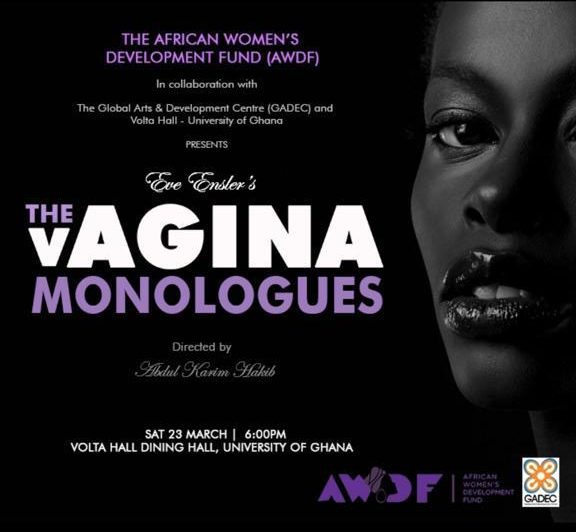
This International Women’s Month, the African Women’s Development fund celebrates the power of Narrative, both on the collective and on the individual level. Throughout history African women have been rebellious change-makers, advocating for their independence and finding ways to gain power in societies that oftentimes restricted them from having full autonomy. It’s important for us at AWDF to celebrate the stories of these women and highlight the ways in which African women continue to own their own narratives. We know just how strong storytelling can be. It can transform nations, inspire and teach whilst reminding us of the art that our own lives have the possibility be, if we’re brave enough to take the first hesitant steps towards something different.
As part of our celebration of Narrative, this year we will be collaborating with the Global Arts and Development Centre in a performance of the Vagina Monologues. This is a collection of a varying number of monologues performed by a broad spectrum of women. Each monologue examines aspects of the feminine experience, touching on everything from HIV and FGM to birth and the female orgasm. The play was written by Eve Ensler and premiered in 1996. Since then it has been updated and performed hundreds of times around the world with various adaptation made by different casts.
We’re excited to partner with the Global Arts and Development Centre to bring this years performance to life, and invite people to come, watch and talk about what they see, and who they see represented in the work. This play forces us to think of the nature of womanhood and how we see and experience it in our daily lives. We invite the general public to come and witness with us the power of Narrative in action, on Friday March 23rd 2019, at the Law Faculty Auditorium, University of Ghana, Legon, at 6.00 pm.
#ThePowerOfNarrative
CALL FOR APPLICATIONS – Consultancy, Grantmaking Audit
CALL FOR APPLICATIONS – Consultancy, Grantmaking Audit

The African Women’s Development Fund (AWDF) is inviting applications from feminist oriented grantmaking systems consultants to undertake an audit of its grant making systems and processes.
For Terms of Reference, Kindly click here
Closing date for receiving applications is Friday 26th April 2019 2019”
What We Know: The Role of Knowledge Production in Owning our Narratives as African Feminists
What We Know: The Role of Knowledge Production in Owning our Narratives as African Feminists
 By: Rita Nketiah, Knowledge Management Specialist, AWDF
“We claim the right to theorise for ourselves, write for ourselves, strategise for ourselves and speak for ourselves as African feminists.” –The African Feminist Charter
Each morning, as I sit down at my desk at the AWDF House, this quote from the African Feminist Charter greets me. It is a constant reminder of the power of feminist knowledge work, as a transformative tool for justice, expansion and the wellbeing of African women. At AWDF, we believe that women’s capacity to tell our own narratives is how movements are built and sustained. Indeed, while knowledge production has historically been viewed as the domain of white Western men in academic institutions, part of our work as an organization is to create the conditions that may garner African feminists to engage in the deep, rigorous and political work of intellectualism as a way to own our narratives, and forge our own liberatory futures. Knowledge production is the practice of creating, researching, analyzing and documenting critical ideas, which can provide some observation about worldly phenomenon. And yet, the work of knowledge production, much like most other areas of human life, is laden with power relations. Historically, the university space has been heralded as the bastion of knowledge production, often dominated by white men. Intellectual work was understood as the work of those in positions of power. While there is an old adage that “knowledge is power”, insofar as knowledge arms you with the capacity to make better, more informed choices in the world, power also determines who and what can be known and who is allowed to be a “knower”; in this way, power is knowledge. Much of the work of feminist intellectuals, then, has been to disrupt all the ways in which institutionalized patriarchy has denied, invisibilized and exploited the very necessary and longstanding intellectual work of women and minoritized communities.
————————-
Why African Feminist Knowledge Production Matters
Ever since I can remember, I have loved reading and learning. I can remember being 16 years old, and discovering some of my favourite poets, including Nikki Giovanni and Maya Angelou. I was struck by the simplicity with which they seemed to express deep and complex truths about being Black women. Around the same time, I was fortunate enough to discover African feminist poet and former AWDF USA Board Chair Abena P. Busia’s collection of poems, Testimonies of Exile, and it fundamentally shifted how I understood my experience as the child of Ghanaian immigrants, living in Toronto. In Busia’s work, I found a longing for a home she had left, a desire to tell a story that had yet been told and a freedom to imagine life after the trauma of migration. And it meant something to me as a young African child to read the work of someone from my ancestral homeland, articulating the experience of being Black, African and female in the murky waters of North American life.
Later, when I began undergraduate studies, I searched desperately for all the African feminist writers I could find. Alas, I developed a deep friendship with the theoretical work of a cadre of African feminists including, Ama Ata Aidoo, Amina Mama, Yaba Blay, Njoki Wane, Notisha Massaquoi, Tsitsi Dangarembga, and Obioma Nnaemeka, to name a few. The literature ranged from fierce radical poetry to deep political/activist theory. And I was thankful for all of it. I understood all of these writers as storytellers and knowledge workers, who excavated their life experiences to teach us something about the human condition, about African women’s human condition(s). Their narratives became a mirror, a blueprint and a guide for what was possible both in my writing and activist world. Their words transformed me.
But as I entered graduate school, and began to pursue my feminist academic career, I realized that very few of my colleagues (and professors) had heard of these remarkable writers. I understood that if I were to produce “rigorous” knowledge in the academy, I would be forced to cite (mostly) white feminists who were more well-known and lauded by the academy. And I understood this as part of the deep and longstanding tradition of epistemic violence that is hurled at Black African women who dared to produce knowledge in the university system. While Black feminism has historically been preoccupied with the ways in which white supremacist constructions of gender, race and class come to structure Black female life in the Americas, African feminists have been instrumental in shaping nationalist independence movements across the continent, the struggle against patriarchal violence and global economic imperialism that threatens the lives of women and girls in their communities. And yet, despite these long intellectual traditions across Africa and its diasporas, there is still a perception that African women do not have the time or are disinterested/disengaged from intellectual labour. African feminists who have historically engaged in intellectual labour have been accused of being Westernized elitists. Certainly, this accusation sits as a betrayal for any well-intentioned African female intellectual engaged in this labour in pursuit of social justice for her people.
The history of African feminist organizing was understandably assumed to be anti-intellectual. That is to say, our feminist foremothers did not have the luxury or access to pursuing seemingly bourgeois endeavours like “research” or “theory”. African women were said to be more concerned with “pressing issues” such as poverty, disease and nation-building and development. And the indigenous knowledge we may have accessed on a daily basis was not considered “intellectual work” –it was simply the way we did things based on our spiritual inner life. Beyond this, the identity of the intellectual was often masculinized, creating a perception that African women did not have the mental acumen to be engaged in the male-dominated world of knowledge production. In a panel discussion a few years ago, BYP National Coordinator Charlene Carruthers observed that “Black people are deep thinkers, even if we don’t always have the time to do it”. Thinking about Black African women, I would extend this to say that we are also deep thinkers, but that patriarchal structures often demand that we mute this intelligence in the face of our men; that we do not (selfishly) pursue the intellect, because this takes us away from caring for communities and families. Gendered expectations of Black African women have meant that the work of “thinking” has historically been the domain of men. The access to education has historically privileged boy-children and missionaries were complicit in this patriarchal education structure. In Ghana, young people who ask critical questions are often charged with and chastised for being “too-known”, which means to go beyond the expectations of adults. One who seeks to question or explore critical thought and analysis is often accused of thinking too highly of themselves, of wanting to know (or actually knowing) too much. This colonial residue is a reminder of how European masters did not want us to access the knowledge that could precipitate our freedom. But what if intellectual work could actually save our lives as African women? What if intellectual work is the very stuff that our liberation is made out of?
————————
Building an African Feminist Knowledge Hub
At AWDF, we currently organize a Feminist Knowledge Hub, which consists of managing, disseminating and co-creating feminist knowledge, as well as strengthening feminist knowledge production institutions. More tangibly, this Knowledge Hub consists of a physical Resource Centre, which houses hundreds of books, DvDs and archives of African feminist knowledge production. The Centre is open to the public three times a week, free of charge. We also manage a complimentary Resource Centre Catalogue, which allows the general public to virtually access a database of our materials. The African Women’s Development Fund Repository (AfriREP) is host to hundreds of articles, reports and research papers on feminist and gender issues in an African context. The materials are sourced through searching through various open access academic journals, and functions as a clearinghouse for innovative African feminist content. We also engage in strengthening the feminist knowledge production movement, through collaborations with research collectives such as Feminist Africa and our Know Your African Feminist series. We recognize all of this work as deep political work that helps to sharpen our analysis as African feminists.
————————-
Conclusion:
Feminist intellectual Patricia McFadden once wrote that “intellectual engagement is the most sensual and most satisfying experience of living. It is akin to nurturing the very essence of [her] being”. As we forge ahead as feminist knowledge producers, I feel strongly that the work of the intellectual is to observe, analyze and document our life narratives, and that this work can be deeply rewarding. I encourage us all to support the work of African feminist knowledge producers, through an engagement with our work. In fact, this was the impetus for the twitter hashtag #citeAfricanfeminists, which culminated in the publication of an African Feminist reading list by feminist scholar Awino Okech late last year. At AWDF, we will continue to support and amplify African women’s knowledge production, as we understand that a movement that consistently reflects, analyzes and observes is one that thrives.
Bio:
Rita Nketiah is currently the Knowledge Management Specialist at the African Women’s Development Fund. She is also completing her PhD at York University in Human Geography. In her spare time, she enjoys an active Netflix life and playing with her cats ☺
Theo Sowa shares her thoughts with ‘Deliver for Good’ on Advocacy, Narrative and Her Sheroes!
Theo Sowa shares her thoughts with ‘Deliver for Good’ on Advocacy, Narrative and Her Sheroes!
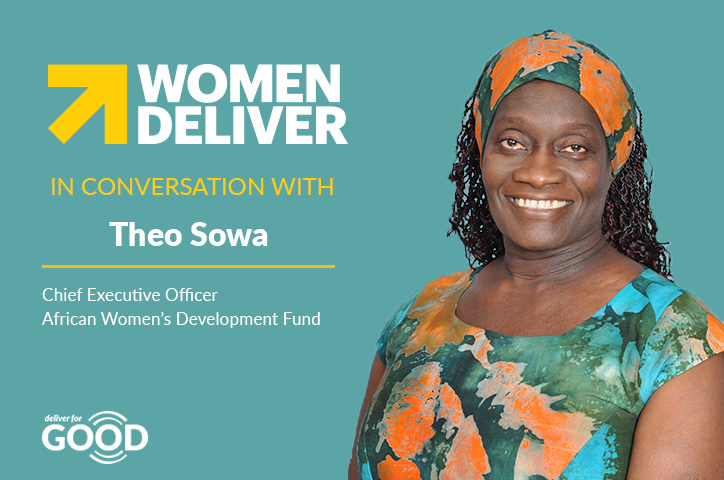
Deliver for Good is an incredible global campaign, initiated by Women Deliver and its partners. It is an evidence-based advocacy campaign that applies a gender lens to the sustainable Development Goals, pushing actors to enhance policy programing and investment in girls and women. As part of this campaign,Theo Sowa, CEO of AWDF, spoke with Deliver for good in a brief interview. She shares her thoughts about who she considers her Sheroes and how the African woman’s narrative and reality can be a game-changer.
Here’s an excerpt from the interview:
WD: You have been listed as a leading African feminist helping to inspire the next generation of women leaders across Africa – and truly all around the world. Who are your sheros and how did they inspire you to become such a key voice for gender equality? Given this month’s editorial focus, if you have any education specific examples, please share!
TS: I have so many sheroes! Too many to list. For today though, I’d mention my mother and grandmother, who believed in the power of a good education, made sure that all the children in our family had that opportunity – but also made sure that we understood and appreciated the full potential, diversity and power of women – and the importance of listening, learning from and respecting all people. I’d mention Graca Machel, who pushed me to use my voice rather than staying in my comfort zone of helping other people to use their voices and show the world their own versions and visions of leadership. She taught me the importance of women recognizing and using our power constructively, and not colluding with those who would strip us of our power or tell us that to be visionary, powerful and amazing changemakers is somehow not feminine or not African. I would mention the fantastic women and girls that I met over the years in refugee and displaced persons camps in Liberia, Sierra Leone and Uganda (amongst other places) who had been through such horror, but showed every day that they were not victims but survivors and pushed to change the injustices in our world so that other women and girls did not go through the horrors that they had experienced. I’d mention the girls, adolescents, women and grandmothers who have taught me about resilience and solidarity – and all my sheroes who have taught me that rights and justice without love does not make a feminist revolution.
For the full interview, please click this LINK.
EXPRESSION OF INTEREST – Women and Girls project
EXPRESSION OF INTEREST – Women and Girls project
The African Women’s Development Fund (AWDF) is seeking for an expression of interest from an experienced consultant to undertake end of project evaluation. We are looking for a consultant with demonstrable expertise on monitoring, evaluation and learning (ME&L) with special focus on women’s rights work in Africa. The consultant is expected to carry out an end of project evaluation in one of the projects implemented through support from Comic Relief.
The time frame expected for the execution of this study is 30 days during the second quarter of the year 2019.
Interested applicants are encouraged to send their expression of interest with:
- Copy of CV
- One recent example of similar task accomplished
- Financial proposal – consultancy fees (daily rates and number of days required)
This should be sent to the following address: jobs@africlub.net/awdf and meassistant@africlub.net/awdf
Please find the Terms of Reference (TOR) here TOR – CR W&G end of project evaluation
The deadline for submission of applications is Friday March 22, 2019. Only shortlisted consultants will be contacted.
Applications from women consultants based in Africa are especially welcome.