
Category: News
Exciting Consultancy Opportunities
Exciting Consultancy Opportunities
We are looking for a consultant to develop and implement a collectively agreed approach to feminist leadership training and follow up coaching to all Line Managers within the organisation. The training and coaching programme is intended to enable managers be more impactful in their leadership, and to improve on their management and coaching skills.
AWDF recognises the importance of ensuring that all staff with supervisory responsibilities have the requisite skills to lead, manage and coach their teams in ways that are aligned with our organisational values, principles and ethics as well as feminist leadership principles as outlined in the African Feminist Charter.
Please click here to download the Terms of Reference for more details.
2. Information Technology Transformation Initiative
AWDF is embarking on the development of an IT Transformation Initiative that will transform how it utilises technology to meet the strategic objectives of the organisation. We seek a consultant/team of consultants to undertake the design and implementation of the IT modernisation that will supports the needs of AWDF and which is characterised by risk management, flexibility, efficiency, productivity, and the transformation of policies and processes.
Please click here for Terms of Reference for this assignment
If this is you, we’d love to hear from you.
Closing date for submission of applications is 15th October 2021
Reflections on the generation of evidence for prevention of Violence Against Women
Reflections on the generation of evidence for prevention of Violence Against Women
 Decentring the colonial gaze: conversation on inclusive knowledge and evidence for Violence against Women Prevention in Africa
On September 09, 2021, the African Women’s Development Fund (AWDF), Raising Voices and the Sexual Violence Research Initiative (SVRI) unveiled an Introductory guide (also available in French) for the creation of prevention knowledge and evidence for African women’s rights organisations in a webinar themed Decolonised and Inclusive: Reflections on the generation of VAW prevention evidence for African Women’s Rights Organisations.
The Guide is an extension of the Violence Against Women (VAW) Prevention Primer (also available in French) produced by Rasing Voices and AWDF in 2019, providing an in-depth look into approaches to generating knowledge and evidence on the prevention of violence against women. It seeks to deconstruct the traditional framing on ownership of knowledge and evidence and prioritises methodologies and processes that centre the voices, needs and expertise of African women and women’s rights organisations.
Edna Ninsiima and AWDF’s Dinnah Nabwire reflect on the webinar and on issues arising from the discussions, in this article.
AWDF 2021 Recognition Survey Report
AWDF 2021 Recognition Survey Report
As part of our monitoring, evaluation and learning process, AWDF conducts grantees’ Recognition surveys annually to identify achievements and recognition of grantees supported. The recognition survey report focuses on highlighting grantees achievements and acknowledging their impact and contribution to achieving women’s equal rights and gender justice.
Read the 2021 Recognition Survey here
Consultancy: Inception of Initiative on Sexual Violence
Consultancy: Inception of Initiative on Sexual Violence
AWDF is embarking on an exciting multiyear initiative supported by the Ford Foundation to address sexual violence in West Africa. To support the Inception Phase of this work, we are looking to engage a consultant or a team of consultants preferably womxn from Africa who have in-depth understanding of (and commitment to) feminist principles.
We’d love to hear from Consultants who bring demonstrable expertise and knowledge of the landscape of women’s rights and approaches, organisations and networks and advocacy and campaigning organisations working on sexual violence particularly in West Africa.
Please find attached the full Terms of Reference and information on how to apply.
Closing Date for submission of proposals: 13th September 2021
Introducing the AWDF Knowledge Exchange Platforms
Introducing the AWDF Knowledge Exchange Platforms

AWDF is excited to invite you to visit our redesigned Knowledge Exchange Platforms – AfriRep and the SAUTI Centre.
The AWDF Knowledge Exchange Platforms are generative, innovative and safe spaces (virtual and physical) for creative and diverse feminist learning, sharing and engagement. They are structured around AWDF’s responsibility to knowledge creators, subjects of content, users, and the broader community of the African feminist movement.
SAUTI Centre
The Sauti Centre is a semi-virtual space with a physical centre in Accra and an online catalogue. It aims to be a collaborative space for learning and is open to students, researchers, writers, activists among many others who are interested in African feminism. The Centre currently hosts over 3,000 materials in varied forms and formats. The materials cover a range of topics such as feminism, philanthropy and the African women’s movement.
We invite you to contact us if you want to use the space to host your own in-person or virtual session! In the past we have hosted panel discussions, small reflection meetings and film-screenings and are excited to co-host the same with you through the centre.
AfriRep
AfriRep is an open-source African feminist knowledge hub. Here you will find materials that range from research articles, Women Rights Organisations (WROs) reports and unpublished dissertations to toolkits on capacity building, lessons from feminist convenings and AWDF publications. Our aim is to make the tremendous knowledge that African women yield accessible and to strengthen the women’s movement through learning.
Here is a Tutorial Video to help you navigate through the sites.
Please email malaika@awdf.org if you have any feminist open-source materials that you would like us to review and upload on any of these platforms!
We invite you to visit our sites!
Consultancy: Developing our Strategic Framework
Consultancy: Developing our Strategic Framework

Established in 2000, the African Women’s Development Fund (AWDF) is a feminist grantmaking foundation that supports local, national and Africa regional women’s organisations working towards the promotion and realisation of women’s rights and recognition of African women’s leadership in all spheres of life. As an intersectional feminist organisation, we have an inclusive understanding of the word “women”.
As our current strategic plan, entitled “Shaping the Future”, is coming to a close, AWDF is now seeking to develop a new strategic framework to guide our work over the next ten years (2022-2032). This process comes at a critical time, as the world has experienced seismic changes since the above-mentioned were developed (including the challenges and opportunities facing African women, the organisations and movements that support their rights, and those affecting the regional and global ecosystem in which we operate), and as AWDF is reflecting on what growth means after 21 years of existence.
AWDF is therefore seeking to engage a consultant, a team of consultants or a consultancy firm to provide strategic, technical and facilitation support to AWDF in the development of our new strategic framework. The purpose of the strategic planning process is to develop a new strategic framework that will guide AWDF’s work and institutional transformations over the next ten years, with the aim to increase our impact and ability to fulfil our mandate. The consultancy will take place from September 2021 to March 2022.
The deadline for submission of proposals is 31 August 2021. Proposals should be sent by email to consultants@awdf.org with “Strategic Planning Consultancy” in the subject line. In line with AWDF’s mission, qualified and interested African women are encouraged to apply.
For more details about the consultancy, the preferred profile of the consultants, and how to apply, please download the full
Terms of Reference here
Call for Consultants: Project Design and Proposal Writing Training
Call for Consultants: Project Design and Proposal Writing Training

Purpose of the Consultancy
AWDF is seeking to support organisations who may want to apply to us for funding. To deliver this capacity building, we are seeking women who are expert individual/s or organisations to deliver training tailored to respond to the AWDF core thematic areas. The training for potential applicants will cover project design and proposal writing respectively.
To Apply, please click here for Terms of Reference
Please note that this consultancy is open only to Women Facilitators.
Deadline for submission: 31st August 2021
Frequently Asked Questions – Cycle 50 Applicants
Frequently Asked Questions – Cycle 50 Applicants
Call for Proposals: Leading from the South (LFS) and Main Grants.
Call for Proposals: Leading from the South (LFS) and Main Grants.
[tp lang=”en” not_in=”fr”]
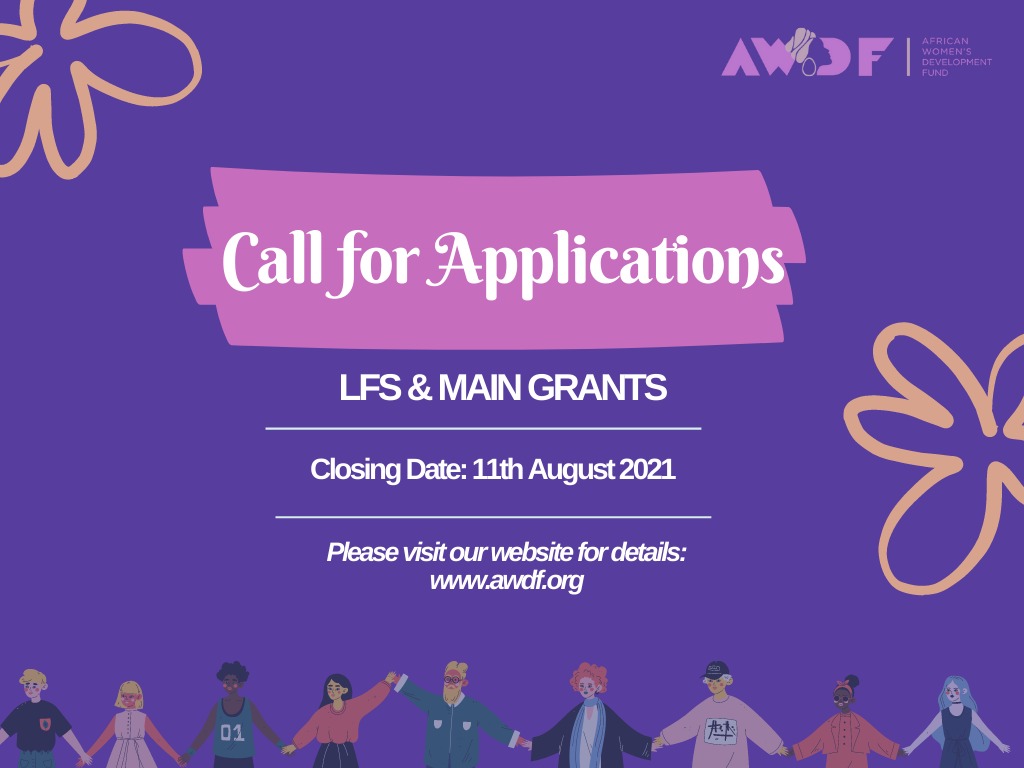
We are inviting proposals from interested women-led organisations with an annual income less than USD200,000 who are registered and working in Africa and the following Middle East Countries: Jordan, Lebanon, Palestine, Iraq and Yemen. For this funding round, we are prioritising applications from the following regions and/or countries: the Sahel, French speaking Africa, North and Central Africa, Jordan, Iraq and Yemen.
We have two funding streams you can apply to: Leading from the South (LFS) Yalla grants and Main Grants.
- LFS Yalla Grants:
- If you are applying for a LFS Yalla grant, you can apply for a maximum of US$50,000 per annum for three years.
- If you are applying to work in an eligible country in the Middle East region, you can only apply under LFS Yalla.
- Please note that Leading from the South grants are primarily to support projects focused on advocacy (though you are able to include costs for service delivery as long as they represent less than 20% of your total budget).
- If you are applying for a Main Grant you can apply for up to USD50,000 for one year.
Please note that we expect to receive over 1000 applications and are only able to contact successful applicants once the review process is completed – successful applicants will hear from us in December 2021.
If you are interested in applying, please read the Application guidance document as it contains essential information to help you through the process.
To apply, please use the link below
AWDF GRANTS PORTAL
Closing Date: 11th August 2021
Specifically for this call, AWDF is organising Webinars in English and French. To join, please register here. The English applicants webinar is on Wednesday 21st July at 10.00am GMT and the French applicant webinar is on Friday the 23rd July at 10.00am.
[/tp]
[tp lang=”fr” not_in=”en”]
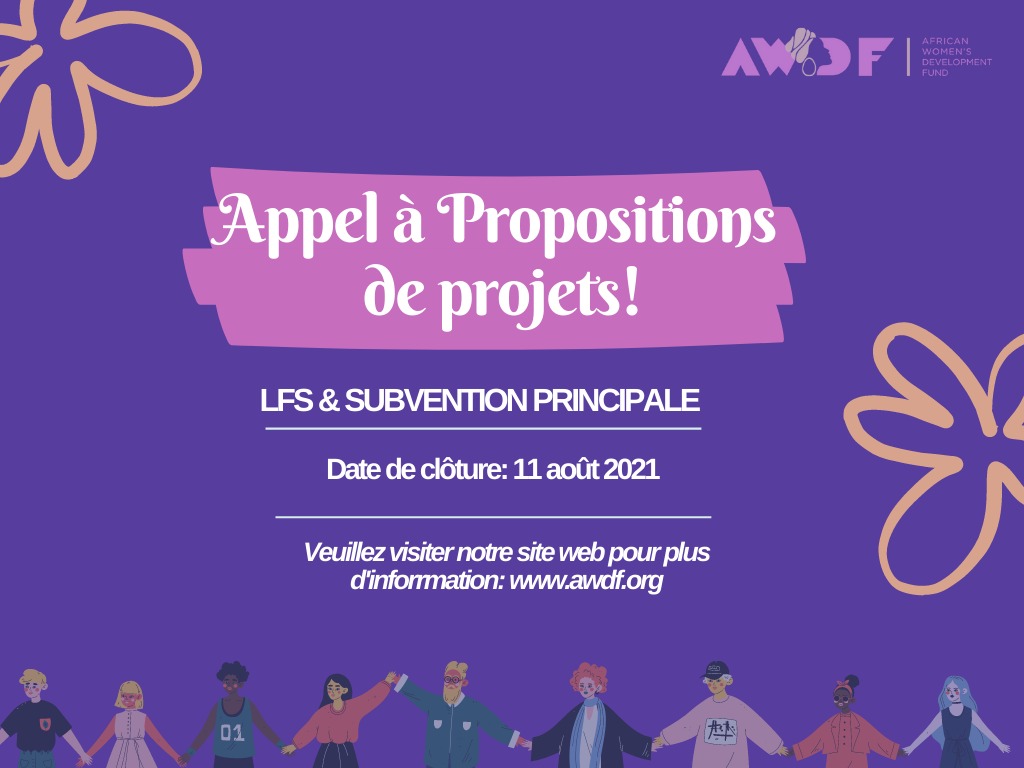
À partir du 14 juillet 2021, l’AWDF acceptera les propositions de projet d’organisations dirigées par des femmes africaines ayant un revenu annuel inférieur à 200 000 USD, enregistrées et travaillant en Afrique et dans les pays du Moyen-Orient suivants : Jordanie, Liban, Palestine, Irak et Yémen.
Pour ce cycle de financement, nous prioriserons les demandes provenant des régions et/ou pays suivants: le Sahel, l’Afrique Francophone, l’Afrique du Nord et Centrale, la Jordanie, l’Irak et le Yémen.
Nous avons deux types de financement pour lesquels vous pouvez soumettre vos projets: Le Sud Aux Rênes du Leadership (LFS) subvention Yalla et Subvention principale.
- Subvention LFS: Yalla
Si votre demande est pour la subvention LFS Yalla, vous pouvez demander un montant maximum de 50 000 USD par an pour trois ans. Si votre demande/projet est pour travailler dans un pays éligible de la région du Moyen-Orient, vous ne pouvez postuler que dans le cadre de LFS Yalla. Veuillez noter que les subventions LFS sont principalement destinées à soutenir des projets axés sur le plaidoyer (bien que vous puissiez inclure des coûts pour la prestation de services tant qu’ils représentent moins de 20% de votre budget total).
- Subvention Principale
Si votre demande est dans le cadre de la subvention principale, vous pouvez demander jusqu’à 50 000 USD pour un an. Veuillez noter que nous nous attendons à recevoir plus de 1000 demandes et que nous ne pouvons contacter les organisations retenues qu’une fois le processus d’évaluation terminé- les organisations retenues seront contactées en Décembre 2021.
Si vous souhaitez soumettre une demande, nous vous invitions à lire attentivement le guide de soumission de subvention, qui contient les informations essentielles pour vous aider dans votre démarche.
POSTULER EN LIGNE ICI
Date de clôture: 11 août 2021
Spécifiquement pour cet appel, AWDF organise des webinaires en anglais et en français. Pour y participer, veuillez vous inscrire ici. Le webinaire en anglais aura lieu le mercredi 21 juillet à 10h00 GMT et le webinaire en français aura lieu le vendredi 23 juillet à 10h00.
[/tp]
Exciting New Vacancies: Join our Team!
Exciting New Vacancies: Join our Team!
[tp lang=”en” not_in=”fr”]
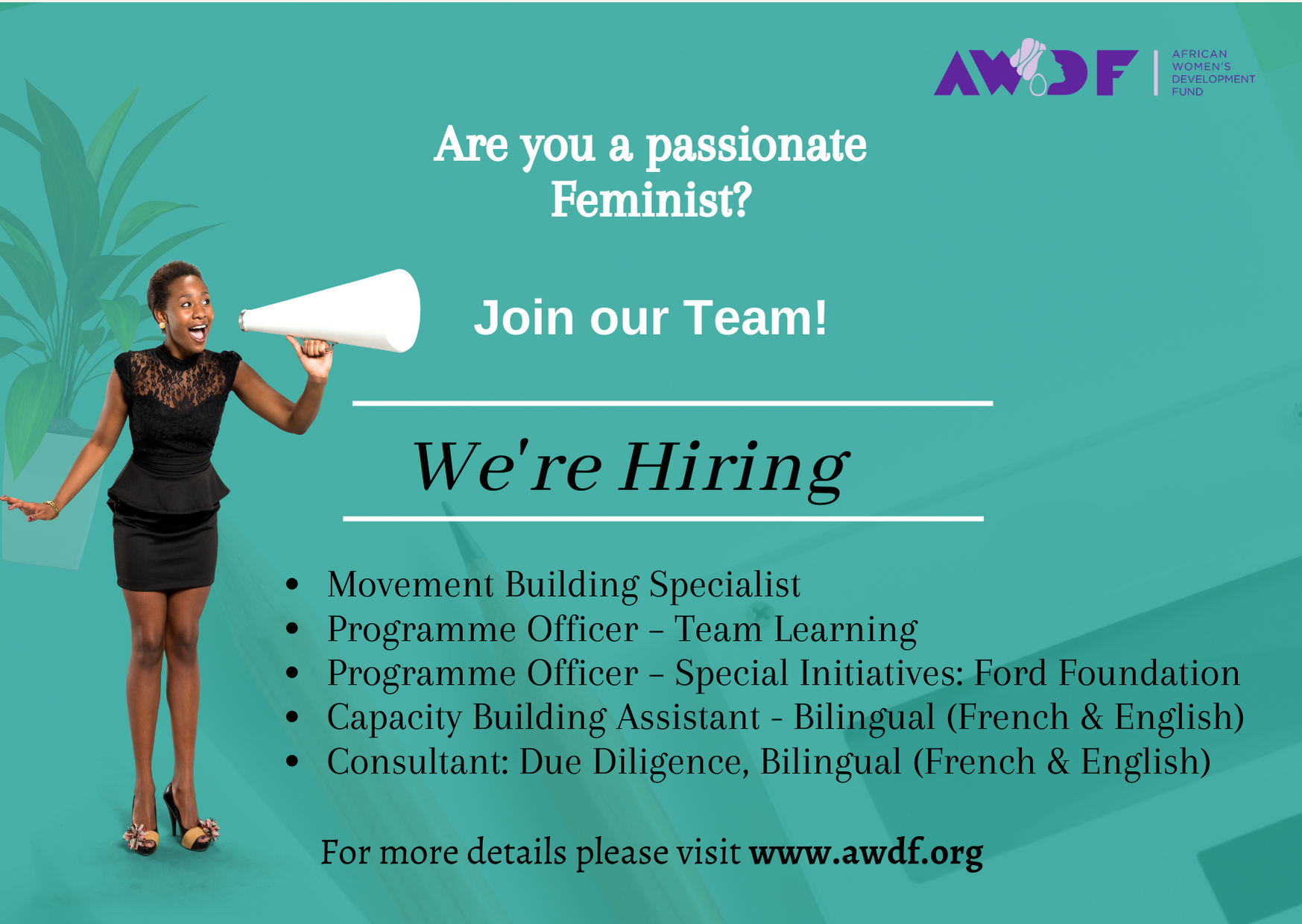
We have vacancies for dynamic, driven African Feminists with a passion for women’s rights and social justice. If you are a team player, proactive and excited about working with multiple stakeholders and partners, we’d love to hear from you.
The following positions are currently available.
1. Movement Building Specialist (Click here for Terms of Reference)
2. Programme Officer – Team Learning (Click here for Terms of Reference)
3. Programme Officer – Special Initiatives: Ford Foundation (Click here for Terms of Reference)
4. Bilingual Capacity Building Assistant, French & English (Click here for Terms of Reference)
5. Bilingual Consultant: Due Diligence, English & French (Click here for Terms of Reference)
Closing Date for submitting Applications: 15th July 2021
[/tp]
[tp lang=”fr” not_in=”en”]
Nous avons des postes vacants pour des féministes africaines dynamiques et motivées, passionnées par les droits des femmes et la justice sociale. Si vous avez l’esprit d’équipe, et si vous êtes enthousiaste à l’idée de travailler avec de multiples parties prenantes et partenaires, nous serions ravies d’avoir vos candidatures. Suivant, sont les postes disponibles :
Spécialiste : Construction de Mouvements (Cliquez ici pour les Termes de Référence – en Anglais)
Chargé(e) de Programmes – Apprentissage en équipe (Pour les Termes de Référence, Cliquez ici – en Anglais)
Chargé(e) de Programmes – Initiatives spéciales – Fondation Ford (Postulez ici! Termes de Référence en Anglais )
Assistant(e) -Renforcement des Capacités, Bilingue (Français et Anglais) (Postulez ici! Termes de Référence en Anglais)
Consultant(e) – Due Diligence, Bilingue ((Français et Anglais) (Pour les Termes de Référence, Cliquez ici – en Anglais)
Date de clôture : 15 juillet 2021
[/tp]