
Category: News
Empowering Francophone Partners: Intensive Communication and Advocacy Training Week
Empowering Francophone Partners: Intensive Communication and Advocacy Training Week
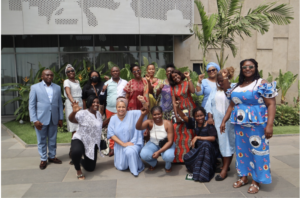
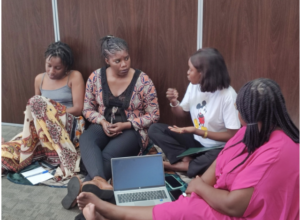
On the 5th to 9th February 2024, 14 participants representing 13 organizations from 11 countries from Francophone Africa participated in an Advocacy and Communications Learning Platform. AWDF organised an intensive and enriching week in Accra, bringing together its Francophone partners for a workshop focused on communication, and advocacy. This innovative event provided a strategic platform to strengthen collaboration among organizations working for the development of women in Francophone Africa. The training session was led by Maïmouna Jallow, a multidisciplinary African feminist artist and communication consultant.
A Timely Training
At the heart of the gathering, intense communication sessions were conducted to enhance participants’ skills in delivering impactful messages and managing issues related to the promotion of women’s rights. Modules on feminist communications, media relations, and the writing of press releases provided a fertile ground for discussions and learning.
Advocacy, the central pivot of the discussions, shed light on the specific challenges faced by women in Francophone countries, while exploring innovative strategies to influence policies in favor of gender equality. The training emphasized the crucial importance for women’s rights advocacy organizations to be visible, creative, and consistent in their communication to impact change.
For LaDouce Irakoze, from the Young Women’s Knowledge and Leadership Institute in Burundi:
“The workshop was very beneficial, and I want to thank the facilitator for her excellent communication skills. Our organization, engaged in advocacy in Burundi for clear policies on women’s rights, especially for domestic workers, gained essential skills. Communication training for feminist associations is crucial to be creative, effective, consistent, well-coordinated, and to communicate impactfully to our audience. The section on press releases was particularly enriching for me, and I am confident that it will significantly enhance our work.”
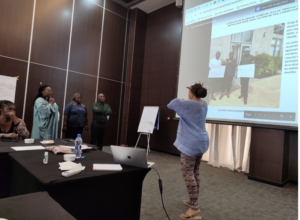
Tools Against Online Violence: Reflections on Feminism 2.0
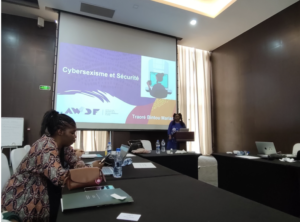
An essential part of the workshop was dedicated to the challenges of the digital world, where women journalists and communicators face a growing threat: cyber harassment. Participants discussed the concepts of feminism 2.0 in Francophone Africa, image appropriation, cybersexism, and online security. Experienced speakers shared strategies to address these challenges, emphasizing the importance of cybersecurity for feminist activists.
“As a communicator, journalist, and feminist, I actively manage several feminist pages and communicate daily on social media. I consider this to be an important step, but as a feminist activist, the need to communicate, inform, and especially advocate for our causes is crucial. I particularly appreciated the module on communication strategy and cybersecurity for feminist activists. I am convinced that all feminists should acquire these skills. AWDF should continue to further support training in communication and advocacy, both for organizations and their communication officers.” Aminata Pilimini Diallo, Guinean feminist web journalist
Francophone Connection and Future Perspectives
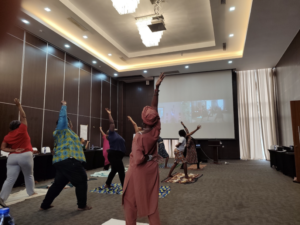
The training took a well-being break with a rejuvenating yoga session. Beyond the physical movements, this experience created a special connection among the participants, strengthening the bonds within the group. Shared smiles, compassionate glances, and emerging camaraderie contributed to forging a strong Francophone connection within the community.
At the end of the training, participants expressed the need to develop additional skills and emphasized the importance of post-workshop follow-up. This request underscores the ongoing commitment of organizations and AWDF to support the professional development of participants and enhance the impact of collective actions for gender equality.”
Bintou Mariam Traoré, Communications officer
Webinar invitation: Popularising Solidarity & Care Strategy- Communing in Communities of Care, 25 Apr, 1pm (GMT)
Webinar invitation: Popularising Solidarity & Care Strategy- Communing in Communities of Care, 25 Apr, 1pm (GMT)
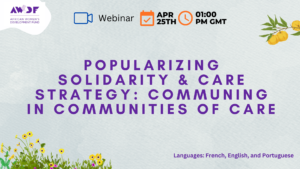
We are thrilled to extend an invitation to an upcoming webinar hosted by the AWDF team! As we transition into a new phase of our journey, from movement building to solidarity and care we are eager to connect with you all to explore, reflect, and envision together the future of feminist movements.
**Event Details:**
📅 Date: 25 April 2024
⏰ Time: 1 PM GMT / (3PM SAST)
🌍 Language: French Portuguese and English
In this webinar, we aim to create a dynamic space for reflective conversations led by esteemed panellists including :
Nana Darkoa Sekyiamah, Ghanaian feminist, author of”The Sex Lives of African Women”
Nathalie Fanja Haaby, Senegalese holistic feminist therapist and Kundalini Yoga teacher
Buky Olabukunola Williams , Sexual and Reproductive Health and Rights Lead at Akina Mama wa Afrika
Aaliyah O. Ibrahim , Nigerian multidisciplinary artist, and international development practitioner
Ruth Nyambura, Kenyan feminist and renowned political educator
This conversation will be moderated by Crystal Simeoni.
The speakers’ diverse experiences, stories, knowledge, and narratives will enrich our discussions about feminist aspirations, collectives, and women’s rights organisations.
The Webinar seeks to:
Popularise the Solidarity and Care strategy within women’s rights and feminist movements;
Cultivate connections and solidarity among movement, women’s rights, and feminists;
Facilitate collaboration and innovation in producing and sharing indigenous knowledge and technologies;
Inspire and promote practices of rest, recuperation, and celebration within women and feminist movements, nurturing their well-being;
The webinar will be conducted in a conversational style, allowing ample opportunities for participants to engage, ask questions, share experiences, and connect with fellow activists.So, come and join us as we delve into what has been accomplished, explore the present landscape, and collectively envision the future of feminist solidarity and care.
Registration
To secure your spot and receive further details about the webinar, please register on the following link https://bit.ly/3xCT59H
Let’s come together to ignite conversations, inspire action, and nurture the bonds of solidarity that fuel our movements!
AWDF thrilled to announce new Board member
AWDF thrilled to announce new Board member

Reimagining Feminist Governance
The African Women’s Development Fund is delighted to announce the appointment of Yvonne Ofosu-Appiah to its Board of Directors. Ofosu-Appiah is an investment professional and Independent Board Director.
She joins Board members Taaka Awori (Board Chair), Arielle Enninful (Board Treasurer), Dr. Hilda Tadria and Bisi Fayemi (Founders), along with Lamyaa Achary, Nicolette Naylor, Jean-Ann Ndow, Mariama Abdou Gada. Ofosu-Appiah is a member of the AWDF Board Finance, Risk and Audit Committee.
She brings a wealth of diverse experiences, expertise, and perspectives that will further strengthen AWDF’s mission and commitment to empowering women and girls across the continent. The addition of Ofosu- Appiah to the AWDF Boards brings the total number of AWDF Board members to nine. Read more about AWDF Board members here.
In 2022, the African Women’s Development Fund (AWDF) embarked on a “Reimagining the Board” initiative to strengthen AWDF’s Board so that it is both responsive to AWDF’s strategic framework, Lemlem, and trailblazing in its approach to feminist governance. AWDF is committed to ensuring that we embody the spirit of Lemlem and infuse it throughout our processes and governance.
About our new Board member:
Ofosu-Appiah has 17 years combined experience working in banking, capital markets and impact investing across sub-Saharan Africa. She is the Co-founder and Managing Partner of Sahara Impact Ventures, a female owned/led impact fund manager and investment advisory firm based in Ghana, investing with a gender and climate lens within Sub Saharan Africa. Prior to this, she was the Chief Investment Officer of Wangara Green Ventures, a climate focused investment company that provides patient capital to green small and growing businesses in Ghana.
Ofosu-Appiah also serves on the Board of Impact Investing Ghana (IIGH), Ghana’s National Advisory Board for Impact Investing and VRA Health Services Ltd (a subsidiary of Volta River Authority) where she is also Chair of the Finance Committee. She is passionate about causes that defend women’s rights, support and empower women. Learn more here
Looking into the future
AWDF remains committed than ever to its mission to fund, strengthen and uphold the organisations and movements led by African feminists, women, girls and gender-diverse people, in pursuit of gender justice and social transformation.
We are excited about the opportunities that lie ahead as we embark on this journey with Ofua – Appiah. Her unique perspectives and passion for feminist causes will undoubtedly enrich AWDF as we strive for a more gender just world. We look forward to walking that journey together!
Strengthening leadership & governance in African Women’s Rights Organisations programme
Strengthening leadership & governance in African Women’s Rights Organisations programme
Women Rights , Feminist Organizations and Movements often find it difficult to secure needed funding to strengthen, grow their leadership and support institutional/organisational resilience to manage internal pressures and external challenges. In light of this, AWDF implemented a Strengthening Leadership and Governance (L&G) in African Women’s Rights Organisations programme between 2021- 2023 aimed at strengthening the capacities of African WROs and feminist leaders through tailor made feminist leadership capacity strengthening programmes.
In February 2024 the Agency and Resilience Unit ( A&R) led a reflection post evaluation space for the L&G programme; a significant stride to engage in conversation and reflect with movements on how to better enrich and nourish funded and non funded entities on their leadership journeys so that they are self determining in the work that they do. The reflection space was an impetus for futuristic , non conversional platform centering African Women’s Rights organisations and feminist movements experiences in future feminist leadership projects and programmes. Thirteen (13) leaders from Zimbabwe, Uganda, Ghana, and Tanzania gathered to share their experiences and what success looks like for an L&G programme centred on feminism, leadership and power.
The space allowed for stories of journeys, self-reflection and reflection on insights and highlights summarised below
Read reflections from our Agency an Resilience team ;
……. great opportunity for us to meet again as a cohort to affirm our self worth, this creates the much needed solidarity which is often overlooked” – Funded partner, L&G programme
Another participant expressed ;
“The programme challenged traditional leadership paradigms, embraced feminist principles in an inherently disruptive way. Coaching me together with the Board at the same level did lead to uncomfortable discussions because the sessions challenged and shifted power. Overall this was very meaningful for personal, for the board and for organisational growth. The leadership content and approaches were just dynamic. The Women’s Rights Organisations and Feminist Movements need more programmes like this” – Funded partner, L&G programme – Ghana
An “expansion pitch deck” provided opportune time to co- create, imagine future L&G programmes to look like when they are expansive and intersectional bringing to the fore care, healing, wellbeing and wellness as these are critical to an organization’s overall internal systems and external programming work. Furthermore, participants proposed the establishment of an Alumni Network, and board-to-board knowledge exchanges to strengthen individual organizations and foster a sense of community and support among women leaders.
By Agency and Resilience team
AWDF is thrilled to announce two exciting opportunities!
AWDF is thrilled to announce two exciting opportunities!
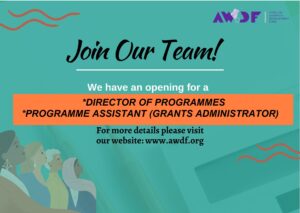
The African Women’s Development Fund (AWDF) is thrilled to announce two exciting opportunities.
Are you ready to be part of a passionate, diverse and dedicated team working to support and strengthen feminist organisations and movements in pursuit of gender justice and social transformation in Africa?
Then join our team as part of these exciting opportunities:
Director of Programmes
About this position
The Director of Programmes at AWDF plays a pivotal role in translating the organisation’s strategic goals into impactful actions supporting African women’s rights and feminist organisations. She/They nurtures these movements’ resilience, knowledge, and voice, fostering solidarity and care among actors by leading the development of programmatic strategies, initiatives, and processes.
Reporting to the Chief Executive Officer, the Director of Programmes oversees a multicultural, multi-disciplinary, partly remote team with the support of three Programme Managers. As a member of the Executive Leadership Team, this position collaborates closely with the CEO, the Director of
Operations, the Director of Partnerships and Philanthropy and the Senior Management Team to provide thought leadership and contribute to management decisions that ultimately build a healthy, accountable, and efficient organisation.
Externally, the Director of Programmes is a key ambassador – establishing and maintaining strong relationships with funding partners, developing strategic alliances with peers in African and international philanthropy, and increasing AWDF’s visibility on a global stage.
Job Location
AWDF House, Accra – Ghana or work remotely from any African country where you have the legal right to work from.
How to apply for this position
Mission Talent is handling recruitment for this role, and further information can be found here: https://mis.tl/AWDF-DP.
To apply for this role, please prepare your CV (in English) and a motivation letter (one page) that summarises how your profile aligns with the key requirements, skills and abilities of this role. Both files should be submitted as Word documents via Mission Talent’s Submit your CV portal.
After submitting your application, you will receive an automated confirmation. If you do not receive this or have general questions about submitting your application, please write to enquiry@missiontalent.com. If you require reasonable accommodation in completing this application, interviewing, completing any pre-employment testing, or otherwise participating in the employee selection process, please contact Mission Talent.
Programme Assistant (Grants Administrator)
About this position
The Programme Assistant-Grants plays a critical role in the grant making function of the organisation and works closely with Programme Staff to manage the grant making process. The job holder will be responsible for the pre-grant review stages of the grant making function.
The Programme Assistant-Grants will provide hands on support to applicants as it relates to the grant application and serve as the key point person for applicant queries. The person will be the key administrator for the grant management system, with oversight from the Grants Manager. The role holder will be responsible for inputting all necessary data into the Grants Information Management system and for mining that system for specific information as requested and approved by the Grants Manager or DoP.
The Programme Assistant also has a role in building and sharing team knowledge on one of AWDF’s thematic areas and contributing to team discussions around ways to engage and grow the grants portfolio and grant support services under this/these themes. The GA will also participate in departmental conceptualisation of projects and reporting to relevant stakeholders.
Duration
The assignment shall be for 6 months from the day of engagement.
Job Location
AWDF House, Accra – Ghana or work remotely from any African country where you have the legal right to work from.
How to apply for this position
Qualified and interested persons should send a cover letter indicating their relevant skills and experience and CV of not more than three pages with application for the position being applied for indicated as the subject line via the following link.
https://awdf.simplicant.com/jobs/47049-programme-assistant-grants-administrator-short-term/detail
Applications for the vacancy should reach AWDF no later than Monday 25th March 2024. Due to limited capacity, only shortlisted candidates will be contacted. for additional information and interviews.
Read more about this position HERE
In line with AWDF’s Mission, qualified African women are encouraged to apply.
#CSW68: Funding feminist movements in French-speaking Africa event, 19 March
#CSW68: Funding feminist movements in French-speaking Africa event, 19 March
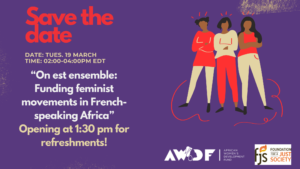 Date: Tuesday 19 March, 2024
Time: 2pm-4pm (EDT)
Join the African Women’s Development Fund (AWDF) and Foundation for a Just Society (FJS) for CSW68 event under the title On est ensemble: Funding feminist movements in French-speaking Africa
This session is part of a deliberate effort by the AWDF to deepen its understanding and support for the challenges and realities faced by movements of women, girls, and gender-diverse people in Francophone Africa/French-speaking Africa while strategising on the response and involvement of feminist funds and the philanthropic sector in advancing gender justice in this region.
During the event, AWDF and FJS will present the outcomes of a joint study on the context, realities, and priorities of these movements in eight Francophone African countries (Burkina Faso, Chad, Ivory Coast, Guinea Conakry, Mali, Mauritania, Niger, and Senegal). The findings of this study will be made available to the general public in 2024 after being presented to activists in the region during the Francophone Feminist Forum in Lomé, Togo, at the end of 2023.
To confirm your attendance, RSVP here.
Read more about the event HERE
We hope to see many of you as we deliberate on fundamental issues that affect African feminists.
Join AWDF events at #CSW68
Join AWDF events at #CSW68

Join us for some impactful conversations at the Commission on the Status of Women.
We’re excited to share our programme with you for the 68th session on the Commission on The Status of Women happening 11 – 22 March 2024.
Just like many of our partners, and friends, we at the African Women’s Development Fund have planned a few sessions and will also join our partners at the CSW 68.
We hope to see many of you in the crowds as we deliberate on fundamental issues that affect African feminists at the heart of AWDF’s work.
Here are the events we have lined up.
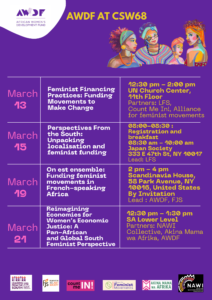
March 13: Feminist Financing Practices: Funding Movements to Make Change
Partners: Leading from the South, Count Me In! Consortium and the Alliance for Feminist Movements
The event addresses the crucial role of autonomous feminist movements in advancing gender equality and human rights across various domains, including economic rights, gender-based violence, reproductive justice, and political participation. Despite their significant impact on policy, institutional strengthening, and social norm changes, feminist movements face chronic underfunding and operate under precarious conditions amidst anti-gender movements and a growing polycrisis. Additionally, feminist activists and organisations are increasingly threatened in hostile political and social environments. To confirm your attendance, RSVP here
March 15: Perspectives From the South: Unpacking localisation and feminist funding
Partners: Leading from the South
Leading from the South (LFS) has been a game-changing partner & funder to feminist & women’s rights organizations and their communities. This side-event will aim to showcase LFS’s unique model of partnership and collaboration with the larger ecosystem of women’s funds, feminist organizations and movements. The conversation will seek to amplify the impact and achievements that have emerged from the Consortium’s work over the last seven years. LFS has been deeply connected to the realities and experiences of communities on the frontlines to advance gender equality and its intersections including climate justice, migration, racial and ethnic justice. To confirm your attendance, RSVP here.
March 19: On est ensemble: Financer les Mouvements Féministes en Afrique Francophone
Partners: AWDF and Foundation for a Just Society (FJS)
This session is part of a deliberate effort by the AWDF to deepen its understanding and support for the challenges and realities faced by movements of women, girls, and gender-diverse people in Francophone Africa/French-speaking Africa while strategising on the response and involvement of feminist funds and the philanthropic sector in advancing gender justice in this region.
During the event, AWDF and FJS will present the outcomes of a joint study on the context, realities, and priorities of these movements in eight Francophone African countries (Burkina Faso, Chad, Ivory Coast, Guinea Conakry, Mali, Mauritania, Niger, and Senegal). The findings of this study will be made available to the general public in 2024 after being presented to activists in the region during the Francophone Feminist Forum in Lomé, Togo, at the end of 2023. To confirm your attendance, RSVP here. Read more about the event here.
March 21: Reimagining Economies for Women’s Economic Justice: A Pan-African and Global South Feminist Perspective
Partners: Akina Mama wa Afrika (AMwA), NAWI Afrifem Macroeconomic Collective, AWDF
During this session, we will seek to emphasize the urgency for economic related gender inequality to be addressed as a macro-critical disparity by applying a feminist analysis to the full range of macro-economic and financial policies – from tax administration to trade negotiations, so that countries, policy makers and development practitioners can assess and avoid the gendered and unjust impacts of such policies. The discussion will therefore foreground the imperative to approach women economic justice as a process that shifts social and political power.
Read more about all the events HERE
Your presence and participation will not only enrich our dialogue but also contribute to shaping resilient and vibrant feminist futures in our regions!
Call for Consultants- Events coordination, Graphic Design and Layout
Call for Consultants- Events coordination, Graphic Design and Layout
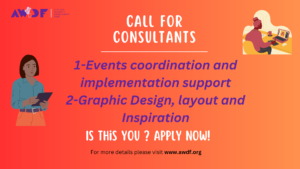
Consultant: Events coordination and implementation support
The African Women’s Development Fund (AWDF) invites suitable candidates to apply for a consultancy position to collaborate with us on Events coordination and implementation support.
The candidate should have:
- Extensive knowledge and experience in events coordination, advocacy and documentation
- Experience of working in or with African women’s rights and feminist organisations and
collectives to host product disseminations, advocacy engagements with a bias in body and
health rights, leadership and participation and economic justice and security. - An understanding of African women’s rights broadly is essential
- Excellent writing skills and proficiency in English essential
- Excellent interpersonal skills and flexible attitude
- Proven ability to work to tight deadlines.
- Commitment to AWDF’s values of feminist leadership, accountability, diversity, respect
and solidarity.
For full details about the opportunity click here
Please submit your CV and cover letter to consultants@awdf.org by March 20, 2024.
Submissions must be received no later than 20 March 2024.
We are also searching for a
Consultant: Graphic Design Layout and Inspiration
The consultant should have:
- Extensive experience designing and laying out organisational documentation, including annual reports, technical reports or similar publications, using professional design software (e.g., InDesign, Illustrator).
- Prepare to provide samples of past similar work
- Knowledge of and working with women’s rights in Africa is essential
- Excellent interpersonal skills and flexible attitude
- Proven ability to work under tight deadlines
- Commitment to the AWDF’s values of feminist leadership, accountability, diversity, respect and solidarity.
For full details about the opportunity click here
Please send your CV and 2 design samples to consultants@awdf.org with the email subject header: Application: Design and Layout
Submissions must be received no later than 20 March 2024.
Meet our panelists for the upcoming International Women’s Day celebration
Meet our panelists for the upcoming International Women’s Day celebration
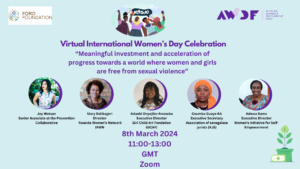
Meet our stellar lineup of panelists for the upcoming virtual convening on International Women’s Day happening under the theme ‘Meaningful investment and acceleration of progress towards a world where women and girls are free from sexual violence’. Read more about our event.
Remember to Register HERE and be part of the event on:
Date: Friday, 8th March 2024
Time: 11:00am (GMT)
Where: Zoom
Celebrating International Women’s Day 2024
Celebrating International Women’s Day 2024
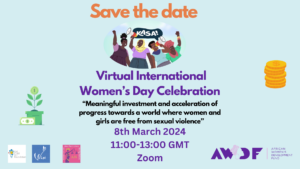
On 8th March, we join the world in commemorating International Women’s Day under the banner Invest in Women: Accelerate Progress. These commemorations come in the backdrop of the Sixty Eighth session of the Commission on the Status of Women.
For the African Women’s Development Fund, this is a time to reflect, celebrate the achievements of women in all their diversities and an opportunity to call for action and investment to accelerate gender equality.
As part of activities to mark the day, AWDF has organised Virtual Partner Convening on ‘Meaningful investment and acceleration of progress towards a world where women and girls are free from sexual violence’. The event will bring together a diverse group of funded and partner organisations working on Sexual Violence.
To be part of the event join us on:
Date: Friday, 8th March 2024
Time: 11:00am (GMT)
Where: Zoom
Register HERE to secure your spot and be a part of this impactful event.
We are thrilled to be joined by the following panelists in the discussion moderated by Nadia Ahidjo, Director of Partnerships and Philanthropy, AWDF.

Bintou Mariam Traoré