
Author: Isatou
Holistic approaches in ending FGM in The Gambia: GAMCOTRAP’s Resilience
Holistic approaches in ending FGM in The Gambia: GAMCOTRAP’s Resilience
In 2025, FGM remains a persistent practice in The Gambia, despite being banned since 2015. The parliamentary debate over the anti-FGM law in 2024 highlighted the ongoing challenges. When a private member’s bill sought to repeal the existing law, 30 out of 65 members of parliament voted to maintain the anti-FGM law in the country.
The Gambia Committee on Traditional Practices Affecting the Health of Women and Children has been at the forefront of combating FGM through a multifaceted approach. Their three-decade-long efforts focus on culturally sensitive strategies that challenge harmful practices while respecting community dynamics. Key initiatives include community-based surveillance, where regional coordinators monitor and prevent FGM cases. In a recent success, five out of eight girls were saved from undergoing FGM in the Central River Region.
Dr. Isatou Touray, Executive Director of GAMCOTRAP powerfully states, “The fight against FGM is not just the responsibility of women, it requires the collective effort of all stakeholders, including men, policymakers, traditional leaders, and the global community.” The organisation employs comprehensive strategies such as engaging traditional and religious leaders, empowering youth and men as allies, and providing alternative employment for ex-circumcisers. Their work extends beyond immediate intervention to systemic change through policy advocacy and rights education
Key Learnings and Insights
A key lesson for GAMCOTRAP in their efforts to end the persistence of FGM in Gambia is that sustainable change requires holistic community involvement. When women and girls understand their rights and the risks associated with FGM, they become powerful agents of change. The approach combines legal frameworks, social mobilization, and economic empowerment to create lasting impact.
Notably, the fight against FGM is no longer seen as solely a women’s issue. Men, youth, and community leaders are increasingly recognised as crucial allies in challenging harmful traditions while respecting cultural values.
Support Needed to Accelerate Change
To accelerate FGM elimination, a coordinated approach is essential. This includes:
- Systematic engagement of community structures
- Survivor-led programs challenging gender norms
- Increased funding for grassroots organizations
- Sustainable financial support for prevention programs
***
The contents of this article are from GAMCOTRAP, an AWDF grantee partner in The Gambia, supported under the Komboa Initiative
AWDF Leaders Recognized Among Avance Media’s 100 Most Influential African Women 2024
AWDF Leaders Recognized Among Avance Media’s 100 Most Influential African Women 2024
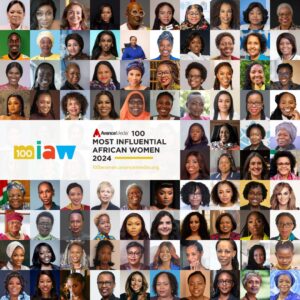
Two AWDF trailblazing leaders, Francoise Moudouthe, our CEO, and Taaka Awori, our Board Chair and CEO of Busara Africa, have been named among Avance Media’s 100 most influential African women 2024, marking a significant milestone in the recognition of female leadership on the continent. Their inclusion highlights a broader shift in Africa’s development landscape, where women are taking center stage in driving sustainable change. Both leaders have demonstrated exceptional vision in advancing gender justice and social transformation across the continent, implementing innovative solutions to long-standing challenges.
You can find more information on the incredible nominees ➡️ https://lnkd.in/du9H9aB
This recognition not only celebrates individual achievement but also underscores the growing impact of female leadership in shaping Africa’s future. We join in celebrating all remarkable individuals who made this year’s list, each contributing to the continent’s progressive transformation.
Join our Team: We are hiring a new Operations Officer
Join our Team: We are hiring a new Operations Officer
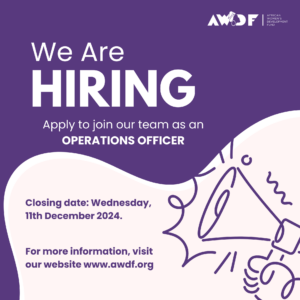
Are you a dynamic individual with experience in Salesforce administration and interested in supporting the redesign and maintenance of other technology improvements, planning, communication, testing and troubleshooting, documentation and training? Are you excited about supporting the project management initiatives including organisational planning processes and coordination as the administrator of the Project Management Tool (Asana)? Are you keen to contribute to organisation-wide project management through the project management tool, tracking and collaborating across the organisation to ensure AWDF delivers on its commitments both internally and externally? We would like you to join our team!
The Operations Officer will work in close collaboration across the organisation with programmes and operations teams to support AWDF’s grant application and donor management information and process flow, to continually improve and enhance our Salesforce platform as an integrated system, gathering requirements and feedback, designing scalable best practice and integrated solutions, and managing the product road map with the support of external consultants. AWDF’s Salesforce user experience is of great importance to the organisation, therefore the Operations Officer should be committed to and enjoy all aspects of user management including training, and designing solutions with user satisfaction as a priority. The Officer also supports the project management initiatives including organisational planning processes and coordination as the administrator of the Project Management Tool (Asana). The Officer reports to the DoO and DoP and her/their role is crosscutting between Programmes and Operations.
To apply check out more information here
Submit your applications by Wednesday, 11th December 2024. Due to our limited capacity, only short-listed candidates will be contacted for additional information and interviews.
Leaning into Revolutionary Hope: Reimagining a world beyond violence and injustice.
Leaning into Revolutionary Hope: Reimagining a world beyond violence and injustice.
By Jodi Williams
Revolutionary hope has a longstanding history in African Feminist movements. A political practice that presents us with alternative possibilities to not become dismayed or desensitised by pervasive injustice, mass suffering and continued cycles of violence. African Feminists have long understood revolutionary hope to be an incredibly radical and transformative political principle that is strongly rooted in our deep love for justice, equity and collective liberation.
Revolutionary hope helps us visualise a future where African women, girls and Queer communities are free, safe, self-reliant and lay full claim on our land, bodies, knowledge, and autonomy. Revolutionary hope is a life-sustaining force and spiritual practice that anchors our movements as we challenge systemic oppression and create new possibilities for justice, dignity and freedom.
It is within this context that 16 Days of Activism Against Gender-Based Violence can simply not just be a calendar event. Rather, it is a call to action for fierce resistance against systems of patriarchy, imperialism and exploitation that continue to perpetuate violence against women, girls and Queer communities in Africa.
For African Feminists, 16 days forms part of a much larger ongoing struggle for collective liberation. This year’s theme “No Excuse – Unite to End Violence Against Women” serves as a clarion call to pause, reflect, gain clarity on politics and renew our commitment in the fight for justice. A much needed reminder to lean into revolutionary hope to reimagine and build a world free from violence and injustice.
As mentioned by Rosebell Kagumire in The Makings of Revolutionary Hope, How does one hope when genocide, ethnic cleansing, divide and decimate is the order of the day? How does one hope when the system constantly tests one’s humanity? These questions ring true, especially in Africa, where we see several crises unfolding around us coupled with the widespread normalisation of suffering of African peoples under dehumanising systems of brutality.
Gender-based violence (GBV) is deeply woven into our social fabric and reinforced by systems of power and control that we have inherited from our violent colonial past. The violence we see – whether physical, sexual, psychological, economic and cultural – is a direct consequence of a world order that devalues the lives, safety and inherent humanity of women, girls and queer communities, particularly black and brown marginalised communities.
African feminists understand gender-based violence (GBV) to be an intersecting issue that stretches across cultural, political, and economic structures. A system that normalises sexual violence as a tool of terror and dehumanisation (like in the case of rape being used as a weapon of war in the Democratic Republic of the Congo). A system that denies women, children, and gender-diverse populations their bodily autonomy by normalising destructive practices including child marriage, forced marriages, and genital mutilation. A system of interconnected oppressive structures that African feminists seek to dismantle.
To trace the footprints of revolutionary hope in African Feminist Movements is to encounter many powerful examples of feminists who have remained steadfast in their pursuit of freedom. One such example from my own history is that of the homecoming of Sarah Baartman. Sarah Baartman was a Khoikhoi woman who was enslaved and taken from South Africa in the early 1800s to be exhibited in “human zoos” in Europe. Sarah was objectified and gawked at in inhumane and dehumanising ways. When she died, her remains were displayed in a Paris museum until 1985.
In 2002, after years of advocacy by African Feminists, Sarah Baartman’s remains were returned to South Africa and laid to rest in accordance with traditional customs. Sarah Baartman’s posthumous homecoming to a post-Apartheid society stands as a symbol of the struggle against racism, colonialism and gender-based violence across the continent. A reminder that there is hope that you will achieve a certain degree of progress – even if it is after death.
To trace the footprints of revolutionary hope is to encounter many present-day examples of feminists who are at the forefront of challenging deeply ingrained patriarchal violence. The feminists that dare to dream. The feminists that remind us that tasting liberation is possible. The feminists that anchor us in the belief that future generations will reap the fruits of the work we do now.
Revolutionary hope helps to fuel the flames of justice in our movements. It’s natural to feel overwhelmed by the persistent injustice and violence that surrounds us – that’s exactly what the system intends. But what if, in the face of it all, we lean into community, deepen our solidarity across struggles and lines of privilege, build mutual aid and build collective power? Because a world free from violence and injustice is possible. It is revolutionary hope that reminds us of that.
Freedom is possible. Dismantling systems of oppression and violence is possible. Revolutionary hope is not passive or docile; it is vigorous, it is powerful, it is embodied and moreover, it is strongly rooted in collective resistance and solidarity.
Written by: Jodi Williams, Knowledge and Voice Specialist|Nurturing and Community Cluster at the African Women’s Development Fund
AWDF’s #VoicePowerSoul: African Feminist Narratives Festival – A Celebration of Creativity and Knowledge
AWDF’s #VoicePowerSoul: African Feminist Narratives Festival – A Celebration of Creativity and Knowledge
Recently, AWDF held a Voice, Power and Soul festival in Accra, Ghana, which showcased the power and diversity of African feminist voices. This event brought together artists, thinkers, and changemakers to challenge the erasure of African feminist narratives.
At its core, the festival celebrated indigenous ways of knowing, being, and creating as integral parts of liberatory praxis. It boldly challenged the erasure of African feminist narratives, placing storytelling, indigenous knowledge, memory, and lived experiences at the forefront of feminist discourse.
This transformative journey served as a powerful reminder of the strength and resilience of African feminist voices. It highlighted their crucial role in shaping our collective future and driving positive change across the continent. This event speaks to our strategic priorities geared to shape and amplify positive narratives of African women and African feminism.
Read the magazine here and watch the video highlight of the festival below.