
Author: Isatou
AWDF Announcement: CEO Transition and Interim Leadership Appointment
AWDF Announcement: CEO Transition and Interim Leadership Appointment
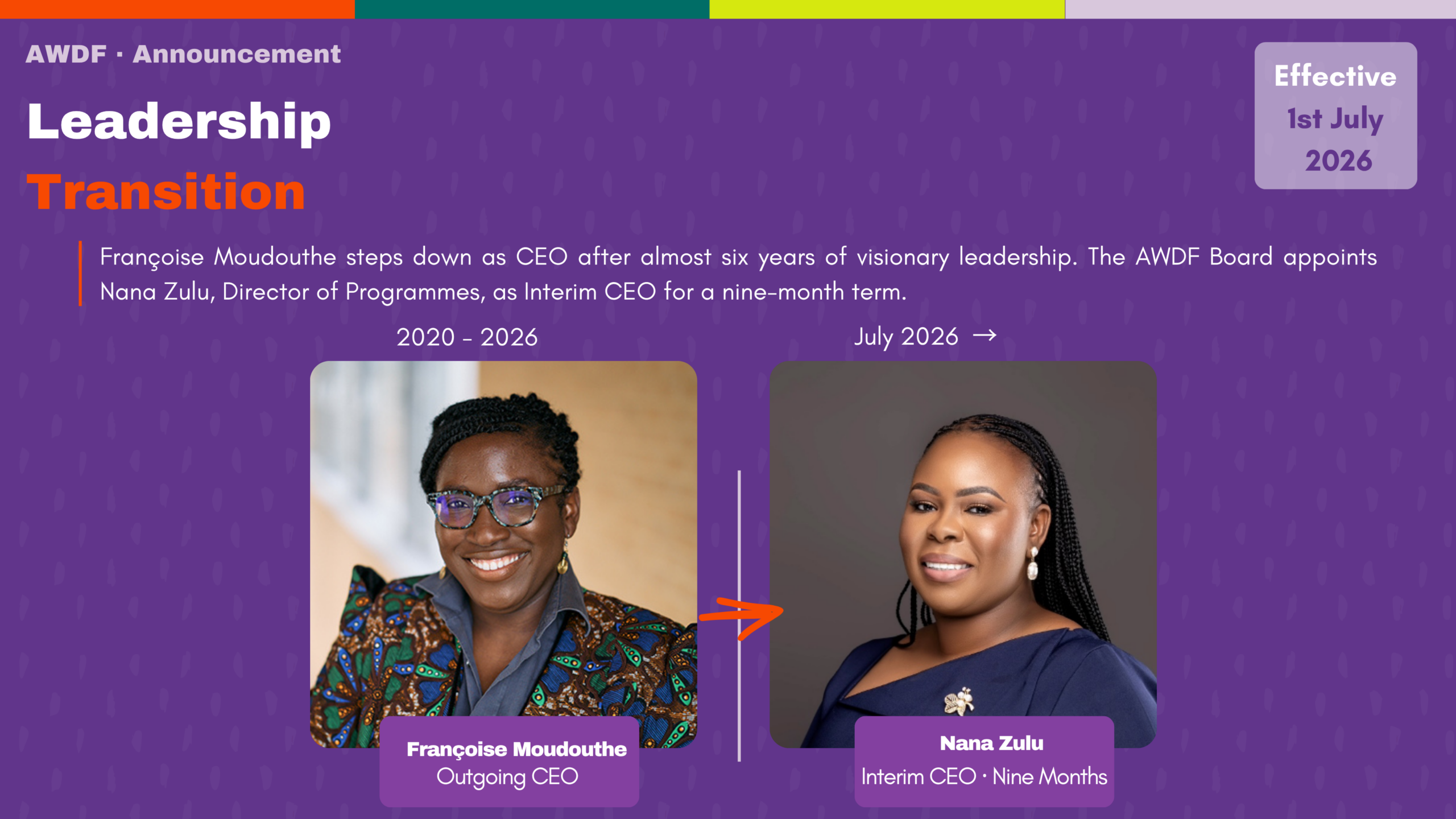
After nearly six years at the helm of the African Women’s Development Fund (AWDF), Chief Executive Officer Françoise Moudouthe has decided to step down from her role, with her final day being 30 June 2026, to pursue a new professional opportunity.
Reflecting on her decision, Françoise shared:
“Serving as CEO of AWDF has been one of the greatest privileges of my life. I am deeply grateful to have been entrusted with building on AWDF’s extraordinary vision, impact, and legacy, and proud of what we have advanced together with focus and integrity. At a time that calls for clarity of purpose, I have chosen to focus my contribution to gender justice on girls’ rights, an area that remains critically overlooked and underfunded.”
To ensure a smooth transition, the AWDF Board of Directors has appointed Nana Zulu, currently Director of Programmes, as Interim CEO for a nine-month term (effective 1 July 2026), during which a new CEO will be recruited. Nana has been instrumental in shaping AWDF’s context-responsive programmatic strategy and brings a clear vision, strong leadership, and deep commitment to the organisation’s mission and values.
Nana shared:
“I am honoured to step into the role of Interim CEO at this pivotal moment. We remain focused on meeting the demands of this moment: resourcing feminist movements, defending the rights of women, girls and gender-diverse people, challenging oppressive power structures, and shaping the feminist futures that African feminists envision. I look forward to working closely with the Board, our team, and most importantly, our partners to carry this work forward with clarity, accountability and courage.”
AWDF enters this transition from a position of strength. The organisation has a clear strategic direction, a capable and committed team, strong relationships with African feminist movements, and the continued trust of its funding partners.
Board Chair Jean-Ann Ndow added:
“The Board thanks Françoise for her visionary leadership and her fearless advocacy in favour of African women’s rights and feminist movements. Her commitment to listening to those at the forefront of injustice made AWDF stronger, and the way she centred care in her work was deeply felt by the team and Board. We wish her well as she moves to the next chapter in her journey. Looking forward, AWDF remain steadfast in its mandate, and the Board has full confidence in Nana’s ability to lead AWDF through this transition and deepen our impact.
With the guidance of the Board and the support of the team, Françoise and Nana will work closely together over the coming months to ensure a structured and thoughtful handover. Further updates will be shared with our partners and allies as the transition progresses.
KASA! Close out Forum: An Account of five years of partner-led work to End Sexual Violence in West Africa
KASA! Close out Forum: An Account of five years of partner-led work to End Sexual Violence in West Africa
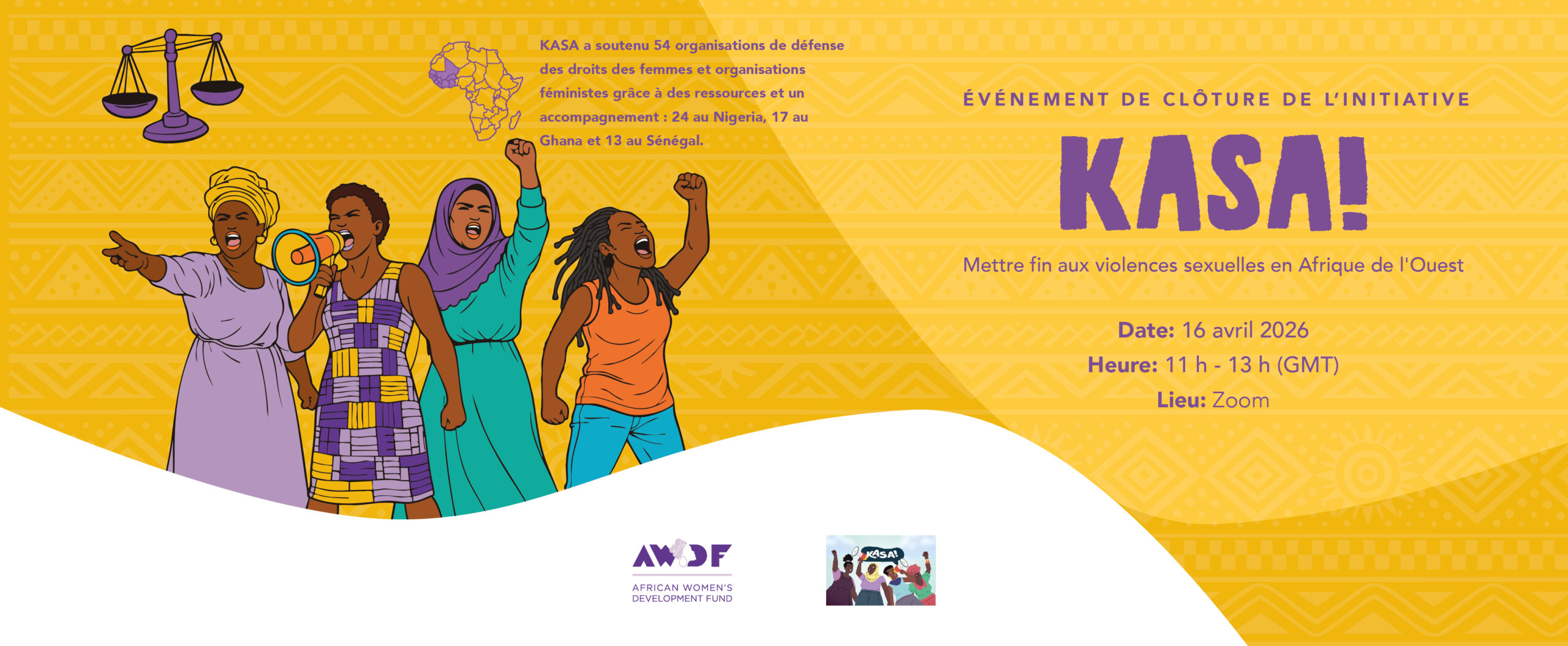
In 2021, the African Women’s Development Fund (AWDF), Ford Foundation West Africa, and Open Society West Africa (OSIWA) came together with a shared conviction: that addressing sexual violence in West Africa required more than emergency response. It required a coordinated, feminist, long-term effort to uproot the conditions that make such violence possible. That conviction became the Kasa! Initiative, a five-year joint programme designed to support women’s rights and feminist organisations on the frontlines of this work across Nigeria, Ghana, and Senegal.
The initiative was built on the understanding that sexual violence is both a cause and a consequence of gender inequality. Kasa! worked across multiple levels simultaneously, legal and policy systems, community awareness, emergency infrastructure, and the cultural narratives that normalise and enable abuse. Rather than operating through a single implementing partner, Kasa! chose to invest directly in the ecosystem: funding, accompanying, and strengthening 54 women’s rights and feminist organisations working closest to the communities most affected.
As the Kasa! Initiative draws to a close, we are convening a close-out forum, an opportunity to come together, review what was learned, and honour the work of the organisations and communities who made this initiative what it was.
The forum will present findings from the Kasa! Evaluation, offer a space for partner reflections, and explore the strategies, contexts, and approaches that shaped the initiative’s impact. It is a moment to learn, to share, and to ask: what does this body of work teach us about building feminist movements that last?
We invite partners, feminists, academics, policymakers, and social justice actors to register and join the conversation.
Make your voice count: Take part in this global survey to reimagine the African Feminist Charter. Submit by 5 April 2026.
Make your voice count: Take part in this global survey to reimagine the African Feminist Charter. Submit by 5 April 2026.
For nearly two decades, the African Feminist Charter has served as a vital political framework for feminist movements across the continent. Adopted in 2006, it gave African feminists a shared resource and political framework to identify, build solidarity, and collective struggle.
Twenty years later, the challenges facing African feminists in 2026 are rapidly evolving. Anti-rights attacks, democratic and economic crises, increased insecurity, and overlapping social crises have reshaped our realities in profound ways. Our Charter must reflect that.
As we gear up for the African Feminist Forum 2026 in Windhoek, Namibia, we have launched a continent-wide process to review the achievements and gaps in utilising the Charter. And to enable feminists to collectively reimagine the Charter in the context of the current and future realities of feminist organising. This is a participatory, community-driven process to ensure this foundational political framework speaks to who we are and what we face today.
This process belongs to all of us. We are calling on African feminists in all our diversities, across countries, languages, generations, identities, and lived experiences, to contribute to this reimagination.
The survey is available in English, French, Portuguese and Arabic. Please complete it in whichever language you are most comfortable with. Your responses will directly inform the revised Charter and help ensure it reflects the full breadth of African feminist experience.
Access the survey here. Submit by 5 April 2026
Your insights will directly inform a Charter that represents all of us.
The African Feminist Forum 2026: Announcing Call for Applications and Change of Dates
The African Feminist Forum 2026: Announcing Call for Applications and Change of Dates
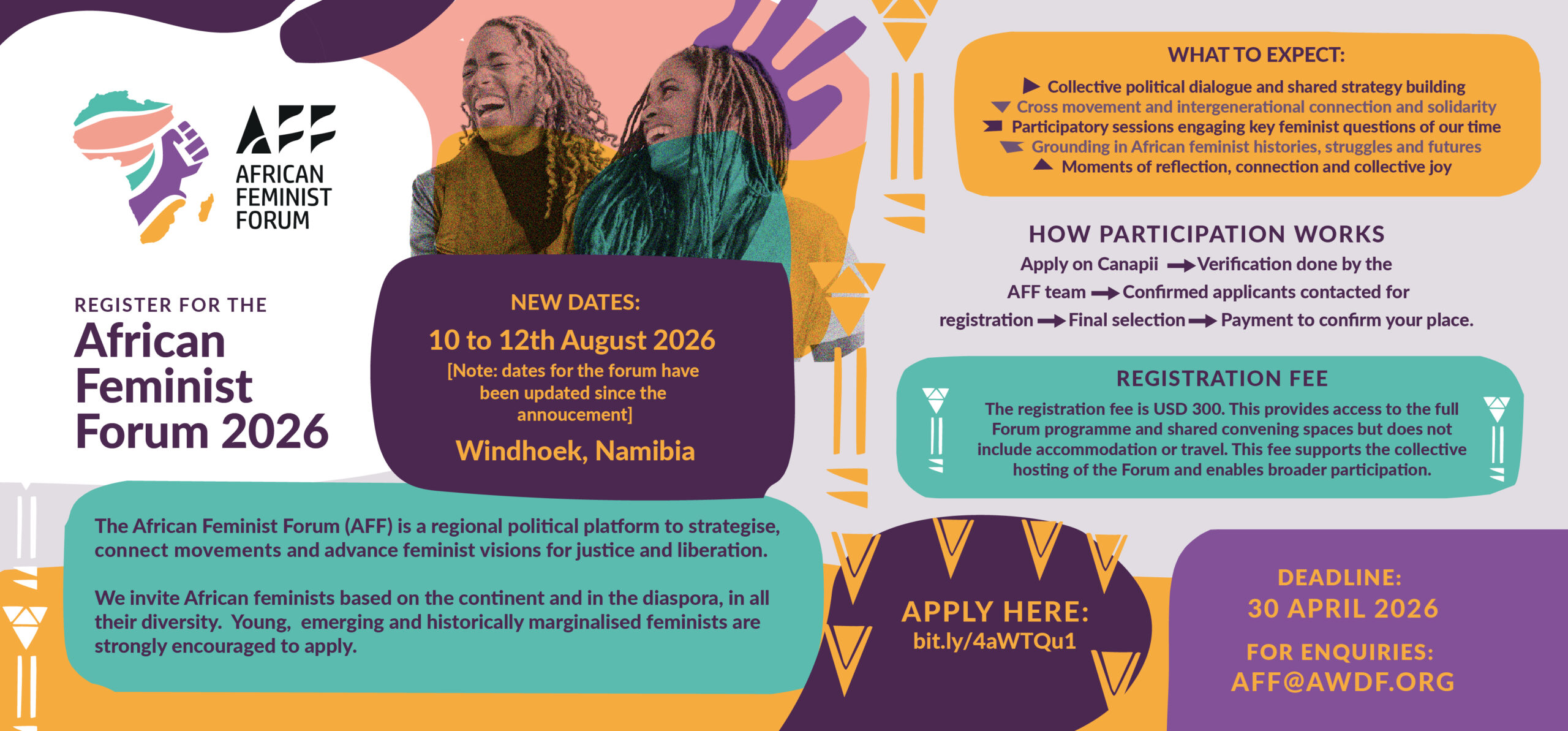
AFF is a regional political platform that brings together African feminists from the continent and the diaspora to strategise, connect movements, and advance feminist visions for justice and liberation. The forum’s registration is now open and we are calling on African feminists organising in Africa and the diaspora to participate. The registration fee is USD 300. This provides access to the full Forum programme and shared convening spaces but does not include accommodation or travel. The contribution supports the collective hosting of the Forum and enables broader participation.
Following the encouraging response to the Forum announcement, the dates have been updated to allow us to better prepare and welcome participants into a thoughtful and well held space. We appreciate your flexibility and apologise for the inconvenience caused. The African Feminist Forum will now take place from 10 to 12 August 2026 in Windhoek, Namibia.
To hold a politically grounded and collectively safe space, participation follows an application and verification process grounded in shared feminist values.
Who can apply:
The African Feminist Forum is open to and invites African feminists in Africa and the diaspora in all their diversities. Feminists are expected to apply in individual capacity and not as affiliates/partners of a feminist/gender justice organisation. This ensures that we guard against institutional agenda-setting or the professionalisation of feminist agendas and encourages bottom-up movement-building as a political strategy to inspire collective action.
You do not need to have attended a previous AFF or hold a formal organisational role. Young, emerging and frontline feminists, including those identifying as LBTQI+ and Indigenous, are strongly encouraged to apply.
How to apply:
To commence an application to attend AFF 2026, submit your application through a form on Canapii. Your submission will be reviewed and a response provided within two weeks of submission. Submitting an application does not guarantee participation, and all participants, including sponsored participants, will be subjected to the same review process.
Following the assessment process, selected applicants will receive registration instructions, payment details and will sign a feminist undertaking and code of conduct.
A Well-Earned Farewell: Beatrice Boakye-Yiadom Retires After Almost Two Decades at AWDF
A Well-Earned Farewell: Beatrice Boakye-Yiadom Retires After Almost Two Decades at AWDF
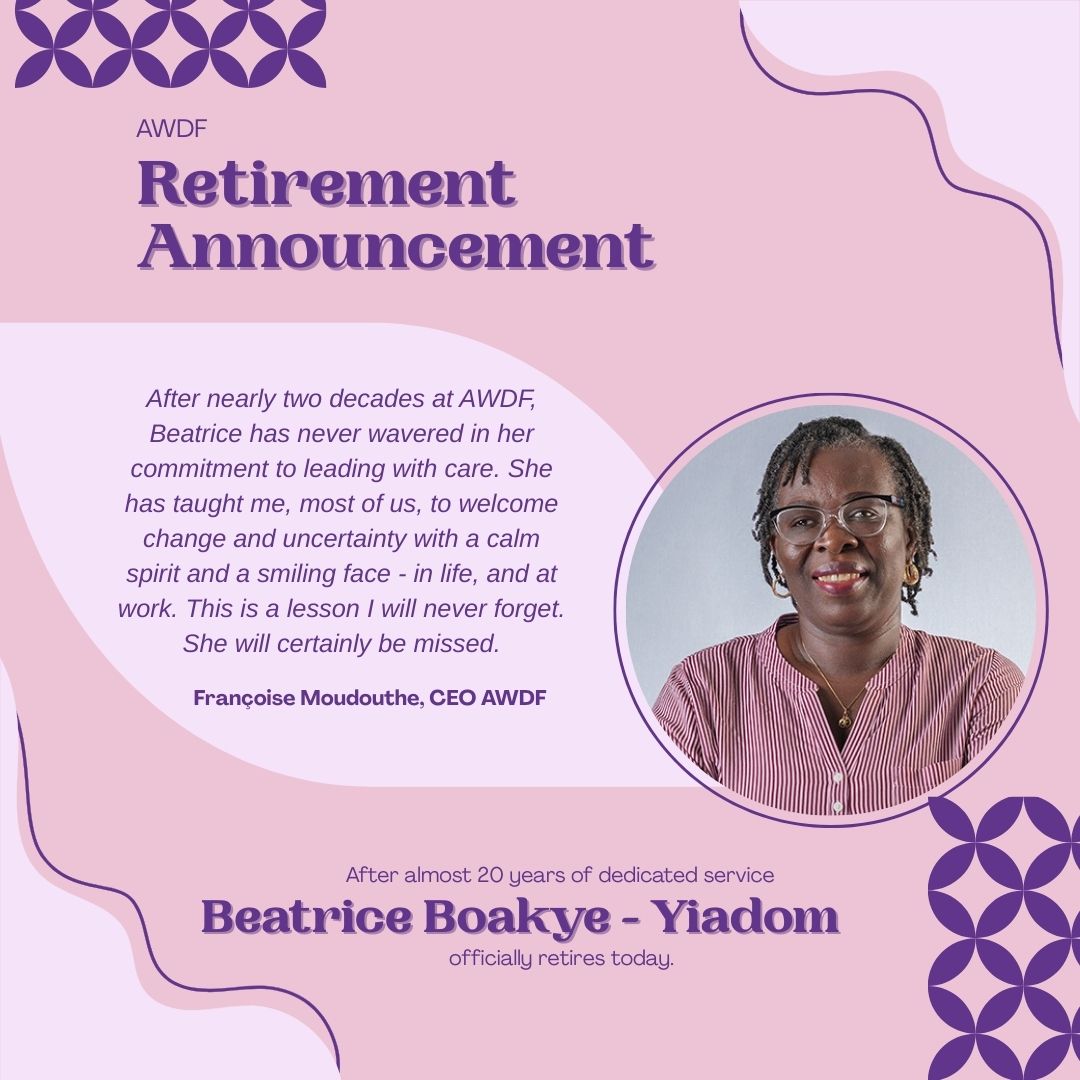
After almost 20years of dedicated service, Beatrice Boakye-Yiadom, our Programmes Manager-Resourcing Movements, retires today. Throughout her time at the African Women’s Development Fund (AWDF), Beatrice has played an integral role in shaping and delivering our grantmaking initiatives, building strong relationships with partners like you and advancing our mission to resource, strengthen and uphold women’s rights organisations and feminist movements across Africa. Her passion, leadership and commitment have left a lasting impact on our work and the feminist movements that we serve.
While we will greatly miss Beatrice’s presence on our team, we are excited to celebrate this new chapter in her life and express our deep gratitude for her legacy, which will continue to live on in the work we do and in the strong relationships she has nurtured with our partners, donors and other feminist actors.
“Looking back, the Programme Manager role at AWDF has been far more than a job for me; it has been a vocation and a place of deep purpose. AWDF has shaped my professional life, my values, and my understanding of what feminist resourcing can achieve when it is grounded in trust, solidarity, and accountability to African women and girls.”
Beatrice Boakye Yiadom
While we will greatly miss Beatrice’s presence on our team, we are excited to celebrate this new chapter in her life and express our deep gratitude for her legacy, which will continue to live on in the work we do and in the strong relationships she has nurtured with our partners, donors and other feminist actors.
“After nearly two decades at AWDF, Beatrice has never wavered in her commitment to leading with care. She has taught me, most of us, to welcome change and uncertainty with a calm spirit and a smiling face – in life, and at work. This is a lesson I will never forget. She will certainly be missed.”
Françoise Moudouthe, CEO AWDF
We wish Beatrice the very best and we look forward to celebrating whatever new passions and interests she will be pursuing. We will be reaching out to many of you to gather your thoughts, memories and well wishes for Beatrice, which will be compiled into a special send-off to honour her incredible journey with us.
During this transition period, Lana Razafimanantsoa will provide interim leadership for the Program Manager, Resourcing role. She can be reached at Lana@awdf.org. We welcome any questions or conversations you would like to have regarding this transition. Please do not hesitate to reach out to our Director of Programmes, Nana Zulu, at nanazulu@awdf.org
International Day of Zero Tolerance Against FGM: The Gambia is at the Brink of Another Anti-FGM Repeal Threat
International Day of Zero Tolerance Against FGM: The Gambia is at the Brink of Another Anti-FGM Repeal Threat
Today, 6th February, the world over pauses to commemorate International Day of Zero Tolerance for Female Genital Mutilation (FGM) and affirm one absolute principle: FGM is a harmful cultural practice unacceptable everywhere.
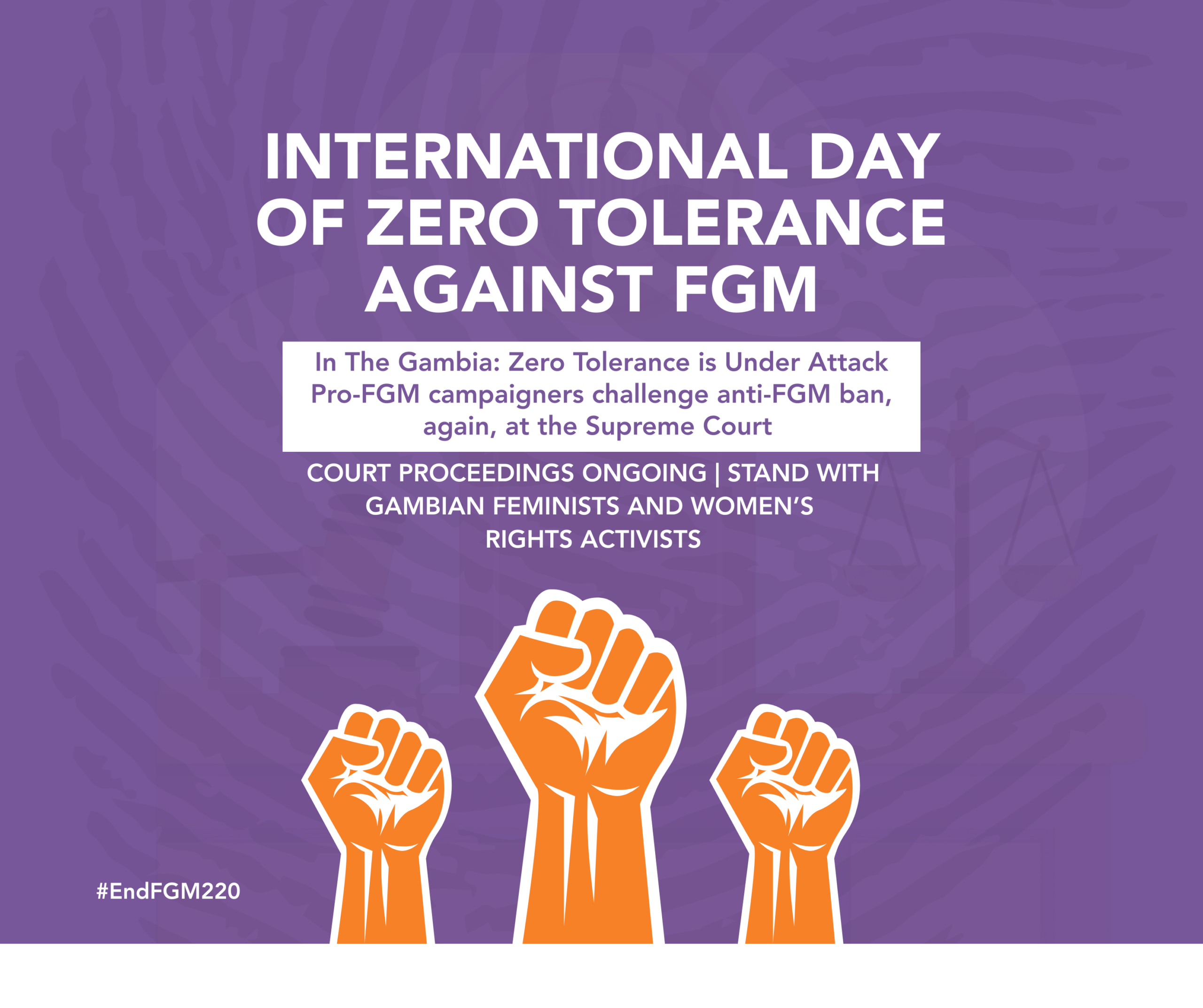 Yet, as global attention turns to ending the practice, apivotal battle is unfolding in The Gambia, where the Supreme Court is hearing arguments that could reverse the country’s 2015 ban on FGM and strip women and girls of their legal protection from FGM.The urgency of this moment is underscored by recent reports of the death of two babies after undergoing FGM in Banjul and Basse after undergoing FGM. These deaths reveal the stark and immediate cost of FGM’s continuance, particularly on girls.
Understanding the origins of this backlash in The Gambia is crucial. FGM has been a historic practice in The Gambia and most countries in Africa. It reportedly continued even after the ban in 2015, its persistence contested by feminists, women’s rights activists and survivors. However, its persistence has been contested by feminists, women’s rights activists and survivors. In August 2023, The Gambia made progress, three women were convicted for subjecting eight infant girls to FGM, the first prosecution since criminalisation in 2015. For feminists, survivors, and women’s rights defenders, this moment confirmed that decades of advocacy had translated into real accountability.
Almost immediately, an organised backlash emerged. Pro-FGM religious leaders paid the fines imposed on those convicted and launched public campaigns framing the ban as foreign-imposed, uncultural, and unislamic. The Supreme Islamic Council issued a fatwa claiming FGM is religiously required.
In 2024, a National Assembly Member introduced legislation to repeal the ban entirely, framing it as defending “religious norms” and threatening other protective laws, including child marriage prohibitions. Although Parliament upheld the ban following intensive advocacy, pro-FGM campaigners have advanced their challenge to the judiciary, arguing that criminalising FGM violates constitutional rights to religious and cultural freedom in The Gambia.
The scale and severity of FGM is stark. According to the 2019-2020 Gambia Demographic and Health Survey, approximately 73% of women aged 15-49 have undergone FGM, the overwhelming majority before the age of five. Crucially:
- 73% of affected women underwent procedures involving cutting and removal of flesh (WHO Type II).
- 17% were subjected to more severe forms involving stitching or narrowing of the vaginal opening (Type III).
- Nearly all women and girls affected live with the most invasive and harmful forms of FGM.
FGM in The Gambia is not only a social norm, it is actively defended and rationalised, making the legal protection of girls all the more essential.
What is at Stake in the Supreme Court
If The Gambia’s Supreme Court reverses the ban, the consequences will be immediate and far-reaching:
For girls: Legal protection vanishes. FGM becomes legitimised as a “religious and cultural right” rather than recognised as the harmful practice it is. Girls lose the one safeguard that could prevent them from being subjected to the practice.
For the state: Prosecutorial power disappears, law enforcement loses the ability to prevent, investigate, and prosecute FGM.
For other protections: Child marriage laws and other safeguards become vulnerable to similar “religious and cultural freedom” challenges. If patriarchal control can successfully cloak itself in religious language to override bodily autonomy here, it will be attempted everywhere.
For the region: This sets a dangerous precedent across Africa, undermines international standards, and emboldens anti-rights movements continent-wide. This could call to task similar contentions and challenges across national and regional protective treaties and laws.
An Observed Pattern We Cannot Ignore
Whilst The Gambia’s FGM crisis is urgent and specific, it reflects a broader, coordinated anti-rights backlash unfolding across the continent. We are witnessing systematic rollbacks: abortion access restricted and challenged LGBTQI+ rights criminalised, domestic violence protections undermined, women’s political participation resisted.
The playbook is consistent, frame women’s rights as “foreign imposed ideals”, mobilise religious authority, claim that protecting girls violates freedoms, then litigate whilst harm continues.
On this International Day of Zero Tolerance for Female Genital Mutilation, Gambian feminists and women’s rights advocates are on the frontlines of this fight, and they need sustained solidarity:
- Flexible, long-term funding for legal defence, survivor services, and sustained organising
- Amplification with Gambian feminist experiences and expertise centred
- Accountability from governments and international bodies to uphold regional standards
- Long-term commitment that recognises this as ongoing resistance
When feminists in The Gambia fight for bodily autonomy, they fight for all of us. AWDF stands with Gambian feminists and women’s rights advocates defending the law. We call for sustained, resource-backed international solidarity, not just today, but in the long-term commitment that movement work requires.
KASA: Empowering communities to speak against Sexual Violence
KASA: Empowering communities to speak against Sexual Violence
In a small fishing community nestled in rural Accra, four-year-old Adoley was once the embodiment of innocence, her voice echoing through the compound house as she sang rhymes and called on other children to play. Her mother, Naa Kwarley, sold smoked fish from the front of their home, making a modest living to support her only daughter. Life was not easy, but it was full of warmth and hope. That hope was violently shattered one sunny afternoon.
Adoley, full of her usual cheer, knocked on the door of a neighbour, Nii Otublohu, hoping to gather his children for their usual playtime. Otublohu, a 42-year-old fisherman, had just returned from sea. In the silence of the house, he lured Adoley into his room with the promise of cartoons, locked the door behind her, and committed an unspeakable act of defilement. When Adoley stumbled toward her mother, blood trailing down her leg, Naa Kwarley’s world collapsed. Overwhelmed by fear and rage, Naa Kwarley reported the incident to the local police. The case was quickly transferred to the Domestic Violence and Victim Support Unit (DOVVSU), a specialized wing of the Ghana Police Service. Recognizing the urgency and trauma involved, DOVVSU referred Adoley and her mother to The Women’s Initiative for Self-Empowerment (WISE), a frontline grantee of the KASA initiative. While the perpetrator fled to sea in an attempt to escape justice, the police worked diligently and apprehended him upon his return.
Today, he is serving a 25-year prison sentence. But the real story of transformation was only beginning. WISE swiftly facilitated access to medical care and began therapeutic interventions through a clinical psychologist. Beyond immediate care, they laid the foundation for long-term healing, emotionally, socially, and economically. For Naa Kwarley, whose livelihood was disrupted, WISE extended financial support to stabilize her business and for little Adoley, the process of reclaiming childhood began with counselling, play therapy, and community protection measures.This is what the KASA Initiative is designed to do: respond, restore, and rebuild lives fractured by sexual violence. “You know the pain never leaves,” says Ms. Adwoa Bame, the Executive Director at WISE.
Under the KASA initiative, meaning “speak” in Twi, survivors are not merely recipients of aid; they are catalysts of change. In safe, inclusive spaces, girls and women are taught to recognize abuse, assert their rights, and support others, some even return as peer advocates, speaking boldly in communities once mired in silence and shame. She recounts that in places like Dome Kwabenya, Oshie, Bortianor, and notably Tifa, WISE has helped turn the tide on deeply entrenched norms. “When we first entered Tifa, the community often shielded perpetrators and blamed victims,” says Adwoa. “Today, those same leaders are referring cases to the police instead of resolving them privately.”
For Miss Bame this transformation didn’t happen by chance, WISE recognized the need to include traditional and religious leaders, not as obstacles, but as allies. She says community entry meetings evolved into co-created solutions as time went by. Crisis Response Teams, trained by WISE, now serve as first responders before cases reach police or NGOs. These teams are embedded within the very fabric of the community, making interventions more sustainable and trusted. According to Miss Bame , the success of the KASA initiative lies not only in its reach but in its approach. Rather than imposing external frameworks, WISE adapts its methodology to suit each community’s social and cultural context. “We work with the chief and with what exists—local languages, beliefs, and power structures and involve them to disrupt harmful practices from within,” Ms Bame says.
In addition to immediate support, WISE addresses root causes like economic hardship, gender inequality, and lack of education. By supporting survivors’ families and reintegrating girls into school, the cycle of vulnerability is actively broken. The Executive Director says WISE does not act alone; through partnerships with schools, health facilities, the Ghana Police Service, and local NGOs, a multi-sectoral response is being built. “Each partner brings unique expertise, ensuring that survivors like Adoley are protected, healed, and empowered from multiple angles,” she said. With support from the African Women’s Development Fund (AWDF) under the KASA! Ending Sexual Violence in West Africa program, WISE has become a model for how grassroots activism, backed by sustainable funding and strong networks, can shift not just individual lives but entire social structures.
Under the KASA initiative, WISE is investing in capacity-building within communities, training local teams, involving survivors in leadership roles, documenting best practices and ensuring that communities take ownership of the project with its responsibility. “As funding cycles shift, these structures will remain, girls will still speak up, leaders will still act and communities will still protect,” Miss Bame says. Despite global commitments like the Sustainable Development Goal 5.2, which calls for an end to all forms of violence against women and girls, a report by the Ghana Statistical Service reveals that 30 per cent of Ghanaian women have experienced sexual violence.
Sexual violence is not a moment but a culture which can be changed.
***
This is a commissioned feature story by Linda Naa Deide Aryeetey, a Journalist based in Ghana.
Combatting Sexual Violence in Ghana: A snapshot of the work of WiLDAF Ghana
Combatting Sexual Violence in Ghana: A snapshot of the work of WiLDAF Ghana
In one of the rural communities in the Ga-West district of Amasaman in Accra, Ghana, a teenage girl Naa* was empowered to use her voice, and reported to her teachers that her father had been sexually abusing her, after her mother had passed away. He had lied to her that it was normal for fathers to have sexual relations with their daughters when their mother was not around. She had lived with this belief till her exposure to new information after joining a WiLDAF school club against sexual violence.
In another rural community was the pervasive belief, due to low-income households and general poverty, that if a girl does not have sex before twenty, she will have some type of cognitive challenge. In low income and rural communities, the imposed 32.5% total tax on sanitary pads as luxury items has a snowball effect on the prevalence of sexual violence. Young girls fall prey to sexual predators with the promises of financial support to buy pads.
Sexual violence, evidently prevalent in Ghanaian society is a key issue for feminist and women’s rights organisations. To address it, requires speaking up about the causes, and building systemic and sustained socio-cultural change, as well as challenging patriarchal norms and replacing them with stronger voices around positive norms. The African Women’s Development Fund Kasa! Initiative aims to do just this. Geared towards addressing and reducing sexual violence and its roots in West Africa, ‘Kasa’ means to ‘speak out’, this initiative encourages the strengthening of the voices of women and girls against sexual violence by partnering with local organisations and supporting their work under sexual violence. One of such organisations is Women in Law & Development in Africa (WiLDAF) Ghana.
WiLDAF is a pioneering organisation in women’s rights on the continent in general, and in Ghana, in particular. A legacy from the formation of the United Nations, WILDAF became one of the first women’s rights organisations formed on the continent to champion human rights and protections for African women and girls, sexual violence a major theme tackled under this purview. WiLDAF’s Girl Empowerment Programme supported by the KASA initiative is dedicated to empowering young girls to fight against sexual violence. This work involves challenging limiting and false cultural beliefs, addressing issues of lack of access to resources and financial support, and encouraging girls to focus on their education for their economic empowerment.
Going back to the history of the issue, 2007 was a landmark victory for women’s rights when the government passed the Domestic Violence Act which women’s rights activists had been advocating for. This act defined Domestic Violence to include physical, sexual, emotional, psychological, and economic abuse within domestic settings. One challenge with the implementation of this Act was in awareness and reporting, especially in rural areas where many individuals were unaware that certain behaviours constitute domestic violence, leading to underreporting.
In work that continues today under the Kasa! Initiative, WILDAF took this on – going to rural communities to sensitise them on the issues, establish agents of community change, and provide pro bono lawyers to take up cases.
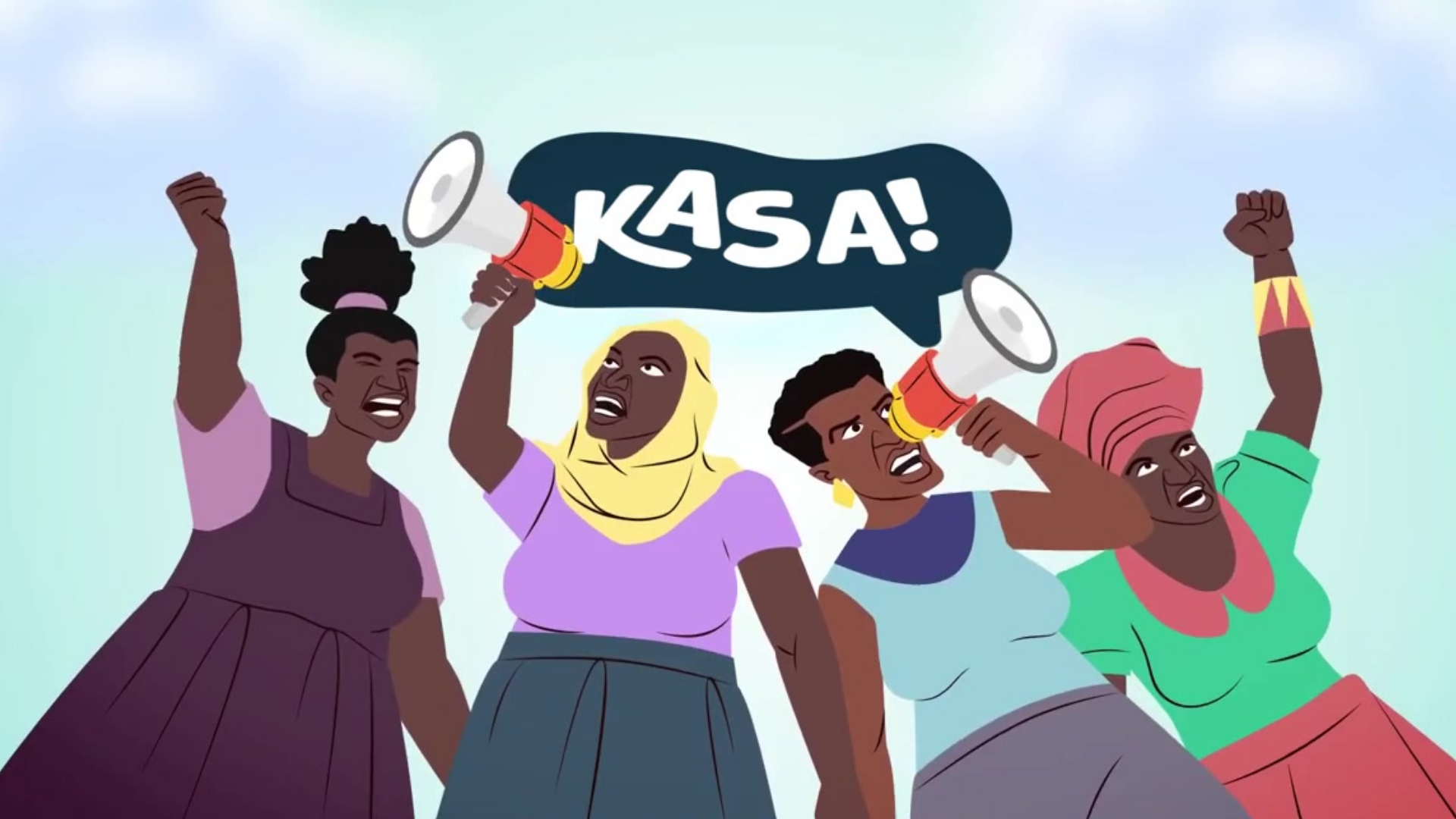
Sexual Violence & the Kasa! Initiative
Lois Addo, the Programme Manager for WiLDAF Ghana, highlights the high occurrence of sexual violence within youth communities in rural communities. She identifies lack of parental care, financial hardship, the advent of social media and easier access to harmful information, harmful cultural norms and beliefs and peer pressure as some of the underlying causes of sexual violence.
To address this, WiLDAF Ghana established school clubs in rural Junior High schools, Girls and Boys for Change, where selected champions of change amongst the students are selected, to push positive norms, grow confidence and self esteem, educated on knowing their rights and where to report violence. Girls in these clubs have become more assertive, can speak up on experiences they have gone through and challenge anyone who wants to sexually abuse them. In the case of Naa* shared earlier, her father was arrested and the girl removed from her harmful situation at home and put under the care and protection of Social Welfare. To ensure the longevity and ownership of these clubs in the schools, manuals and handbooks are developed such that beyond WiLDAF’s initial involvement, the clubs can run on their own. The formation of these clubs marked a reduction in cases of teenage pregnancy and an increased turnout of girls continuing on from Junior High School to Senior High. More girls were empowered to have aspirations, strive for good grades and to further their studies, in a landscape where the norm was to drop out and settle with a man who will take care of them.
Beyond this, WiLDAF also trains selected champions of change in rural areas to tackle sexual violence in these communities. Twelve people in each community, who are usually turned to, resolve communal issues, were selected to undergo training to understand the laws. The community agents do sensitivity trainings with parents about the need to show care and attention to their children to prevent sexual violence, make referrals to state agencies and become watchdogs in the community.
Resilience & Forging Ahead
The work of advancing women’s rights is never-ending. Lois Addo shares that some pushback in doing this work, particularly in sexual violence, is challenging harmful societal beliefs. In the establishment of the school clubs, some parents did not allow their children to join because of the misconception that they were being overexposed.
However, the existence and resilience of pioneering women’s rights organizations like WiLDAF ensures that the work continues and women’s emancipation is achieved, in spite of these challenges.
***
Naa* name has been changed for privacy and safety reasons.
This is a commissioned feature story by Nana Akosua Hanson, a Media Practitioner based in Ghana.
“My Body Matters”: Ending Sexual Violence against Sex Workers in Accra
“My Body Matters”: Ending Sexual Violence against Sex Workers in Accra
Tucked away in a slum area in Mamprobi, in the heart of the capital of Ghana, Accra, about 15 minutes away from the Human Rights court is Women of Dignity Alliance (WODA). WODA plays a very important role in the lives of sex workers in that community and other slum areas in the capital. Sex work remains a profession that navigates a dangerous landscape, with sex workers constantly at high risk because they receive little to no societal or legal protections in many countries in Africa. Sex work is criminalised in most places on the continent. However, one would often find that in countries where it is illegal, it is still quite commonplace.
In Ghana, sex work is illegal but widespread. This has created a ‘black marketisation’ of sex work. Due to this, sex workers are vulnerable to abuse and have little to no recourse to justice or protection when their rights and freedoms are taken away. There is also an underlying prevalence of human trafficking and child prostitution, given fertile ground to thrive because of economic hardship. The stigma attached to sex work creates a general disregard for the lives and bodies of sex workers. In Ghana, they are robbed, abused and killed; and justice is difficult to get in a system that criminalises the work.
In such a climate, relief and advocacy for change are therefore spearheaded by sex workers themselves, community voices and activists. The African Women’s Development Fund (AWDF) is supporting WODA’s resilient work for the protection of sex workers’ rights and freedoms. WODA is built on the ethos of creating a safe space and network for women in slum communities and sex workers in these communities, providing social support, access to sexual health and human rights information, HIV testing and counselling, empowerment, skills building and vocational training to provide an alternative livelihood for the sex workers, should they need this.
Mamle* was arrested by police for sex work, robbed, and then set free. She discovered WODA during an outreach and became a member. She is now a project officer in the organisation, leads police sensitisation projects as part of WODA’S outreach initiatives, serving as a listening ear and resource to sex workers who visit the centre to report abuse. Today, due to these efforts, some police stations in the vicinity have appointed some of their police men and women as designated officials that sex workers can go to to report police abuse. In a separate case, a 15 year old girl found solace in the vocational training that WODA provides. Her attendance and assimilation into the empowerment, the space provides, led to the discovery that her mother had been sexually exploiting her, by selling her daughter for sex. The case was amplified and police have taken it up. As at the time of writing this article, she is graduating from her vocational training, in the hope that it will give her a livelihood.
“My Body Matters” & the AWDF Kasa! Initiative
‘‘My Body Matters’ is a flagship project funded by Kasa! Initiative to address and reduce sexual violence in West Africa. The project is aimed at challenging the misconception amongst sex workers that they have no worth. Through counselling, community outreach projects, Theatre, radio drama and more, ‘My Body Matters’ aims to empower sex workers to understand that they have dignity, to learn to speak up for themselves in a dangerous landscape with this understanding and are entitled to all rights of protection.
The organisation was founded and is directed by Susan Dartey. Dartey grew up in Jamestown, an old township on the coast of Ghana, formerly known as British Accra. In her childhood, she saw a lot of abuse in her household, but there were no avenues to express what were jarring experiences for a young girl. As a child growing up in Jamestown, she says, you are admonished by adults not to speak, only endure. Her mother had gone through the trauma of being trafficked into Accra.
In Junior High School, joining the theatre club opened up an avenue of expression for her that would be healing and light a fire in what will later become her community work. Through storytelling, a learner-centred approach, music, games interaction, enactment and audience participation, Theatre was an exceptional medium for exploring difficult issues such as sexual abuse in the community. Theatre provided that empathetic space like no other to tell one’s story and to affect an audience, such that a push for communal change becomes off the audience’s own volition.
Theatre for Development is one of WODA’s flagship community outreach programmes within slum communities in big slum communities in Accra such as Jamestown, Old Fadama, Railways, Chorkor, Labadi and Circle, to disseminate messages, and to conscientise communities, the police, power players, community leaders, and more about the social protections for sex workers, destigmatise sex work and end cycles of abuse and violence against women. Radio drama is also used to reach communities beyond the organisation’s reach, partnering with local radio stations in those communities to air radio drama sharing the stories of the women and encouraging discussions about the issues. Every performance is a sex worker’s story.
The center is open everyday for sex workers to walk in for social support, information and rehabilitation.
Societal Stigma
Dartey reflects that most of the sex workers in the community have the perception that anything from sex work is not valuable. This translates into the perception that their bodies have no worth and they do not matter.
Society hammers in this misconception in various ways. Marash, recounts stories of sex workers who have been killed by clients who did not want to pay for services rendered; of sex workers who have simply vanished; of sex workers preyed on for ritualistic purposes because of the prejudice that sex workers’ bodies have no worth; and as in her own case, are abused by police whose mandate is to protect.
Sex workers who are lesbians also find a safe space in WODA. In 2024, Ghana’s parliament passed the Human Sexual Rights and Family Values Bill, a draconian anti-lgbt bill criminalising the identity of being LGBT+ and associated sanctions in the community as a means of state crackdown on this community. The bill did not become law, however, the societal hatred and stigmatisation it ramped up remains a fixture with far reaching consequences in Ghanaian society because of the inevitable intersectionality of oppression. For example, with the parliamentary passage of the anti-LGBT bill, WODA being a space for only women, experienced a lot of threats due to a growing misconception in that community, that the space was a lesbian organisation. The organisation had to change locations.
Dartey, however, has a positive outlook on what the future holds after ten years of advocacy and movement for change.
After ten years of advocacy, Susan notes that there is a marked reduction in sex workers reporting cases of abuse. More sex workers in the community have joined the organisation, taking up staff positions furthering the work of the organisation as community facilitators, project officers, and as trainers sensitising on issues of child trafficking, abuse of sex workers, rehabilitation and more. As at the time of writing this article, another group in vocational training will be graduating. Many sex workers have found their voice – in becoming aware of their inherent rights and dignity, in learning how to protect themselves, and in speaking up for themselves.
As Susan says quite aptly, “When a woman finds her voice, she feels safe, she can protect herself, and her dignity is respected.”
The Women of Dignity Alliance calls for the decriminalisation of sex work, and for social protections of sex workers to be put in place. Sex work is work. Sex workers’ dignity must be protected.
***
Mamle* name has been changed for privacy and safety reasons.
This is a commissioned feature story by Nana Akosua Hanson, a Media Practitioner based in Ghana.
Healing Through Hope: How WYFSD is Safeguarding Lives of Survivors in Western North Region
Healing Through Hope: How WYFSD is Safeguarding Lives of Survivors in Western North Region
“I was scared and could not sleep properly. I would jump at the slightest sound of footsteps. I did not have a reason to live,” recalls Hagar Boakye, her voice trembling as she remembers the darkness that once consumed her life.
Thirty years ago, Hagar was sexually exploited by a stranger when she desperately needed money for her father’s medical care. The trauma shattered her sense of safety, left her emotionally paralysed, and plunged her into a darkness she never imagined she could escape. Today, in 2025, this 46-year-old woman sits with confidence and strength, her eyes steady and full of resilience. In a region where traditional customs are often prioritised over the welfare of vulnerable populations, particularly women and children, Hagar found her voice and began resisting sexual violence from her husband after years of silence.
This story highlights the meaningful work of Women and Youth Forum for Sustainable Development (WYFSD) in safeguarding the lives of survivors, empowering them to become advocates, and providing counseling to help them overcome their fears and face society with confidence.
WYFSD was established in April 2004 in response to a survey conducted in the Aowin Suaman district in the Western North Region of Ghana, which measured women’s human rights and health, bodily autonomy, and sustainable livelihoods.
The organisation has successfully created sustained awareness on Gender Based Violence prevention, established a platform of women champions against Violence Against Women and Girls (VAWG), created clear reporting channels for VAWG cases, and strengthened the efforts of religious and traditional authorities in supporting VAWG prevention.
Through the KASA project by the African Women Development Fund (AWDF), a funding partner of WYFSD, educational and advocacy programmes have been implemented in several communities in the region to protect survivors, especially women, from the trauma, stigma, and fears they encounter after sexual abuse.
KASA, meaning “Speak Out,” has over the years assisted many NGOs in Africa, including Ghana, Nigeria, and Senegal, in initiating various projects and interventions to help eradicate sexual violence. The project was launched by AWDF together with the Ford Foundation and Open Society West Africa.
Hagar was empowered and trained on resisting sexual violence through the KASA project implemented by WYFSD in partnership with the Department of Social Welfare in the district. She is among other women who have struggled and are overcoming the emotional trauma and stress of sexual violence.
WYFSD empowers women and girls to demand their human rights, bodily autonomy, integrity, and improved livelihoods. Recognising that recovery is multi-dimensional, they connected with Hagar through their empowerment programmes and guided her through the process of finding her voice to resist the violence and helped her reclaim the control she had lost.
According to the World Health Organisation, one in three women globally experience sexual and physical violence in their lifetime. In Ghana, underreporting and stigma remain persistent barriers to justice and healing.
WYFSD, led by Madam Rose Ackah, the Executive Director, is working to change this narrative not only through support services, but also through community education programmes, outreach initiatives, and partnerships with relevant stakeholders to create survivor-friendly reporting mechanisms.
In the first phase of the project, funds from AWDF were channelled toward empowering and educating survivors and other women within the region to resist sexual violence. “Survivors do not need pity from anyone; they need justice and support to thrive,” says Madam Rose Ackah. Hagar’s story is one of thousands, but each time one woman finds healing, we all take a step forward in the fight against sexual violence. Today, Hagar volunteers with other survivors as a peer counsellor, empowering other survivors by giving them voice, strength, and support to deal with their emotions. “I advise them to be strong and persevere, as they are bigger and stronger than their issues and what they have been through,” she says. Hagar is no longer defined by her pain and struggles. She is a woman reborn, not in spite of her trauma, but through the strength she found in facing it.
The partnership between WYFSD and AWDF has over the years been impactful and transformative for survivors like Hagar and her colleagues. “We had no one to talk to until they reached out to encourage and motivate us after the assault,” she said. The transformational work of WYFSD continues, but requires additional support to advance their mission and protect more survivors in the Western North Region and beyond.
***
This is a commissioned feature story by Victoria Agyemang, a Journalist based in Ghana.