
Tag: film
Nigerian Tope Ogun Wins AWDF Women In Film Award
Nigerian Tope Ogun Wins AWDF Women In Film Award
[tp lang=”en” not_in=”fr”]Nigerian Director/ Producer Tope Oshin Ogun has won the African Women’s Development Fund’s first African Women in Film Award.
Ogun, an acclaimed director with roots in both Film and Television was given the award at the Golden Movie Awards ceremony held on Saturday June 27 at the State House banquet hall in Accra.
The “AWDF African Women in Film Award,” honours an African woman whose work demonstrates measurable efforts to change the narrative and challenge stereotypes about African women. Tope was chosen for her outspoken voice against domestic abuse in Nigeria, an issue she brilliantly addressed in the 2014 short film New Horizons, a story about four women’s experiences with abuse.
“Being the recipient of AWDF’s first African Woman In Film Award is a true honour for me, and it’s a big surprise to learn that one is recognised and celebrated for being true to oneself and calling and passion and profession, ” Ogun told AWDF.
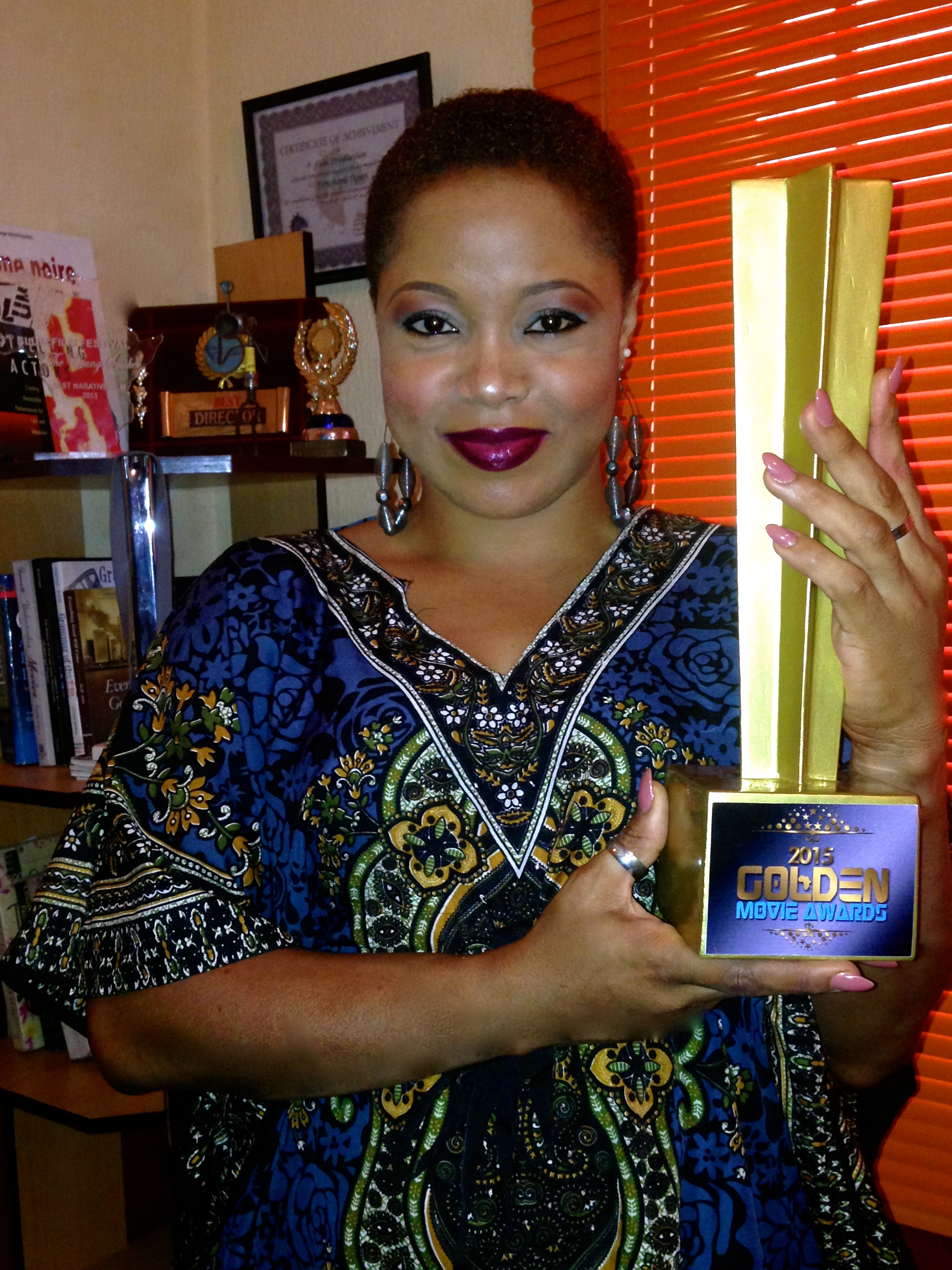
AWDF conferred the award at the ceremony which was organized by Golden Movie Awards (GMA), a new pan African award scheme that seeks to recognise outstanding work in the African movie industry. AWDF partnered with GMA for its maiden edition as part of its mandate to use arts as tool to promote social justice and to challenge negative stereotypes about women.
As the winner of the award, Ogun will be a lead facilitator in a one- day capacity building programme for African women in the film industry, organized by AWDF and GMA.
Ogun has an expansive portfolio that includes directing 350 episodes of the successful African soap opera “Tinsel”, an award winning feature length film “Journey To Self” and 3 multiple award winning shorts films namely “The Young Smoker”, “Till Death Do Us Part” and “New Horizons.”[/tp]
[tp lang=”fr” not_in=”en”]La réalisatrice/productrice nigériane Tope Oshin Ogun a remporté le Premier Prix de Cinéma des femmes africaines du Fonds Africain de développement de la femme.
Ogun, réalisatrice de renom impliquée à la fois dans le cinéma et la télévision a reçu le prix lors de la cérémonie des Golden Movie Awards tenue le samedi 27 Juin à la State House banquet hall à Accra.
Le “Prix de Cinéma des femmes africaines d’AWDF” honore une femme africaine dont le travail démontre les efforts tangibles pour changer le récit et lutter contre les stéréotypes sur les femmes africaines. Tope a été choisie pour sa voix franche contre la violence domestique au Nigeria, une question qu’elle a brillamment traitée en 2014 dans le court-métrage New Horizons, une histoire sur les expériences de quatre femmes victimes d’abus.
«Être lauréate du Prix de Cinéma des femmes africaines d’AWDF est un véritable honneur pour moi, et c’est une grande surprise d’apprendre que l’on est reconnue et célébrée pour être fidèle à soi-même, sa vocation, sa passion et à la profession,” déclare Ogun à AWDF.
AWDF a décerné ce prix lors de la cérémonie qui a été organisée par Golden Movie Awards (GMA), une académie panafricaine qui vise à reconnaître les travaux remarquable dans l’industrie du cinéma africain. AWDF a collaboré avec GMA pour sa première édition dans le cadre de sa mission, utiliser les arts comme outil pour promouvoir la justice sociale et de combattre les stéréotypes négatifs sur les femmes.
En tant que lauréate, Ogun sera le médiateur principal dans un programme de renforcement des capacités d’une journée pour les femmes africaines dans l’industrie du cinéma, organisé par AWDF et GMA.
Ogun dispose d’un portfolio large dont la direction de 350 épisodes du feuilleton africain “Tinsel”, un long métrage primé “Journey To Self” et plusieurs courts-métrage dont 3 primés à savoir «Le jeune fumeur”, “Till Death Do Us Partie “et” Nouveaux Horizons “.[/tp]
AWDF To Give First African Women In Film Award June 27th
AWDF To Give First African Women In Film Award June 27th
[tp lang=”en” not_in=”fr”]The African Women’s Development Fund (AWDF) will announce the winner of its first African Women in Film Award (AWIF) on Saturday 27th June at a movie awards ceremony in the Ghanaian capital Accra.
AWDF has partnered with Golden Movie Awards, a new pan-African award scheme that seeks to honour innovation, excellence and humanitarian efforts of individuals within the African Film industry.
The event is set to take place at the State House Banquet Hall, bringing together performers, writers, directors and other content creators from all over the continent.
AWDF’s African Women in Film Award will celebrate the contribution of African women to the industry.
The award will be given to an African woman who has demonstrated through her work, measurable efforts to change the narrative and challenge stereotypes about women on the continent.
AWDF recognizes the importance of the arts as a tool for social justice work and as a medium to train, nurture and raise the profile of African women through their creative works and expression.
The aim is to build the cadre of skilled African women who can use the different art mediums to promote women’s rights.
Tickets for the events can be purchased in Accra for GHS 150 at Surfline Ghana offices in Osu, Dansoman, East Legon, Tema and the Accra Mall.[/tp]
[tp lang=”fr” not_in=”en”]Le Fonds Africain de développement de la Femme (AWDF) annoncera le vainqueur de son premier prix pour les femmes africaines dans Cinéma (AWIF) le samedi 27 Juin lors d’une cérémonie de remise de prix de cinéma dans la capitale ghanéenne Accra.
AWDF a conclu un partenariat avec Golden Movie Awards, un nouveau système d’attribution panafricain, qui cherche à honorer l’innovation, l’excellence et les efforts humanitaires des individus au sein de l’industrie cinématographique africaine.
L’événement est prévu à la State House Banquet Hall, réunissant des artistes, des écrivains, des réalisateurs et autres créateurs de contenu de partout dans le continent.
Le prix pour les femmes africaines dans le cinéma d’AWDF célèbre la contribution des femmes africaines à l’industrie.
Le prix sera décerné à une femme africaine qui a démontré à travers son travail, des efforts mesurables pour changer le récit et lutter contre les stéréotypes sur les femmes sur le continent.
AWDF reconnaît l’importance des arts comme outil pour la justice sociale et comme un moyen de former, entretenir et élever le profil des femmes africaines par leurs œuvres créatives et expression.
Le but est de construire un cadre de femmes africaines qualifiées qui peuvent utiliser les différents médiums de l’art pour promouvoir les droits des femmes.
Les billets pour l’événement peuvent être achetés à Accra pour 150GhC dans les bureaux Surfline Ghana à Osu, Dansoman, East Legon, Tema et le centre commercial d’Accra.[/tp]
Women’s Learning Partnership’s Gender Based Violence Film Screenings
Women’s Learning Partnership’s Gender Based Violence Film Screenings
In observance of the global 16 Days of Activism to End Gender Based Violence campaign the Women’s Learning Partnership is hosting a free online screening of two short films on eliminating gender based violence around the world.
The screenings will also be interactive, allowing the audience to share their thoughts and reactions via chat. The chat is non-moderated and audience-focused, however participants are encouraged to be respectful in their exchange. The goal is to facilitate an insightful global discourse on the pertinent issue of gender based violence. The details on the films and their screenings are as follows:
‘Film 1
From Fear to Freedom: Ending Violence Against Women
A 40-minute film featuring activists and scholars from across the globe discussing the root causes of gender-based violence, sharing strategies to combat it, and providing inspiring accounts of the important milestones already achieved through the international women’s movement.
2 screenings: Wednesday, December 3rd, 2014, @ 10:00 am & 3:30 pm EST
To join a screening at the time of the event CLICK HERE,
or copy and paste this URL into your browser: https://abanlearning.
Film 2
Waiting on Justice
A 30 minute film that follows a selection of cases handled by WLP’s partner organization in Mauritania L’Association des Femmes Chefs de Famille (AFCF) as they fight on behalf of victims while demanding justice and accountability from the Mauritanian authorities.
2 screenings: Monday, December 8th, 2014, @ 10:00 am & 3:30 pm EST
To join a screening at the time of the event CLICK HERE,
or copy and paste this URL into your browser: https://abanlearning.
For social media interaction, use hashtags #16days & #GBVTeachin to share your remarks on the films and tag the Women’s Leaning Partnership @wlp1!
“Together we can make a difference and end Violence Against Women. “‘
To learn more about the event, click here.
The Art of AMA ATA AIDOO: Documentary Film Launch
The Art of AMA ATA AIDOO: Documentary Film Launch
Once I became aware of myself, it occurred to me that maybe I should add to the world’s store of stories.
-Ama Ata Aidoo
On 17th September, The African Women’s Development Fund launched The Art of Ama Ata Aidoo, a documentary on the life and work of critically acclaimed Ghanaian author, Ama Ata Aidoo, at the British Council in Accra. The documentary was directed and produced by Yaba Badoe and co-produced by Amina Mama for Fadoa Films. AWDF contributed 40% funding for the project with the remaining 60% accumulated through crowdsourcing on IndieGogo.
AWDF CEO, Theo Sowa, introduced the documentary and its protagonist with these words: “Here we celebrate one of our icons – an African leader who pushes for social justice and change. She has done so much for all of us. She’s marked by a love for her people today and forever. Using an evocative and magical medium, Yaba and Amina have helped us to understand this phenomenon in our world. She is representative of African women who are strong, agile, and flexible and have been leaders on our continent for ages. Her words will continue as a model for younger generations.”

Prof. Ama Ata Aidoo
Prof. Esi Sutherland-Addy, who served as a member of the film’s Advisory Committee, also offered opening remarks. She humored the audience with her personal insights of the writer, describing her ‘feisty’ character, praising her rare ability to reflect critical questions in her characters, and her adeptness at baking pineapple pie. As Sutherland-Addy mused, “This film plunges us deep into Ama Ata Aidoo’s world. She is a playwright, essayist, poet, novelist, short story writer, academic and politically conscious intellectual. What force caused such a person to emerge in our literary scene?” She highlighted the need for women’s stories to be told and encouraged events such as these to promote the visibility of African women.

Prof. Esi Sutherland Addy’s opening remarks
Kinna Likimani, Ama Ata Aidoo’s daughter, spoke on her mother’s behalf stating how “increasingly pensive and nervous she became as we were getting closer to this day. She kept saying, there’s so much exposure!” Kinna revealed that three books had been written about Aidoo’s life detailing that this was a great accomplishment preceding the documentary. Kinna shared, “She has labored to write while being an African woman – also mother, grandmother, daughter, caregiver, teacher and philanthropist. She struggles to be appreciative of what she’s done, mournful about the books she hasn’t written.”
Kinna explained that, “growing up, no one in her life discouraged her from writing.” In fact, Aidoo was supported by anchors from her early days in Abeadzi Kyiakor to her studies at Wesley Girls [where a teacher gave her a typewriter] and the University of Ghana-Legon, teaching at the University of Cape Coast and working within an evolving sisterhood of African women writers. Kinna continued, “her life is situated within a community of women writers, academics and filmmakers. In many ways, this documentary is a coming together of African women creators.”

Prof. Ama Ata Aidoo and Kinna Likimani
In the film, Aidoo’s writing journey is documented through snippets of her life history. She reads excerpts from a diverse archive including Dilemma of a Ghost (1965), Our Sister Killjoy (1977) and Changes: A Love Story (1991). This adds a serene pace to the tone of the documentary. The film portrays her relationship with mentor Efua Sutherland and fellow writers Mariama Ba and Buchi Emecheta, among others.
Aidoo’s story takes the audience on her journey from start to finish. The film also illustrates how Aidoo’s love of storytelling came from her mother who would share stories in the early hours of the morning. An insistence on showing her hometown gave the audience a better insight into the early days of her life there as daughter of a chief and part of the royal family. Aidoo explains the Fante folktale culture of her childhood, giving the audience an opportunity to witness a story being performed live with music and dance.
Her ability as a writer to develop complex characters that signal the demands of social life is matched by a close attention to the contradictions within relationships. As Aidoo muses in the film, “Ghanaians have always been nervous about the presence of people from the diaspora here. This is in part because they remind us of what we don’t want to deal with. In the wake of the slave trade, we ourselves were colonized. We were conquered and we have not really dealt with the implications of colonization…So the relationship between us and the African diaspora is charged.”
Her literary diversity is further highlighted in the range of stories she tells. The stories are timeless in the sense that the characters and attitudes portrayed are still very much relevant today as is evident in No Sweetness Here (1970). Aidoo is also a strong believer in the capacity of African communities to solve problems experienced. She uses literature to encourage her audience to consider social issues more seriously.
A Q+A followed with the filmmakers and Aidoo providing greater insights into her personality and range of work. As Ghana’s Minister of Education from 1983-84, she encouraged the recruitment and development of women teachers. Aidoo shared that this is the accomplishment she was most proud of during her tenure. Ultimately, the author left this position because writing is and has always been her calling. The scene that stood out most in the film was how speechless Aidoo was by the crowd’s reaction at the close of Anowa, performed by theater students from the University of California, Santa Barbara. The performance of Aidoo’s work by these students translates the vast impact of her work not only for Literature but also for Theater and Performance Studies. There is also a deep sense that Aidoo is impacted by the influence her work has achieved among fellow writers and admirers.

Open forum with Yaba Badoe, Prof. Ama Ata Aidoo, Prof. Esi Sutherland Addy and Amina Mama
Ama Ata Aidoo discussed her own struggle with publishers and the lack of support in the publishing world for African writers, particularly African women writers. She highlighted that this was now changing with the success of writers like Chimamanda Ngozi Adichie. This conversation sparked a fundraising call to boost AWDF’s support of women organizations in Art, Culture and Sports. DVDs of the film were then auctioned and pledges were made by multiple audience members, totaling more than 11,000GHC.

Abigail Burgesson auctioning copies of the Documentary
The filmmakers also discussed the challenges experienced making The Art of Ama Ata Aidoo over the last three years. Yaba Badoe and Amina Mama gave greater perspective on the process of creating a documentary and encouraged more women to get into the filmmaking practice by portraying the affirming aspects of African cultures. Amina Mama detailed, “Many people outside of the continent are only interested in Africans suffering. We did experience difficulty in mobilizing resources for the film. But we can never let money detain us because we have great things to do. This film is a movement and it built its own community.”
By Shakira Chambas and Sionne Neely
Photos by Seth Adu-Amankwah
Grantee Highlight: T.O.M Pictures
Grantee Highlight: T.O.M Pictures

Grantee Highlight: T.O.M Pictures
In 2003, Akin Omotoso, Robbie Thorpe and Kgomotso Matsunyane came together to found a production company in Johannesburg called T.O.M Pictures. They have been able to produce several feature films since then and are continually pushing the boundaries of filmmaking and bringing amazing work to African audiences. As a result of all of their efforts, they have built a reputation for themselves as one of the most progressive, creative and professional production companies in South Africa. T.O.M Pictures says that it runs on one simple philosophy: “To make content that reflects the true nature of our African identity, and also to contribute to and participate in the growth and understanding of South Africa and the African Continent.”

In order to produce a feature film, there has to be a tremendous amount of passion and commitment, indefinitely. Over the past four years, the team at T.O.M has been working tirelessly on a film project called Tell Me Sweet Something. This film follows the love story of two people leading very different lives. Moratiwa (Nomzamo Mbatha) is the owner of a small bookstore, and hopes one day to be a writer. However, her store is not as successful as she would like it to be and her love life is faring even worse. That is until she meets a male model, Nat (Maps Maponyane), who in his entire life has never read one book. Opposites attract, it appears. Both want to find love and to be desired for who they really are, rather than just how they appear on the outside. However, as the story unfolds, a woman from Nat’s past comes back into his life, pregnant with his child. Of course, this leads to complications and confusion, and the love between Moratiwa and Nat is tested.

Stories about love, relationships, and the complex nature of human relations are universal stories that people all over the world can relate to. T.O.M. pictures in particular also believe in portraying strong women as lead characters, and as complex human beings. The African Women’s Development Fund (AWDF) recognizes the potential that the Arts (including film) hold for shaping the way people perceive African women and it is for this reason that AWDF supported the funding of intensive rehearsal and workshop for actresses working on the film. In addition to Nomzamo Mbatha, the film stars other actresses including: Thembi Seete, Mandisa Bardill and Thishiwe Zigubu. The workshop rehearsals was used to help prepare the actresses along with director, Omotoso, for the shooting of the film. This was a month long process, during which actresses could get a grasp for how Omotoso worked and thus exactly how he wanted them to act in the film. It was important because the team was able to work together and develop chemistry prior to shooting. In order for everything in a film to be believable, it has to come from a very real place. Also, the most impressive outcome of the process was the development of an organic script by everyone involved. Each actress and actor contributed to the writing of the script. Therefore, they all own the script and this ownership has been important to the success of the film, according to T.O.M. Pictures.

AWDF cares about the successes of women artists around the continent, because these creative minds are ones that have the capability to reach thousands and millions of people! We believe in encouraging women to follow their dreams, and many dream of becoming artists, writers, singers, actresses, etc. There is always a space for people with a talent and a drive to be seen and heard.

AWDF could not be more proud to have been a part of this project. T.O.M Pictures was able to finally begin the shooting of the film during the month of May after waiting for three and a half years! All of the hard work of the cast and crew is paying off, and we cannot wait to see the completed film!

Resources: Notes from Scriptwriting Masterclass by Ade Solanke
Resources: Notes from Scriptwriting Masterclass by Ade Solanke
At the 2nd African Women in Film Forum (AWIFF), Ade Solanke, award winning playwright and screenwriter led a masterclass on scriptwriting.
The power point from this session is embedded below:

Journey to FESPACO: The Pan African Film and Television Festival of Ougadougou
Journey to FESPACO: The Pan African Film and Television Festival of Ougadougou
I walked out of the airport confidently, ignoring all the traders who were trying to sell me sim cards, mobile phones or whatever else they had for sale. Then I stopped, slightly confused. Where’s the taxi stand? I wondered. I could see no taxis whatsoever. In Accra (where I had journeyed from) there were numerous taxi services at the airport. Official airport taxis, unofficial airport taxis and taxi drivers cruising by, hoping to pick up a passenger who has just arrived from Abrokyire (a trip abroad). Even before you fully emerge from Kotoka International Airport, men (and they are always men) in officious white shirts, and navy blue trousers will confront you with, “Taxi, taxi, airport taxi” but no such thing had happened here.
I paused and turned to one of the young men who had been trying to sell me a sim card “Je cherche le taxi”. “Qui, qui…” he responded, “Taxi ici” and tried to grab hold of my hand luggage whilst I simultaneously tried to maintain hold of my hand luggage. We walked to the main road. “This way, this way” is what I imagined he said, but there was no taxi this way. By now he had been joined by another compadre and they both resorted to hailing down passing taxis whilst simultaneously encouraging me to cross the street. Eventually a battered green taxi stopped in the middle of the road. “Tu connais l’hotel Laico?” (I can’t conjugate vous properly) “Qui” he responded, and so off we went…where to, I had no idea. In the taxi I texted my Mum, “I’ve arrived safely in Ougadougou. I’m en route to the hotel”. It did cross my mind that perhaps I should leave the safe arrival message until I had actually arrived at the hotel but hey ho, I was hoping for a safe arrival.
My predominant memories of Burkina will be women on mopeds, dry, dusty conditions and an amazing FESPACO experience. I’m still not used to seeing women on mopeds. Its not a sight that you ever come across in southern Ghana but in Burkina you see elderly women chugging along on mopeds, young women in little black dresses and heels on mopeds and women with their children on mopeds. “How empowering”, I thought. In a conversation with Deborah Ahenkorah (Co-Founder and Executive Director of the Golden Baobab Prize) she made a similar statement, “Women in Burkina appear so powerful. I get the impression that you shouldn’t mess with them…” Are we mistaken? Probably. Or probably not…

I had come to FESPACO (Pan African Film and Television Festival of Ougadougou) with three main goals:
- To participate fully in the festival and learn as much as possible about the current state of African film on the continent
- To speak on a panel with Amina Mama and Yaba Badoe at a CORDESIA workshop and
- To promote the work that AWDF has done in its popular culture project
Apart from a few logistical hitches, (printed programme booklets of the film schedule being a rare commodity, being sent all around the houses before arriving at the right place to purchase my festival and some technical hitches at one cinema) FESPACO was an amazing experience. I am already planning to attend the 23rd FESPACO that will take place in 2013.
Films, Films, Films
Of course FESPACO was all about watching films. On Day 1 of the film festival I got together with Deborah and Kojo (friends from Ghana who were also attending FESPACO) and we eagerly went through the film schedule and highlighted those films we wanted to watch. Our film watching crew soon included Tsakani (whom Kojo and Debbie befriended over breakfast) from South Africa’s Arts and Culture department[1] and together we decided to challenge ourselves to watch as many films as possible! The film schedule didn’t contain a synopsis of the films so we chose films that we thought sounded exciting, and in my case I advocated for films with women directors (there were so few of those though). There were some days we watched as many as 5 films back to back.
Personally, my favourite films at the festival were:
- A Small Town Called Descent (South Africa)
- Dnoma (Haiti)
- Notre étrangère (Senegal)
- The last flight of the flamingo (Mozambique)
- Bullets over Brownsville (USA)
- Dusable to Obama : Chicago’s Black Metropolis (USA)
- The Figurine (Araromire) (Nigeria)
I liked these films for a variety of reasons and will review my ‘top 3’ below:
My Top 3 Films at FESPACO: A Nutshell Review and Synopsis
A Small Town Called Descent – this film reminded me of the best bits of a Hollywood blockbuster. It had compelling action scenes, good cops versus bad cops, a strong storyline and a romance doomed to failure. The film dealt with the hard-hitting issue of xenophobia, which centered on the murder of a Zimbabwean immigrant in the town ‘Descent’. The commander of the local police station is directly implicated in the murder and so is practically everyone else in the town (either through their action, inaction and unwillingness to speak up about the issue). We get the impression that the real puppet masters may not be the police commander or even the mob that lynched the Zimbabwean but the big businesses looking to buy up tracts of land in Descent. And of course there is the Afrikaner farmer who is the largest landholder in Descent, and was a high ranking military officer prior to the end of apartheid. We’re never quite sure how he is involved in the xenophobic attacks but we’re left with the feeling that he too is complicit
Dnoma – a complex, multi-layered film, which skillfully intertwined issues of race, class, immigration and sexuality. This film was located in France and combined several stories in one piece. There was the femme fatale teacher who gave her pupil a blowjob[2]. The woman who had been adopted as a child and decided to experiment with the concept of love and relationships by picking up a stranger at the train station and taking him home to make love/have sex. The young girl whose parents had moved to Spain, leaving her responsible for the care of her older sister who was dying from leukemia. The pupil (same one who had received a blowjob from his teacher) who was also a pickpocket, and was dating the girl who had caring responsibilities for her sister. The immigrant who worked long hours and sometimes came to school wearing his clothes from his job that later developed a crush on the girl who had caring responsibilities for her sister. Separate stories, yet all inter-connected and fascinating in its complexity and depth
Notre étrangère – A beautifully shot film, which spans Burkina Faso and France. The dominant themes deal with adoption, motherhood and the feeling of being a stranger or being caught in-between two worlds. A young girl leaves France in search of her biological mother in Burkina Faso but only finds her alcoholic Aunt who is overjoyed to see her and treats her like the prodigal daughter. The alcoholic Aunt is lonely; she has no children and despite numerous efforts has been unable to bear her own children. This is especially hard in a country, which valorizes motherhood and scorns the barren woman.
Whilst the young girl searches in vain for her mother, her mother is working as a cleaner in France. Although she had agreed for her daughter’s French father to take the young girl to France she never recovers from the loss of her daughter and disappears soon after the child leaves for France. The audience is aware that the mother is in France and the Aunt heard a rumour that the mother is in France but no one knows for a fact where the mother is located. The film ends without mother and daughter finding each other.
So how does all this relate to what I do at AWDF?
In 2008, AWDF formally launched a popular culture project at the Sixth African Development Forum held in Addis Ababa, Ethiopia, 18th-21st November 2008. The launch of the popular culture project was in recognition of the need for women’s rights organisations to adopt strategies that can target a mass base of the population if perceptions, behaviours and attitudes are to be influenced.
In 2010, AWDF convened the first African Women in Film Forum in conjunction with the Lufodo Academy of Performing Arts led by acclaimed Nollywood actress Joke Silva on the theme, “Nollywood: Women and the Dynamics of Representation”. This forum attracted a wide and diverse cross section of Nollywood’s key players including Directors, Actresses, Scriptwriters and virtually every profession connected in some way to the film profession.
In 2011, AWDF as part of its 3rd strategic plan has decided to add a new thematic area to its work, “Arts, Culture and Sports”. This presents a new opportunity for AWDF to extend its support for the Arts and to consider innovative ways of achieving gender equality.
It is very clear to me that the visual medium is a powerful tool and one that women’s rights activists haven’t engaged with sufficiently.
There was a powerful documentary screened at the 22nd FESPACO, “The Witches of Gambaga”. Women’s rights organizations at the public screening in Ghana on the 15th of February 2011 described the film as “a gift to the women’s movement”. A gift because the film depicts powerfully (in a way no report can) the abuse that women who have been accused of witchcraft face and shows the complex interplay of gender, tradition and power which leave women vulnerable to accusations of witchcraft. Not enough of such films exist, or if they do exist are not widely disseminated.
We need more documentaries that tell women’s stories. We need action films that have women heroines (and not just as the pretty sidekick). We need films that show women in all their beautiful diversities – working women, rich women, lesbians, activists, happy singletons, women living positively, differently abled women…We need women producers, directors, scriptwriters, actresses, distributors…
See you at the 23rd FESPACO in 2013.
Nana Darkoa Sekyiamah
Communications Officer
AWDF
[1] I mention that Tsakani was from South Africa’s Arts and Culture Department because I was impressed that the country had a department dedicated to the Arts and Culture. I was also impressed that the department had sent a number of staff to attend FESPACO. As far as I am aware Ghana no longer has an Arts and Culture Department and the country was not represented well at FESPACO
[2] I intend to write another article looking at the portrayal of women’s sexuality in the films I saw at FESPACO.
Reclaiming Popular Culture to Promote Gender Equality and Women’s Empowerment
Reclaiming Popular Culture to Promote Gender Equality and Women’s Empowerment

[tp lang=”en” not_in=”fr”]The African Women’s Development Fund (AWDF) in collaboration with Lufodo Productions is convening an African Women in Film Forum, 16th-17th June 2010 in Lagos, Nigeria.
This forum is being held to facilitate a dialogue on women’s rights with movie producers and writers, and establish a Gender Dialogue with the `Nollywood’ sector in Nigeria. In order to further promote gender equality and women’s empowerment, there is a need for women’s rights organisations to adopt strategies that can target a mass base of the population if perceptions, behaviours and attitudes are to be influenced. This activity is a crucial component of AWDF’s Popular Culture Project, which is supported by the MDG3 Fund.
According to AWDF’s Executive Director, Bisi Adeleye-Fayemi ‘The African Women in Film Forum will bring together a number of prominent African filmmakers, writers and creatives including Professor Abena Busia, Tsitsi Dangaremba and Akin Omotoso to start a gender dialogue on how we can reclaim popular culture to promote gender equality and women’s empowerment’.
ENDS
The African Women’s Development Fund (AWDF) is a grant-making foundation which supports local, national and regional organizations in Africa working towards women’s empowerment. AWDF through institutional capacity building and program development seeks to build a culture of learning and partnerships within the African women’s movement.
The vision of AWDF is for African women to live in a world in which there is social justice, equality and respect for women’s human rights. To this end, our mission is to mobilize financial resources to support local, national and regional initiatives led by women, which will lead to the achievement of this vision.
Press Enquiries
Nana Sekyiamah – Programme Officer (Fundraising & Communications)
Tel: + 233 (0) 302 521257
Email: nana@africlub.net/awdf
Websites: www.africlub.net/awdf[/tp]
[tp lang=”fr” not_in=”en”]Le Fonds Africain de Développement de la Femme (AWDF) en collaboration avec Lufodo Productions est la convocation d’une des femmes africaines dans le forum du film, le 16-Juin 17th 2010 à Lagos, au Nigeria.
Ce forum est organisé pour faciliter un dialogue sur les droits des femmes avec les producteurs et les auteurs de cinéma, et d’établir un dialogue entre les sexes avec le secteur `Nollywood” au Nigeria. Afin de promouvoir davantage l’égalité des sexes et l’autonomisation des femmes, il ya un besoin pour les organisations des droits des femmes à adopter des stratégies qui peuvent cibler une base de masse de la population si les perceptions, les comportements et les attitudes doivent être influencé. Cette activité est une composante essentielle du projet Culture Populaire de AWDF, qui est soutenu par le Fonds OMD3.
Selon le directeur exécutif de l’AWDF, Bisi Adeleye-Fayemi «Les femmes africaines dans Film Forum rassemblera un certain nombre d’éminents africains cinéastes, écrivains et créateurs, dont le Professeur Abena Busia, Tsitsi Dangaremba et Akin Omotoso d’entamer un dialogue entre les sexes sur la façon dont nous pouvons récupérer la culture populaire pour promouvoir l’égalité des sexes et l’autonomisation des femmes ».
Le Fonds Africain de Développement de la Femme (AWDF) est une fondation d’octroi de subventions qui soutient des organisations locales, nationales et régionales en Afrique travaillent à l’autonomisation des femmes. AWDF à travers le renforcement des capacités institutionnelles et le développement de programme vise à construire une culture de l’apprentissage et des partenariats au sein du mouvement des femmes africaines.
La vision de AWDF est pour les femmes africaines de vivre dans un monde dans lequel il ya la justice sociale, l’égalité et le respect des droits humains des femmes. À cette fin, notre mission est de mobiliser des ressources financières pour soutenir les initiatives locales, nationales et régionales dirigées par des femmes, ce qui mènera à la réalisation de cette vision.
Questions presse
Nana Sekyiamah – Administrateur de programme (Levée de fonds et des communications)
Tel: + 233 (0) 302 521 257
Email: nana@africlub.net/awdf
Sites Web: www.africlub.net/awdf[/tp]