
Reclaiming the Narrative: Feminist Communication as Political Practice
Jun 17, 2025
Media Center /
News
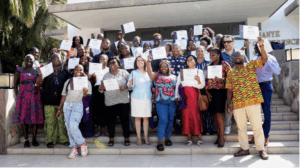
In feminist organising, we have often been asked to document the fight, narrate the work, and “give voice” to those unheard. But what if communication is not simply the storytelling of activism what if it is the activism itself? That was the central question sometimes spoken, sometimes lived during the feminist gathering held in Accra in May 2025. It was not a traditional convening. It was a space of reckoning: with language, with strategy, with the politics of representation. It brought together feminists from Africa not to learn how to better communicate for impact, but to radically reimagine what feminist communication is, can be, and must refuse to be.
🎥 Watch the video that captures these voices, silences, and acts of redefinition here:
Communication as a Site of Structural Violence
One of the most potent revelations from the convening is that communication, as practiced within development systems, is not neutral. It is a site of structural and epistemic violence.
The feminists gathered in Accra did not discuss communication merely as the final layer of a project. They dissected how the words we are asked to use empowerment, awareness, beneficiaries, impact stories do not simply describe the world. They shape what counts as legitimate knowledge. They delimit who gets to speak, and on what terms.
Participants exposed how this language is often inherited from colonial structures and donor expectations. It flattens complexity, sanitises struggle, and turns resistance into palatable narratives for funding cycles. In this context, to say “we are fighting” becomes “we are raising awareness.” To say “we are healing” becomes “we are building resilience.”
The violence of this translation is real. It erases the very people and processes it claims to support.
What Accra made clear is that every word carries ideology and feminist organisers must remain vigilant, constantly renegotiating the terrain of language.
The Politics of Naming and Renaming
Faced with imposed vocabularies, the women at the convening did more than critique they actively re-authored. They turned to ancestral languages and culturally embedded concepts as a way of reclaiming voice.
Words like tchologo (power), yaté (strength), or gbèlè (truth) surfaced repeatedly in discussions. These were not symbolic gestures of cultural pride. They were tactical. These words are embedded in contexts of resistance, in embodied histories, in epistemologies that predate colonial imposition.
What happens when feminists speak from these words instead of about them?
In Accra, we saw a linguistic insurrection. Feminists refused to use the vocabulary of those who have historically silenced them. Instead, they turned language into a weapon not of division, but of collective clarity. This is not just semantic. It is political. Because to name is to claim history, claim struggle, claim futurity.
Visibility as a Trap
A central tension that emerged in the convening and which is powerfully visible in the video is the contradiction between visibility and voice. In the age of social media metrics and donor reporting, visibility has become a currency. But for whom? And at what cost?
Several participants questioned whether visibility, as currently practised, serves the movement or dilutes it. The logic of virality often rewards simplicity, speed, and relatability which leaves little room for contradiction, pain, or radical imagination.
In Accra, communication was not used to perform empowerment. It was used to hold contradiction, to carry silences, to document fracture. That kind of communication doesn’t trend. It doesn’t neatly align with hashtags. But it transforms. It listens instead of amplifies. It builds relationships rather than audiences.
This shift reframes communication not as a bridge between movements and the world but as the fabric of the movement itself.
Storytelling as Feminist Infrastructure
The role of storytelling in feminist movements is widely acknowledged, yet rarely theorised with the depth it deserves. In Accra, storytelling was not treated as a decorative output it functioned as method, memory, and movement.
Participants described how, in their organising, stories are far more than narratives: they are ways of transmitting intergenerational knowledge, of healing collective wounds, of resisting silence under regimes of repression. Stories allow feminists to build political memory in spaces where official records are absent, censored, or violently erased.
In this sense, storytelling is not “creative content.” It becomes infrastructure. It is how strategies are shaped, how histories are carried, how survival is sustained.
Importantly, these narratives are not always meant for public consumption. Some feminist stories must travel in hushed tones, encoded messages, or private networks. They circulate underground, resisting the extractive gaze. The documentary produced from the convening recognises this. It honours what must remain unsaid not by showing everything, but by refusing the compulsion to expose it all. It reminds us that feminist storytelling carries its own ethics of discretion, intimacy, and protection.
Feminist Media as Refusal
Alongside these reflections, the convening articulated a subtle but sharp critique of mainstream media logics. Feminist communication, participants insisted, must not replicate the formats and rhythms of extractive journalism or branded storytelling.
Instead of offering clarity at all costs, feminist media can embrace non-linearity, hold space for ambiguity, and move at the pace of trust. It may resist translation. It may choose opacity. Not everything must be immediately understandable especially to systems that have historically consumed and commodified feminist voices for institutional gain.
In this refusal to simplify, to smooth, or to explain, lies a powerful act of resistance. Feminist media does not always aim to be useful. Sometimes, it exists to disorient, to haunt, to protect.
The documentary itself reflects this ethos. It does not narrate the convening through a voiceover. It does not insert easy lessons. Instead, it evokes. It feels. It unsettles. Through its atmosphere, its silences, its unrushed rhythm, it invites the viewer to unlearn the demand for resolution and to witness on different terms. In doing so, it rejects surveillance and spectacle, and joins a long tradition of feminist media that resists not only what is said, but how it must be said.
Rethinking Resources and Recognition
If feminist communication is infrastructure, then it must be resourced as such. And yet, participants described communications teams being underfunded, isolated, and last in line for organisational support.
This devaluation is not accidental. It reflects a broader refusal to see voice, memory, and imagination as strategic.
What Accra offers both in practice and in theory is a call to reverse this logic. To treat communication not as a way of “disseminating” change, but as making it. To invest in the people who hold the stories, who shape the discourse, who refuse the easy narrative in favour of a truer one.
We Speak, Therefore We Fight
The video that emerged from the Accra gathering does not simply document what happened. It extends it. It holds the texture of a political moment a moment where African feminists refused to be tools of someone else’s message. A moment where they reclaimed time, language, narrative, and voice.
What this convening proved is that communication when treated as feminist practice becomes something else entirely. Not a deliverable. Not a campaign. But a mode of existence. A form of resistance. A method of care.
To communicate, in this way, is to organise. To remember. To insist.
And in a world that constantly tries to silence, flatten, or consume feminist voices, this insistence is everything.
Bintou Mariam Traoré is a Communication officer , AWDF. This blog is a personal reflection of the Advocacy and Communications training that took place in Accra, Ghana.