
New Report: Mapping of Feminist Movements and Actors in Portuguese Speaking African Countries
Oct 9, 2026
Media Center /
News
Historically, feminist organising in Portuguese-speaking Africa has operated at the edge of global and regional feminist conversation, largely attributed to linguistic isolation, postcolonial authoritarianism, and funding systems that were never built with these movements in mind.
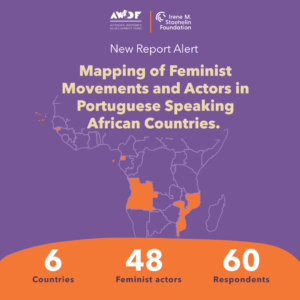
Today, we are very excited to launch the Mapping of Feminist Movements and Actors in Portuguese Speaking African Countries report, a comprehensive look at feminist and women’s rights organising across six countries: Angola, Cape Verde, Equatorial Guinea, Guinea-Bissau, Mozambique, and São Tomé and Príncipe.
“We are not less political or less radical. We are just excluded by the power of language.”
– Angolan Feminist
The report and data reflects 48 feminist actors who tAWDF_ Mapping of Feminist Movements and Actors in Portuguese Speaking African Countries ook part in focus group discussions; 60 feminists completed a rapid quantitative survey; three key informant interviews with funders shaped the funding analysis; and six distinct national contexts, each mapped on its own terms.
Across all six countries, the same threads keep surfacing: gender-based violence as the most urgent shared issue, chronic underfunding of community-based and unregistered groups, and a persistent invisibility, both online and in donor conversations.
Alongside these challenges, the report also documents real wins. In Angola, colonial-era sodomy laws have been repealed, and abortion access has expanded – though restrictions remain. In Cape Verde, younger generations are talking about feminism more openly than ever. In São Tomé, youth-led programs are bringing gender education directly into communities. In Mozambique, a strong, multi-generational movement continues to grow. And in Equatorial Guinea, where activists face surveillance and censorship, simply continuing to organise is itself a form of resistance.
The report offers country-by-country breakdowns of political, economic, and cultural context; a typology of feminist actors, from community-based organisations to faith-engaged feminists to youth digital movements; an analysis of funding patterns, gaps, and systemic access barriers; documentation of anti-rights pushback and feminist counter-strategies; and strategic recommendations which we believe is crucial to the broader donor ecosystem.
Read the full report in Portuguese.
Read the full report in English.
Explore the key findings in our infographic.