
International Day of Zero Tolerance Against FGM: The Gambia is at the Brink of Another Anti-FGM Repeal Threat
Feb 6, 2026
Media Center /
Blog, News
Today, 6th February, the world over pauses to commemorate International Day of Zero Tolerance for Female Genital Mutilation (FGM) and affirm one absolute principle: FGM is a harmful cultural practice unacceptable everywhere.
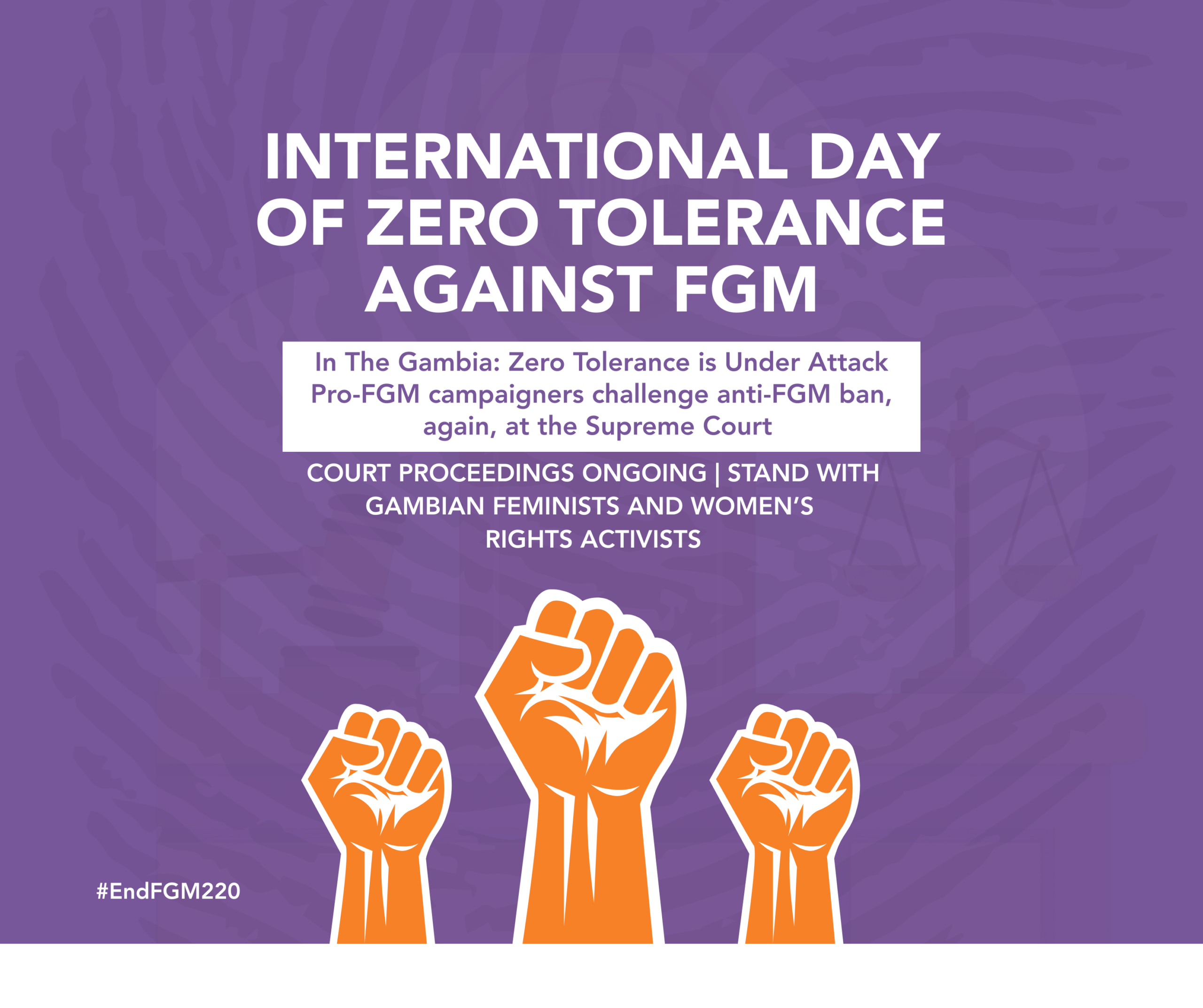 Yet, as global attention turns to ending the practice, apivotal battle is unfolding in The Gambia, where the Supreme Court is hearing arguments that could reverse the country’s 2015 ban on FGM and strip women and girls of their legal protection from FGM.The urgency of this moment is underscored by recent reports of the death of two babies after undergoing FGM in Banjul and Basse after undergoing FGM. These deaths reveal the stark and immediate cost of FGM’s continuance, particularly on girls.
Understanding the origins of this backlash in The Gambia is crucial. FGM has been a historic practice in The Gambia and most countries in Africa. It reportedly continued even after the ban in 2015, its persistence contested by feminists, women’s rights activists and survivors. However, its persistence has been contested by feminists, women’s rights activists and survivors. In August 2023, The Gambia made progress, three women were convicted for subjecting eight infant girls to FGM, the first prosecution since criminalisation in 2015. For feminists, survivors, and women’s rights defenders, this moment confirmed that decades of advocacy had translated into real accountability.
Almost immediately, an organised backlash emerged. Pro-FGM religious leaders paid the fines imposed on those convicted and launched public campaigns framing the ban as foreign-imposed, uncultural, and unislamic. The Supreme Islamic Council issued a fatwa claiming FGM is religiously required.
In 2024, a National Assembly Member introduced legislation to repeal the ban entirely, framing it as defending “religious norms” and threatening other protective laws, including child marriage prohibitions. Although Parliament upheld the ban following intensive advocacy, pro-FGM campaigners have advanced their challenge to the judiciary, arguing that criminalising FGM violates constitutional rights to religious and cultural freedom in The Gambia.
The scale and severity of FGM is stark. According to the 2019-2020 Gambia Demographic and Health Survey, approximately 73% of women aged 15-49 have undergone FGM, the overwhelming majority before the age of five. Crucially:
- 73% of affected women underwent procedures involving cutting and removal of flesh (WHO Type II).
- 17% were subjected to more severe forms involving stitching or narrowing of the vaginal opening (Type III).
- Nearly all women and girls affected live with the most invasive and harmful forms of FGM.
FGM in The Gambia is not only a social norm, it is actively defended and rationalised, making the legal protection of girls all the more essential.
What is at Stake in the Supreme Court
If The Gambia’s Supreme Court reverses the ban, the consequences will be immediate and far-reaching:
For girls: Legal protection vanishes. FGM becomes legitimised as a “religious and cultural right” rather than recognised as the harmful practice it is. Girls lose the one safeguard that could prevent them from being subjected to the practice.
For the state: Prosecutorial power disappears, law enforcement loses the ability to prevent, investigate, and prosecute FGM.
For other protections: Child marriage laws and other safeguards become vulnerable to similar “religious and cultural freedom” challenges. If patriarchal control can successfully cloak itself in religious language to override bodily autonomy here, it will be attempted everywhere.
For the region: This sets a dangerous precedent across Africa, undermines international standards, and emboldens anti-rights movements continent-wide. This could call to task similar contentions and challenges across national and regional protective treaties and laws.
An Observed Pattern We Cannot Ignore
Whilst The Gambia’s FGM crisis is urgent and specific, it reflects a broader, coordinated anti-rights backlash unfolding across the continent. We are witnessing systematic rollbacks: abortion access restricted and challenged LGBTQI+ rights criminalised, domestic violence protections undermined, women’s political participation resisted.
The playbook is consistent, frame women’s rights as “foreign imposed ideals”, mobilise religious authority, claim that protecting girls violates freedoms, then litigate whilst harm continues.
On this International Day of Zero Tolerance for Female Genital Mutilation, Gambian feminists and women’s rights advocates are on the frontlines of this fight, and they need sustained solidarity:
- Flexible, long-term funding for legal defence, survivor services, and sustained organising
- Amplification with Gambian feminist experiences and expertise centred
- Accountability from governments and international bodies to uphold regional standards
- Long-term commitment that recognises this as ongoing resistance
When feminists in The Gambia fight for bodily autonomy, they fight for all of us. AWDF stands with Gambian feminists and women’s rights advocates defending the law. We call for sustained, resource-backed international solidarity, not just today, but in the long-term commitment that movement work requires.