
Tag: leadership
CALL FOR APPLICATIONS FOR AWDF FEMINIST LEADERS & GOVERNANCE COACHING PROJECT, 2016
CALL FOR APPLICATIONS FOR AWDF FEMINIST LEADERS & GOVERNANCE COACHING PROJECT, 2016

Background
In 2014, the African Women’s Development Fund (AWDF) launched a feminist coaching project on leadership for women leaders of its grantee organisations. In 2015, the project was expanded to include strengthening governance frameworks within participating organisations. The project is based on our knowledge of the persistent challenges of African women’s organisations with issues related to resource mobilisation, communications, governance, leadership transition, safety and wellbeing. Given these constraints and the external context women’s organisations work in, they tend to focus on narrow short-term advocacy or urgent service-delivery projects, with little capacity to expand alliances, envision innovative strategies and be forward thinking.
This coaching project seeks to develop the individual leadership skills and values of participating CEOs/EDs as well as those in second level management. It is also aimed at strengthening the institutional and governance structures of participating organisations and providing an enabling framework fortheirrelevance and sustainability. At AWDF, we believe that a well-grounded leader in feminist values, ideology and clarity of purpose can accelerate the process of social justice and development effectively. Therefore, investment in both individual leaders and governance frameworks of African women’s rights organisations is vital.
By September this year, the third batch of 10 AWDF grantee organisations and 20 women leaders will be completing the coaching project. So far, these grantees are reporting improvements in leadership and communication styles, effective staff management and active engagement of their board members. Leaders have improved their visibility and fundraising abilities through written articles and their media appearances.
Project Duration & Methodology
This is a 9-month coaching project on leadership and governance from December 2016– August 2017. The project is targeted at CEO/EDs/Programme Managers/Coordinators and those in second level management of AWDF grantee organisations within the age bracket of 18 – 45 years.
The coaching project will entail the following:
1. Attending a Chief Executive Officer (CEO) forum. This is a 3 day event for orientation, skills sharing, strategy development and networking for participating leaders, coaches and AWDF. This event will be held in Kenya from 15- 17 November 2016.
2. Engaging in one-on-one coaching via phone calls, email, Skype conversations and occasional inperson meetings with their personal coaches from December 2016 – August 2017
3. Governance strengthening activities for boards of participating organisations.
4. Writing of opinion pieces or articles by leaders about their work and development.
5. Participating in at least one AWDF skill building training/workshop where necessary.
Who Should Apply?
Interested organisations should fulfil the following criteria in order to be considered for this project:
✓ Be an AWDF grantee and should have received grants from AWDF in the last 3-5 years
✓ The organisation should have an existing board which will be available for the governance strengthening trainings.
✓ The organisation should have a minimum of 3 full-time staff
✓ The organisation should have access to reliable internet and be able to use Skype and email.
✓ The organisation should have functioning office space with basic office infrastructure.
✓ The organisation should work in any of these areas; Violence against Women (VAW), Health and Reproductive rights (HRR), Economic Empowerment and Livelihood (EEL) areas and with women especially young women.
✓ Two staff members from an organisation’s leadership. That is one CEO/ED/programme Manager/Coordinators and one staff from the next level in management.
✓ Applying leaders should be within the ages of 18 – 45 years.
✓ Leaders should be able to communicate in either English, French or Amharic.
✓ Leaders should be able to communicate via internet, Skype, telephone and email.
✓ Leaders who have demonstrated the potential to develop.
To be considered for the project, your organisation is required to send your application to the AWDF Capacity Building Unit at Nafi@africlub.net/awdf; Ayesha@africlub.net/awdf; cbsintern@africlub.net/awdf justifying why you and your organisation should be selected for the project. All applications MUST be received by 8th August 2016
Please include the following in your application:
❖ Names and positions of 2 staff from your organisation who will be participating in the project
❖ Why your organisation should be considered (highlighting on leadership & governance issues).
❖ Your last grant from AWDF, the year and for what project.
❖ Which level(s) your organisation typically engages in i.e community, national or regional
❖ Challenges you hope to overcome in the process
❖ How the project will enable you achieve your individual and organisational objectives.
❖ Include a written recommendation from your board endorsing you and your participation in the project
❖ Any other information to strengthen your application is welcome.
Participation in this project is by application only. As only a specific number of grantee organisations will be chosen to participate in the project, there are no promises of automatic qualification for applying organisations. This is a non-paying project and participants are required to commit only about 10% of their total work time to the process.
Please note that the individual leadership coaching project is reserved for ONLY women leaders. Deadline for Submission is 8 th August 2016. The full application should be sent to Nafi Chinery, Capacity Building Programme Specialist at Nafi@africlub.net/awdf and cc: Ayesha@africlub.net/awdf, cbsintern@africlub.net/awdf
Thank you.
AWDF’s CEO Forum: Sharing Our Stories with the Media
AWDF’s CEO Forum: Sharing Our Stories with the Media
This video highlights the work of African women leaders who participated in the African Women’s Development Fund’s (AWDF) annual CEO Forum in Nairobi, Kenya, from 10 – 12 August 2015.
This 3-day convening, which is a part of AWDF’s Capacity Building Programme, focused on Leadership and Communications and featured 21 women leaders from 8 African countries. It also includes a 10-month coaching process.
The video illustrates a media skills training, led by Paula Fray, a media strategist and one of the coaches, where some of the participants share the amazing work their organisations are achieving for women on the continent.
Women Featured:
Cynthia Coredo, BoxGirls Kenya
Blessing Ihauku Duru, Alliances for Africa (Nigeria)
Joy Ijeoma Ngwakwe, The Centre for Advancement of Development Rights (Nigeria)
LundiAnne Omam Ngo Bibaa, Reach Out Cameroon
Sharon Handongwe Mainza, Kuvuna Youth Foundation (Zambia)
Juliet Were, Isis-Women’s International Cross Cultural Exchange (Uganda)
Lorato Moalusi-Sakufiwa, Kagisano Society-Women’s Shelter Project (Botswana)
Claret Madzikanda, Uluntu Community Foundation (Zimbabwe)
Susanne Muwazi, Action for Rural Women’s Empowerment (Uganda)
Florence Otieno, Project Coordinator of Boxgirls Kenya
Special Thanks to the African Capacity Building Foundation and the Bill and Melinda Gates Foundation for supporting this CEO Forum and coaching programme.
AWDF’s 4th CEO FORUM IN TWEETS AND PICTURES
AWDF’s 4th CEO FORUM IN TWEETS AND PICTURES
AWDF’s Chief Executive Officer’s Forum 2015
AWDF’s Chief Executive Officer’s Forum 2015
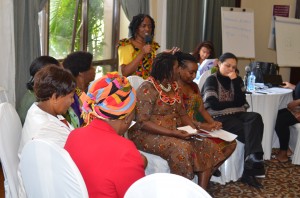
[tp lang=”en” not_in=”fr”]AWDF’s Next Chief Executive Officer’s Forum will be held from 25-27 March 2015 in Nairobi, Kenya.
The three-day programme organized by AWDF’s Capacity Building unit, is designed to support participants’ personal and organizational development.
This year’s forum will be attended by 20 top and middle-level managers from five African countries. They will receive coaching under a new, expanded coaching and mentorship project on Leadership and Governance, aimed at strengthening the capacity and governance frameworks of women’s organisations across the continent. Board members of the various organizations would also be joining in the forum, making a total of 35 female executives expected to benefit from the convening.
The CEO Forum forms part of AWDF’s commitment to strengthening the leadership of women’s organisations in Africa. It provides a safe space for the leadership of women’s organisations to discuss strategic leadership issues, offer hands-on coaching, sharing and reflection time, and an opportunity to network.
AWDF’s CEO forum is designed specifically to foster a safe and enabling creative environment, imbued with feminist values, for the renewal of participants’ energy and spirit.
” l am excited about the project because this provides us with the opportunity to address key issues challenging the growth and robustness of women’s organisations in Africa, in order to promote the rights and development of women. “ says Nafi Chinery, AWDF’s Capacity Building Specialist.
This would be AWDF’s fourth CEO convening.[/tp]
[tp lang=”fr” not_in=”en”]Le prochain Forum des Chefs de Direction s’AWDF se tiendra du 25 au 27 Mars 2015 à Nairobi, au Kenya.
Le programme de trois jours organisé par l’unité de renforcement des capacités d’AWDF, est conçu pour soutenir le développement personnel et organisationnel des participants.
Le forum de cette année sera suivi par 20 gestionnaires de cinq pays africains de haut et de niveau intermédiaire . Ils recevront une formation sous une forme nouvelle: du coaching et un projet de mentorat élargi, le leadership et la gouvernance, visant à renforcer les cadres des capacités des organisations de femmes et de la gouvernance à travers le continent. Les membres du conseil d’administration de diverses organisations se joindraient au forum, soit un total de 35 femmes cadres qui devraient profiter de la convocation.
Le Forum des CD fait partie de l’engagement d’AWDF de conforter le leadership des organisations de femmes en Afrique. Il offre un espace sûr pour les dirigeants des organisations de femmes pour discuter des questions de leadership stratégique, offrir des pratiques de coaching, le partage, le temps de la réflexion, et une occasion de faire du réseautage.
Le Forum des CD d’AWDF est spécifiquement conçu pour favoriser un environnement créatif sûr et favorable, imprégné de valeurs féministes, pour le renouvellement de l’énergie et de l’esprit des participants.
“Je suis enthousiasmée par le projet parce que cela nous donne l’occasion d’aborder les questions clés contestant la croissance et la robustesse des organisations de femmes en Afrique, afin de promouvoir les droits et le développement des femmes.” Dit Nafi Chinery, spécialiste de renforcement des capacités d’AWDF.
Ce serait le quatrième rassemblement des Chefs de Direction d’AWDF.[/tp]
AWDF and ALC Working to Strengthen Women’s Leadership and Representation in Peace Building in Africa
AWDF and ALC Working to Strengthen Women’s Leadership and Representation in Peace Building in Africa
[tp lang=”en” not_in=”fr”]In 2013, AWDF awarded a multi-year grant of US$90,000 over 3 years to the African Leadership Centre to strengthen women’s leadership and representation in peace building processes on the African continent.
The African Leadership Centre (ALC), based in Nairobi, Kenya, was established as an educational trust under Kenyan law in partnership with King’s College London and the University of Nairobi. One of its core programmes is the Peace and Security Fellowship for African Women, which brings together African women at the early stages of their careers, to undertake a carefully designed training programme in Leadership, Development and Security.
As part of the AWDF grant, 2 African women, Grace Kilonzi (Kenya) and Semiha Abdulmelik (Ethiopia), have been sponsored to participate in ALC’s 2014-2015 Peace and Security Fellowship programme. The programme, which takes place at the ALC and King’s College London, is designed to expose young professional African women to the complexities of conflict, security and development to equip them for careers in the field.[/tp]
[tp lang=”fr” not_in=”en”]En 2013, AWDF reçu une subvention pluriannuelle de 90.000 $ sur 3 ans pour le Centre de leadership africain pour renforcer le leadership et la représentation des femmes dans les processus de consolidation de la paix sur le continent africain.
Le Centre africain de leadership (ALC), basé à Nairobi, au Kenya, a été établi en tant que fiducie en vertu de la loi kenyane éducative en partenariat avec le King’s College de Londres et l’Université de Nairobi. Un de ces programmes de base est la bourse ‘Paix et Sécurité pour les femmes africaines’, qui regroupe les femmes africaines dans les premiers stades de leur carrière, afin d’entreprendre un programme de formation soigneusement conçu en leadership, développement et sécurité.
Dans le cadre de la subvention AWDF, 2 femmes africaines, grâce Kilonzi (Kenya) et Semiha Abdulmelik (Ethiopie), ont été parrainées pour participer en 2014-2015 au programme de bourses ‘Paix et Sécurité’ de la SLA. Le programme, qui se déroule à l’ALC et au King’s College de Londres, est conçu pour exposer les jeunes femmes africaines professionnelles de la complexité des conflits, de la sécurité et du développement pour les équiper pour une carrière dans le domaine.[/tp]
Click for Grace‘s full profile
Click for Semiha‘s full profile
Read more about Grace
Reflections on AWDF’s 3rd CEO Forum by Zukisiwa Wanner
Reflections on AWDF’s 3rd CEO Forum by Zukisiwa Wanner
I spent the first three days of this week attending the African Women’s Development Fund’s (AWDF) third Chief Executive Officer’s Forum at the Crowne Plaza Hotel here in Nairobi. The CEO Forum brings together leaders in women’s organizations that work with AWDF.
I admit it, I had no idea what to expect. Yes I had received the program in advance. Yes, I’ve heard of many of the women previously. Maybe even worked with one or two of their organisations. And yes, like me all of these women are African feminists. But but but…there was also a key difference. I am self-employed and in a very practical way, whatever actions I take regarding my advocacy on women’s issues is my own decision and often affects only me. These women, leaders in their own organizations, take actions that impact other women in ways I could never even begin to do.
I knew that I would meet a woman who is pushing to get more African stories by African writers for African children on the continent – my younger sister Deborah Ahenkorah of Golden Baobab.
I had Googled the women training women in politics and those looking out for the rights of young women too often under threat from patriarchy through forced marriages and payment of fines to parents (mostly fathers) where girls have been raped instead of prosecution – Mawusi Awity, Amy Oyekunle, Yvette Kathurima.
I would meet the amazing food microbiologist and retired Dean of Science from the University of Botswana who I planned to ambush to become my son’s newly adopted grandmother, Professor Sesae Mpuchane who is also the Chair of the AWDF Board.
And the legends in Afro feminist circles – Mary Rusimbi, Sarah Mukasa and Hope Chigudu (I knew these three as being part of the team that gave us the Charter of Feminist Principles for African Feminists but had never met them) and the Ugandan Woman Achiever 2013,the incorrigible and lovable Dr. Hilda Tadria.
Then too, I would meet the women behind my meeting these other fantastic women, the AWDF team consisting of the soft-spoken but uncompromising (on feminist issues) Theo Sowa, convenor of all these amazing women Nafi Chinery, well-known Afro-sexuality blogger Nana Darkoa, and of course the aforementioned Sarah Mukasa.
My leadership, if I can be said to have any, is different from any of the women above and consists of much navel-gazing and compliment seeking on whether a word or phrase sounds right and yet, in the three days I never had a single moment of being an outsider looking in. It was amazing listening, learning, laughing, crying, comforting, sharing with all of them. Through being with them, I learnt some very important things that I should have known but did not know. I learnt that whatever successes one makes of whatever they are doing is not very useful if it isn’t communicated to the people who should know about it. As an example, we can set up mentorship programs for young women or set up a centre for abused women, a workshop for women writers but if we do not communicate the message to the people who it’s set out for; to the public among whom may be a sympathetic audience that may help out when needed then there is a degree of failure. And yes, too often while self-identifying as a feminist and talking of a feminist cause on this continent often leads to a hostile media within, there are ways to counter the hostility through proper messaging.
Equally important, I learnt that being a ‘strong African woman’ at the expense of my well-being is counter-revolutionary to the feminist movement. I learnt that it is okay to admit being tired. To ask for help and admit that I cannot do it all and most importantly, I am under no obligation to do it all. To quote Hope Chigudu, “after all, what are human rights if we are fragmented, have no support and are unhappy?”
On Monday 2nd June 2014, I went into a room full of strangers, and left having met some people I know will be lifelong friends. And for those whose paths may not cross with mine again (why ever not?), I leave having learnt valuable lessons from each and every one. A major reason for this was that the group was small enough that in the course of the three days I got to chat with each of the women and found echoes of myself in many of them. As I reflect on the three days spent with the women I met at the CEO Forum, I happily admit that whatever it is I expected, what I experienced was beyond my expectation. If the coaching that many of these women will undertake in the next ten months is as successful as the three days I spent with them, the future of African women leadership and the African feminist movement is in good hands. Best wishes to the CEOs and Executive Directors taking part in the 10 month coaching program as a follow up to this forum on leadership, governance and communications.
By: Zukisiwa Wanner
Zukisiwa Wanner is a writer who was most recently recognised “…as one of the top 39 sub-Saharan African novelists under 40 writing in English, French, Portuguese or an African language.” Check out her blog

AWDF’s 3rd CEO Forum in Tweets and Images
AWDF’s 3rd CEO Forum in Tweets and Images
Hope Chigudu’s thoughts on ‘Riding the Waves of Activist Leadership’
Hope Chigudu’s thoughts on ‘Riding the Waves of Activist Leadership’
The following note touches on some broad issues that we struggle with as we ride the waves of leadership in our organisations. The note is a product of various moments of self and organisational-assessment and organizational development over the years. It is work in progress.
Leadership is the topic of the moment.
‘Leadership’ is one of the sexy topics of the moment. Many young women[1] are targets. Some well-known organisations have programmes related to young women and leadership. Examples include Akina Mama, Young Women Leadership Institute in Kenya, Katswe Sisterhood in Zimbabwe (Vagina Warriors) and Forum for Democracy in Uganda. Isis WICCE promotes women’s leadership in conflict and post conflict countries. The overall aim is to have a cadre of leaders with political skills to analyze, and strategize so that they can change the norms, institutions, policies, and practices that perpetuate inequality.
Generally, underlying some of the current approaches to leadership training and to definitions of leadership is the idea of leadership as a single leader representing a collective agenda, or a leader as the ‘director’, the formal head of an organisation or group. Often we forget that leadership is about learning how to shape the future collectively, especially if feminism is about building a movement with shared values.
Our goal should not be to build leaders, for the sake of building them as much as to build people who show commitment, support and drive activism, those who mobilize others to take risks, stand up for what is both innovative and just and who give their best. Some of them are already leaders, others will become leaders over time and yet others will be more comfortable in different roles, after all, a movement cannot be all leadership. What’s the point of having a good ‘leader’ if there’s nobody left in the army to fight the struggle?
As we coach, tool and support leaders we need to be aware that there are danger in extricating an individual from her community, training her again and again and sending her back to the community without ever checking if she still fits or belongs. One leader, after being trained, told her board ‘I have outgrown you. Better fire yourselves before l fire you.’ She fired them.
Many different models of leadership
We have many models of leadership. For example there are some people we have to greet with fancy words ‘the honourable x’; people who expect to be able to command everyone’s attention. Some of these are in our movements. Have we really and truly adequately considered the classism in many of our activist cultures? What kind of leadership are we promoting? Do we have a vision of the leader that we want as women, the kind of leader Africa needs? How do we deal with positional power vs activist power? Be that as it may, leadership is not about positional power, accomplishments, not even about what we do. It’s about creating a domain in which human beings continually deepen their understanding of reality and become more capable of participating in the unfolding of the world. It’s about giving people hope. Effective women’s organizing requires varieties of activist leadership – including the capacity to facilitate, mediate and mobilize – embodied in multiple leaders. Charter of Feminist Principles for African Feministsprovides guidelines for cultivating innovative new forms of power and leadership and for dismantling patriarchy and its structures.
Ability to inspire: Part of what makes a leader, is their ability to inspire others to action, and to build the capacity of those around them, to encourage people to give their best; and to recognise and value everyone’s participation, rather than requiring recognition themselves. So why are so many of our leaders so concerned with visibility & recognition? Are we contributing to the problem by having different kinds of awards, etc.? Does it also have to do with the need to prove to donors that x leader/organization is worth investing in?
Love:Activist leadership is about shifts in psychology, ideology and practice. It is about transformation.Transformation requires fundamental shifts. It requires love. Why love? It is the ultimate motivation of a transformative leader. Love of a country, movement, cause, principles, people we work with or those whose lives we want to change and love of the future. Love inspires, it activates audacity, boldness and courage, and it generates boundless energy. Without love of a cause, how can we take a stand, how can we make sacrifices, how can we venture, how can we take risks? It is love that generates the energy that keeps us unfolding the future, that keeps us engaged, that keeps us in the ‘groove’. There is a deeper commitment to seeing something through that also makes one willing to be ‘daring’ and not just be a bureaucrat and ‘represent’ people in an ‘all protocols observed’ kind of way. Love is what keeps transformative leaders going when the barriers the movement is fighting against seem insurmountable. Love should be ingrained in the DNA of our leadership training programmes.
Self-renewal: We have some tired leaders and organisations that have done the same things over and over again. A leader should be able to renew her energy and spirit and that of her organisation otherwise both expire. Inside itself, an organisation must be alive and constantly re-inventing its creativity. It should reflect on the spectacles and lenses that inform its practice, and critique these. Critical self-reflection is core not only to the quality of practice but to the ability to withstand processes of rusting and erosion. Anything less and the organisation succumbs to the forces that it thinks it’s so very different from.
Any programme aimed at supporting leaders should seriously encourage them to renew themselves so that they can deliver their messages with a quality of thinking that goes further and deeper than (probably) the prevailing thinking that is taking place around them. One way of renewing oneself is to expand the creative use of social media and improve communication.
Stop: The more we work, the more our work increases. It’s not possible that there will be ‘free time’ unless we create it. Being busy has become a positive value in itself, it’s as if we need to show that we are busy in order to feel validated, useful and important. How many conversations have you been in where people kind of compete with each other to show how busy they are? Should we not start a new competition, where leaders compete to show that they are spending time learning and thinking? Where are the organizations that include in their budgets time to think about what they have done; time to explore with the people in the communities they work with, with the other organizations they ally with – how they are doing? Is our work-style building up the capacity and confidence of those we work with? Are our strategies taking us where we want to be going? Resisting and ultimately transforming power – in all its relations, structures, forms, spaces, and places is not work for extremely tired leaders. It is work for those who stop, re-energise and retool.
Read and theorise: Leadership development needs to be supported with reading. How many of us set aside the time to read and to theorise our work? There are some leaders who claim they do not read because they do not have time. Yet, again, reading is part of keeping abreast of what is going on, and situating one’s own strategies appropriately. And when I am talking about reading, l am not talking about an hour a day on face book keeping up with people and enjoying some jokes although face book and other sites can be very helpful in keeping us aware of struggles going on in our own countries and beyond. But I am talking about reading research findings on our issues, so that our demands are grounded in evidence. Being a credible activist leader also means having an updated sense of political debates and critical thinking on the issues that we work on. Leaders need to have a sense of social movements across Africa and what their agendas are, the strategies they are using, and how these are changing and adapting. They should be able to respond with sharp minds if they are going to stay ahead of the game! There are now a range of online editorial and news sites run by African social justice activists that we could use to strengthen our work.
Share openly: Change is not possible withoutsharing leadership challenges and lessons learnt at least within own organisations or with other sisters. Good leadership encourages people to talk about what is not working, rather than only talking about what is working. The Hewlett Foundation, for example, has a ‘worst grant’ competition, where program officers have to describe the worst grant they made – looking at what lessons they can learn about the way they make grants, from these negative experiences. This is validating learning – creating a safe space within which we can talk about challenges. It also validates failure, acknowledging that many of the ideas that we have do not work! If we do not interrogate what went wrong we are very likely to repeat the same mistakes which is neither a good use of resources nor a contribution to moving our work forward. This is a good point in terms of making the case for both organizations and their donors to invest in regular organizational reflection.
[1] The Southern African Young Feminist Leadership Course looks at the meaning of feminism and how it shapes the politics of our everyday lives. It examines why men dominate in various spheres of life and what women can do to change this. By the end of 2014, the course will have been conducted in six countries, with over 400 young women participating.
References
[1] Zieliñska, M., Kowzan, P and Prusinowska, M., ‘Social movement learning: from radical imagination to disempowerment?’ Studies in the education of adults, 43(2), 2011:251-267.
[1] Ollis, T, ‘The ‘accidental activist’: learning, embodiment and action’, Australian Journal of Adult Learning, 48(2), 2008:316-335.
[1] Barefoot Collective, Barefoot Guide to Working with Organizations and Social Change, The Barefoot Collective, (published online), 2009. http://www.barefootguide.org/download.php.
[1] Holland, J., Reynolds, T. and Weller, S, ‘Transitions, networks and communities: the significance of social capital in lives of children and young people’, Journal of Youth Studies, 10(1), 2007:97-116.

The 3rd Chief Executive Officers Forum (CEO Forum)
The 3rd Chief Executive Officers Forum (CEO Forum)
The CEO Forum forms part of AWDF’s commitment to strengthening the leadership of women’s organisations in Africa. It is a biennial event that provides a safe space for the leadership of women’s organisations to discuss strategic leadership issues, share experiences and build skills that will support their personal and organisational development. It is a safe creative space, imbued with feminist values, for renewing energy and spirit.
The (3rd) Chief Executive Officer’s Forum will be held from 2- 4 June 2014 in Nairobi, Kenya and will focus on the theme, ‘Leadership, Governance & Communication for CEO’s and Executive Directors from African women’s organisations’.
The forum was set up with two key objectives:
- To create safe spaces for the leadership of women’s organisations to share challenges and ideas within the current global context with their peers and collectively develop strategies for addressing these
- To create a platform for the leadership of women’s organisations to discuss challenges around leadership, management and governance issues facing women’s organisations in Africa and how to promote these for development.
These objectives do not end with Nairobi. As part of its core mandate, AWDF has committed itself to efforts that seek to enable and strengthen African women’s organisations and their leadership to contribute to wider development goals and especially those around women’s development. Therefore, as part of its leadership support, AWDF is offering a ten month coaching support to ten Africa women leaders from AWDF grantee organisations in leadership and communication. This coaching is not about teaching, it’s about walking and thinking alongside leaders and supporting them into being transformational in their leadership capacity.
Please see PDF below for bios of the leaders undertaking the coaching programme.
Profiles of 10 leaders to be coached over 10 Months (final)
By: Nafi Chinery, Capacity Building Specialist, AWDF

Erelu Bisi: Celebrating 50 years of making a difference
Erelu Bisi: Celebrating 50 years of making a difference
[tp lang=”en” not_in=”fr”]Currently I am in Ekiti State, Nigeria and have had the pleasure of joining Erelu Bisi, Co-Founder of AWDF and Founder of the Ekiti Development Foundation (EDF) in various activities commemorating her 50th birthday.
Frankly I have been amazed at the energy that Erelu has. A full day was recently spent with journalists from print media, radio and television stations, and the ease with which she answered questions showed clearly that she is a woman with a purpose. Next on the schedule was a donation to beneficiaries of the EDF food bank which supports elderly people in the state of Ekiti who do not have the means to support themselves. Afterwards we headed to an event organised by the women of Ekiti in celebration of Erelu Bisi where various women’s groups have testified to Bisi’s strong support of the rights of women in the State.
To top it all off Iconic magazine presented Erelu Bisi with the iconic woman award. Congratulation Bisi, I remain inspired by the work you do in Ekiti State, Nigeria.
Rissi Assani Alabi
Francophone Programme Officer
AWDF[/tp]
[tp lang=”fr” not_in=”en”]Actuellement, je suis dans l’État d’Ekiti, Nigeria et ai eu le plaisir de me joindre Erelu Bisi, co-fondatrice d’AWDF et fondatrice de la Fondation Ekiti de développement (FED) à diverses activités commémorant son 50e anniversaire.
Franchement, je suis étonnée de l’énergie d’Erelu. Une journée entière a été récemment passée avec les journalistes de la presse écrite les stations de radio et de télévision, et la facilité avec laquelle elle a répondu aux questions a clairement montré qu’elle est une femme avec un but. Suivant le calendrier, c’était un don aux bénéficiaires de la banque alimentaire EDF qui soutient les personnes âgées dans l’Etat d’Ekiti qui ne possèdent pas les moyens de subvenir à leurs besoins. Ensuite, nous sommes allées à un événement organisé par les femmes d’Ekiti pour la célébration d’Erelu Bisi où les divers groupes de femmes ont témoigné du fort soutien de Bisi aux droits des femmes dans l’État.
Pour couronner le tout, le magazine emblématique a présenté Erelu Bisi avec l’attribution de la femme emblématique. Félicitation Bisi, je reste inspiré par le travail que vous faites dans l’État d’Ekiti, Nigeria.
Rissi Assani Alabi
Chargé de Programme francophone
AWDF[/tp]


