
Defending Gains, Disrupting Power, Defining Feminist Futures
Mar 7, 2026
Media Center /
News
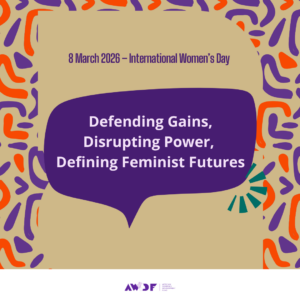
Accra, 8 March: We are living through a moment of profound global upheaval. Across continents, societies are grappling with intersecting crises: genocides and violent conflicts and humanitarian catastrophes, deepening economic inequality, climate shocks, democratic backsliding, and the increasingly coordinated efforts of anti-rights actors to roll back hard-won gains for gender justice. Recent escalation in the SWANA region further exacerbates suffering and inequality amid polarised geopolitics.
In Africa, these global dynamics intersect with complex regional realities. Conflicts in Sudan, the Democratic Republic of the Congo, and northern Mozambique are displacing millions. From Algeria to Tanzania, increased authoritarianism leads to shrinking civic space and increased restrictions on civil society. From Uganda to Ghana, anti-rights actors are weaponising the legal system to make homophobia institutional. Severe droughts in East Africa and repeated cyclones and floods in Southern Africa are having a devastating humanitarian impact. Everywhere, these crises expose girls, women and gender-diverse people to systemic sexual violence and economic precarity and expose social and gender justice activists to increased surveillance and repression.
For us at the African Women’s Development Fund (AWDF), marking International Women’s Day in such a context is not a vain ritual. It is an act of recognition, remembrance, and profound respect. Today, we honour the women, girls and gender-diverse people who bear the brunt of the polycrisis. We pay tribute to the feminist pioneers who paved the way through decades of resistance. We celebrate the organisers who put their lives and freedoms at risk to shape gender-just futures for generations to come.
We feel honoured to have journeyed alongside these changemakers for over 25 years. Since 2000, we have awarded over USD 100 million in grants to more than 1,500 organisations and movements advancing gender justice across Africa. Beyond funding, we have contributed to strengthening feminist knowledge, convening spaces for movement dialogue and solidarity, and amplifying African feminist voices in global debates on development, philanthropy and social justice.
In 2025 alone, we awarded over USD 12 million in grants to partners who challenged discriminatory laws, defended bodily autonomy, fostered women’s leadership and political participation, created new spaces for collective power and political participation, and forged cross-border solidarity that redefines power itself. In Zimbabwe, for example, feminist activists are pushing for stronger legal protections and expanding leadership opportunities for women and girls through advocacy and mentorship. In Chad, feminists are mobilising communities to promote women’s leadership, combat gender-based violence, and create new spaces for feminist dialogue. In the Gambia, we continue to support movements fighting against repeated efforts to decriminalise female genital mutilation. These few examples represent a glimpse of a vibrant and determined feminist ecosystem across Africa.
Harsh realities are forcing impossible choices
This year, we particularly commend African feminist activists, organisations and movements for the extraordinary ways they are responding to multiplying disruptions in a rapidly shifting funding landscape. Across the globe, Official Development Assistance is declining or being redirected (ODA to Africa faced 16-28% cuts in 2025 according to the OECD. Meanwhile, philanthropic funding for gender justice remains a small fraction of overall giving. AWID’s ‘Where is the Money?’ report (2025) revealed stark precarity: 28% of feminist organisations had no budget secured for 2025, 46% had none beyond 2026, and 64% could operate for less than 6 months without external funding. Most grants they received r-emained short-term, project-tied, and restrictive. Such funding models cannot match the scale or urgency of the work feminist movements are undertaking.
Yet even under these pressures, feminist movements continue to organise with remarkable creativity and determination. Many are holding the line, ensuring protection, resilience and survival in the face of repression and crisis. Others are making strategic shifts, moving from reactive programmatic responses to collective and proactive approaches that tackle the root causes of inequality. Across movements, we are also witnessing the recognition of care as infrastructure: organisations are centring wellbeing, collective healing and sustainable organising as essential components of long-term feminist power. African feminist movements are not merely weathering the storm of crisis. In many ways, they are a storm in their own right: a powerful force for change reshaping the political, social and economic futures of their communities.
Yet harsh realities force impossible choices. With limited resources, AWDF partners are having to choose between delivering essential services and advocating for laws and policies, between health and education programmes, or between office rent and staff insurance. Sometimes, funding cuts take away the choice altogether, with the closing of programmes targeting sexual and reproductive health and rights and LBTQI rights, and other issues perceived as contentious.
Defend, Disrupt, Define: How AWDF is meeting the moment
AWDF itself has had to make some difficult decisions in anticipation of funding cuts. We decided to prioritise funding to community-based and marginalised groups, over larger-scale and regional groups. We decided to prioritise grantmaking over some of our other flagship knowledge-building or solidarity-building programmes, and to channel our non-grantmaking programming through the work of the African Feminist Forum. Most critically, we choose depth over scale: resourcing fewer movements more impactfully, because true power builds from strong roots.
We are deepening, not contracting, our work through the bold 3D framework which will guide how AWDF will implement its Lemlem strategy in the next few years. Through our grantmaking, movement-strengthening and thought leadership work, we plan to resource and accompany our partners to:
- Defend hard-won gains, by resourcing and nurturing feminist movements to sustain their impact, to protect and secure human rights, to oppose the backsliding of feminist wins, and sustain the core infrastructure of African feminist movements. This includes expanding resources for feminist groups in underfunded linguistic and geographic contexts, including Portuguese-speaking countries, and strengthening support for feminist responses in crisis and conflict settings.
- Disrupt oppressive ecosystems, by challenging and transforming the narratives, behaviours and practices that hinder feminist movement’s impact, safety and sustainability, thus creating a healthier and more supportive environment for gender justice in Africa. Because disruption cannot happen in isolation, AWDF is working alongside other feminist funds including through the Leading From the South consortium, the pan-African Komboa alliance to counter the anti-backlash, and the Feminist Response Fund, and renewing its partnership with the Equality Fund. At a time when competition for shrinking resources is intensifying, choosing collaboration and solidarity is itself a powerful act of disruption.
- Define visionary futures, by catalysing and supporting innovative, long-term initiatives and providing spaces and opportunities for movements to think beyond resistance and lay the grounds for the feminist realities we want to see in the future. The African Feminist Forum is one of the key spaces for co-creating these futures through strategy sessions and knowledge archives, and we look forward to collectively articulating the feminist futures we want to build when we meet in Namibia in August 2026.
As AWDF Chief Executive Officer, Françoise Moudouthe affirms, “With this 3D framework, AWDF turns crisis into an opportunity to resource African feminists not just to survive, but to lead the long-term transformation we all need. This strategic evolution, shaped by movement wisdom, makes us more impactful, even as we are made to operate at a smaller scale.”
A call to the donor community
In this moment of adversity, we extend deep gratitude to funding partners who have stepped forward with top-up funding, additional flexibility and decreased restrictions. We call on all funders who care about gender justice to fund more and ease the bureaucratic restrictions and risk-averse approaches that hamstring our collective impact. Gender justice can only be achieved if the movements that champion it are provided the space to thrive and innovate, not asked to survive on fragmented, short-term and risk-averse funding models.
As Nana Zulu, AWDF’s Director of Programmes, reminds us, “feminist organising thrives when funding prioritises people, care, safety and collective resilience, and when philanthropy stands firmly with feminist movements even when it appears risky or unpopular. As a feminist fund rooted in African feminist movements, AWDF is committed to deepening long-term support, centring trust over control and adapting to the evolving realities of feminist movements across the continent.”
Especially when funding through women’s and feminist funds, donors should provide multi-year and flexible funding that allows us to resource our partners strategically, not pass on excessive requirements and restrictions. This moment requires supporting programmes, but also to invest in movements’ safety, resilience, healing and infrastructure. It requires philanthropy to stand firmly against anti-rights forces, not shy away from funding politically inconvenient issues.
This is not a call to charity. It is a reminder of our collective responsibility.
On this International Women’s Day 2026, we call on governments, philanthropy and the international development community society to match the courage, urgency and imagination that African feminist movements demonstrate every day. The future of gender justice will be shaped not only by those who resist injustice, but by those who choose to resource that resistance.