
Author: Tarisai Nyamweda
Thirty Years On: A Critical Reckoning for Gender Justice
Thirty Years On: A Critical Reckoning for Gender Justice
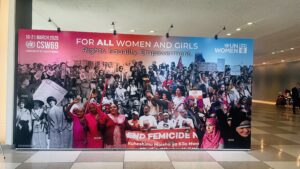
Thirty years after the adoption of the Beijing Declaration and Platform for Action, feminists from around the world converged in New York for the sixty-ninth session of the Commission on the Status of Women (CSW69), held from 10–21 March 2025. This was not just a moment to reflect on a historic milestone, but a critical time to take stock of the gains, the setbacks, and the shifting terrain for gender justice globally.
CSW as a Site of Feminist Strategy and Solidarity
The session focused on reviewing implementation of the Beijing Platform for Action—a document that remains one of the most ambitious, visionary blueprints for women’s rights. CSW is often a collision of worlds: grassroots organisers and movement leaders rub shoulders with diplomats, donors, and bureaucrats. But it’s also a vital space where feminist solidarity is rekindled, collective priorities sharpened, and political strategies debated.
Celebrating Gains, Confronting Realities
And yet, this year’s CSW felt bittersweet. While there was cause for celebration—the political reaffirmation of the Beijing Platform for Action, the powerful convening of feminists across generations—the broader context is troubling. Hard-won feminist gains are under attack. Sexual and reproductive health rights are being rolled back. Gender-based violence laws are being weakened or ignored. Space for feminist organising is closing in the face of rising authoritarianism and anti-rights agendas. Trans and queer communities are being criminalised and erased. Women human rights defenders face targeted harassment and violence. And economic policies continue to devalue women’s labour—especially in the informal and care economies—under the guise of post-pandemic recovery.
AWDF at CSW69: Political Presence and Purpose
In this context, AWDF’s presence at CSW69 was both strategic and urgent. Our focus was clear: to stand with our partners and movements, to amplify African feminist voices, and to push for sustained, flexible funding for women’s rights work—especially for those organising at the margins.
Resourcing Feminist Futures: A Call to Action
AWDF CEO Françoise Moudouthe opened the session with a powerful call for meaningful investment in gender justice. “We must immediately commit to protecting not just gender equality but gender justice for all—not with words, but with resources,” she declared. Her message resonated with urgency and clarity, calling on governments, international institutions, and philanthropic actors—especially those in the Global South—to back their commitments with real, sustained funding.
Strategic Convenings and Collective Visioning
Throughout CSW69, AWDF created spaces for strategic alignment and collective visioning. We hosted and co-hosted key events such as the Leading From the South (LFS) Collective Care event on Safeguarding Feminist Activism in Times of Polycrisis and a strategic meeting with the LFS Consortium. These spaces centred care, safety, and political strategy as feminist responses to a world in crisis.
Legacy, Leadership, and Intergenerational Dialogue
We also convened an intergenerational dialogue bringing together African feminists from across the continent and diaspora. The session explored legacy, mobilisation, and what it means to pass the baton without dropping it. As Bisi Adeleye-Fayemi reflected, “This is a movement. Intergenerational organising is about all of us being in the race, knowing we will be doing different things at different times, and playing different roles.”
Zeedah Meierhofer-Mangeli called for intentionality in passing on feminist knowledge: “Let us not leave it to coincidence—we must train, we must hand over, we must make legacy building deliberate.” Coumba Toure added her rallying voice: “Don’t wait for leadership to be handed to you. Take it. Push. Shift. That’s what the young have always done in this movement.”
Feminists on the Ground: Listening and Learning
Beyond panels and speeches, AWDF also took to the streets—with Warkha TV—to hear from everyday feminist activists. We listened, we learned, and we documented the power and plurality of feminist voices at this pivotal moment.
Movement Support in Practice
In line with our commitment to solidarity and movement support, AWDF enabled over 25 African feminist partners to attend CSW69. Partners like Nyaradzo Mashayamombe of Tag a Life International (TALI) and Anuli Aniebo of Heir Women Hub shared reflections on what it means for African women’s rights organisations to be present, visible, and resourced at global platforms like CSW.
The Road Ahead: From Commitments to Action
The session closed with a political declaration reaffirming the commitments made in Beijing, and calling for strengthened national systems, women’s machineries, and increased financing for gender equality. It was a reminder that while declarations matter, implementation—and resourcing—is what defines progress.
Moving Forward With Purpose
As AWDF, we leave CSW69 with sharper political clarity, deeper solidarity, and renewed urgency to fund, protect, and amplify the work of African feminists. The moment demands nothing less.
*Leading from the South (LFS) is a feminist funding initiative that supports women’s rights activism in the Global South through flexible, movement-led grantmaking. LFS is made up of African Women’s Development Fund (AWDF), FIMI – Indigenous Women’s Fund, Fondo Mujeres del Sur (FMS), and Women’s Fund Asia (WFA).
Consultancy Opportunity: Implementing Capacity Strengthening Activities for National Feminist Forums
Consultancy Opportunity: Implementing Capacity Strengthening Activities for National Feminist Forums
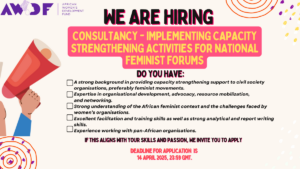
The African Women’s Development Fund seeks a consultant to implement capacity strengthening activities for National Feminist Forums. The consultancy is expected to cover the period from April- September 2025.
Expectations:
- Develop tailored capacity strengthening programs based on the needs assessments and mapping findings.
- Design and deliver various capacity strengthening approaches and initiatives including but not limited to workshops, training sessions, and mentoring programs .
- Provide technical assistance and support to NFFs in implementing their action plans.
- Develop a monitoring and evaluation framework to track the progress and impact of the capacity strengthening activities.
- Conduct regular monitoring visits and collect data on the effectiveness of the interventions.
- Prepare progress reports and a final evaluation report.
Application Process
Interested consultants should submit:
- A technical proposal outlining their understanding of the assignment, methodology and workplan.
- A financial proposal with a detailed budget,
- A CV or profile highlighting relevant experience.
Submit your application to consultants@awdf.org by 14 April 2025.
Read more HERE .
Want to join our team? We have two exciting vacancies. Closing date 8 April.
Want to join our team? We have two exciting vacancies. Closing date 8 April.
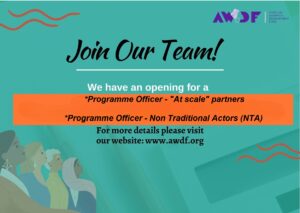
The African Women’s Development Fund is thrilled to announce two exciting vacancies that have arisen in its team.
Are you ready to be part of this passionate diverse and dedicated team working to support and strengthen feminist organisations and movements in pursuit of gender justice and social transformation. Then apply to join our team.
As part of our strategy, AWDF is building on its approach of strengthening partners, through a more transformative and de-colonised approach which gives feminist and women’s rights activists, organisations and collectives in Africa the ownership and space to make transformative choices and impact their communities across the African Continent. The following exciting opportunities will help you contribute to achieving these objectives
Programme Officer – “At scale” partners
The Programme Officer (PO) will work closely with the Senior Programme Officer (SPO) “At scale” Partners” to support the “At scale” Partners cluster. The Programme Officer (PO) will support the implementation of AWDF’s resourcing strategy to strengthen and uphold the voice and agency of African women’s and feminist organisations and movements.
Read more details of this vacancy and how to apply HERE
Programme Officer – Non Traditional Actors (NTA)
The Programme Officer (PO) Non Traditional Actors (NTA) will work closely with the Senior Programme Officer (SPO) – Non-traditional and Emerging actors & collectives to support the Non Traditional and Emerging Actors and Collectives entities. The Programme Officer PO – Non Traditional Actors (NTA) will support the implementation of AWDF’s resourcing strategy to strengthen and uphold the voice and agency of African women’s and feminist organisations and movements.
Read more details of this vacancy and how to apply HERE
How to Apply:
Using the relevant online application form Qualified and interested persons should send:
A cover letter of not more than 2 pages to the Human Resources Manager explaining their interest and excitement in applying for the position to work for AWDF; and highlighting their experience and competencies as they relate to the specific areas of duties indicated in the vacancy to demonstrate a good fit for the role.
A CV of not more than 3 pages outlining their educational qualifications and employment records with key achievements on relevant positions held.
Closing dates
Applications for these vacancies should reach AWDF no later than Tuesday, 8th April 2025. Due to our limited capacity, only short-listed candidates will be contacted for additional information and interviews.
Call for consultants: Delivering capacity strengthening trainings & other accompaniments to grantee partners
Call for consultants: Delivering capacity strengthening trainings & other accompaniments to grantee partners
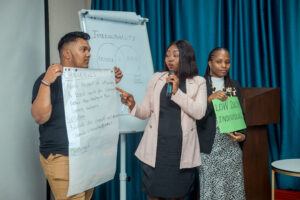
We are hiring a consultant/ team of consultants. to deliver various capacity strengthening trainings and other accompaniments to grantee partners.
As part of our commitment to resourcing, nurturing, and strengthening those best positioned to drive transformative change, African women’s rights and feminist groups, organisations, and movements AWDF seeks to hire a consultant / team of consultants.
This consultancy seeks a skilled facilitator(s) to co-create and deliver one or more of capacity-building training listed below, for AWDF grantee organizations across Africa, taking place between April and June 2025. The facilitator will develop training modules based on the findings of a participatory needs assessment, ensuring relevance and responsiveness. Critically, the facilitator will support grantees in developing tailored, needs-based strategies in:
1. Resource Mobilisation Fellowship
2. Communication, Advocacy & Digital security
3. Research & Advocacy skills building teach-in session
Application Process
Please submit a concise technical and financial proposal, along with your CV or a profile highlighting relevant experience, to wame@awdf.org , copying chipo@awdf.org by close of business on April 7th, 2025.
For more details on this consultancy, please click HERE
Join us and make an impact. We are hiring – Programme Assistant (Shared) Impact and Learning and Funded Initiatives
Join us and make an impact. We are hiring – Programme Assistant (Shared) Impact and Learning and Funded Initiatives

Our team is growing at AWDF, We are hiring a Programme Assistant (shared) for Impact and Learning and Funded initiatives.
Are you a dynamic individual with experience in providing monitoring, evaluation, and learning, as well as administrative and programmatic support, contributing to the efficient operation of AWDF’s Impact and Learning I&L, Resourcing and Funded Initiatives (FI) Project Teams?
Are you excited to contribute and work collaboratively across teams to assist the I&L and Resourcing functions? These teams are responsible for leading the re-imagining, implementation and learning in support of AWDF’s new strategy work with African women’s rights and feminist organisations, gender-diverse communities, collectives and movements working for gender justice in Africa.
Are you comfortable with supporting the piloting of responsive, feminist accompaniment, resourcing and MEL approaches based on movement priorities? If you responded yes to our questions, then we would like you to join our team!
How to Apply:
To apply check out more information and apply HERE
Applications for the vacancy should reach AWDF no later than Wednesday 19 February 2025. Due to our limited capacity, only short-listed candidates will be contacted for additional information and interviews.
AWDF welcomes new Director of Partnerships and Philanthropy
AWDF welcomes new Director of Partnerships and Philanthropy

We are starting this new year with an incredible addition to our team 🎉
Our team is excited to welcome Moreen Majiwa, our new Director of Partnerships and Philanthropy. Moreen is a pan-African feminist from Kenya with over a decade of experience working on critical issues such as sexual and gender-based violence, women’s Participation and Leadership, and managing multi-country and multi-partner programmes.
As the new Director of Partnerships and Philanthropy, Moreen joins the team with a bold vision for transformative change across Africa. Her approach centres on amplifying marginalised voices, reimagining philanthropic models, and building movements that breathe with resilience and hope.
Guided by the philosophy of Ubuntu “I am because we are” she sees connection as the heartbeat of liberation. Her dream dinner companion? Funmilayo Ransome-Kuti, a pioneering spirit whose life embodied resistance through art, culture, and unwavering commitment to justice.
Join us and welcome Moreen to the AWDF team and community. We look forward to a fruitful journey with her.
Send her your well wishes HERE
AWDF is thrilled to announce the Partnerships and Philanthropy Officer and Finance Intern opportunities!
AWDF is thrilled to announce the Partnerships and Philanthropy Officer and Finance Intern opportunities!
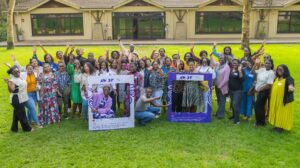
The African Women’s Development Fund is thrilled to announce two new exciting opportunities. Come and join our team, Apply today.
Partnerships and Philanthropy Officer
We are hiring to fill a vacancy for the position of Partnerships and Philanthropy Officer. To fill this position, we are looking for a highly motivated person who is innovative, passionate about women’s rights in Africa, excited about African feminisms and embraces African women’s rich diversity to join our team.
Building on its strong track record, in 2023 AWDF launched Lemlem, a ten-year strategic framework (2023-2033), which guides its efforts to advance gender equality and gender justice for girls, women and gender-diverse people across Africa. At its core, the strategy’s focus is on resourcing, nurturing and strengthening those who are best placed to achieve transformative change: African women’s and feminist groups, organisations and movements.
The Partnerships and Philantropy Officer will be central to AWDF’s effort to cultivate, maintain and strengthen AWDF’s relationships with existing and new partners in feminist and social justice movements, the philanthropic sector and international development. She/They will also be key to the execution of initiatives and activities to advance AWDF’s philanthropic advocacy and influencing agenda – working closely with the Director for Partnerships and Philanthropy (who manages the role), the CEO and the Director of Programmes.
How to Apply:
For more information on the role, and also on the application process, please visit the Application Portal HERE
Applications for the vacancy should reach AWDF no later than Friday 10th January 2025. Due to our limited capacity, only short-listed candidates will be contacted for additional information and interviews.
Finance Intern (Due Diligence desk )
Another exciting opportunity we have is the Finance Intern position (Due diligence desk)
AWDF requires the services of a Finance Intern to support the work of the Finance Department. The intern will have the opportunity to learn as well as support the finance team to achieve its set objectives. We are looking for an intern who is dynamic, curious, innovative, conscientious, and believes in the true value of effective and efficient financial management. The Finance intern will report to the Finance Manager and will have responsibilities of supporting key financial management processes including planning, transaction processing and reporting and risk management. The Intern will be responsible for receiving, reviewing, recording, uploading, filing documents for processing documentation and any other duties assigned.
How to Apply:
For more information on the role, and also on the application process, please visit the Application Portal HERE
Applications for the vacancy should reach AWDF no later than Friday 10th January 2025.
In line with AWDF’s Mission, qualified African women are encouraged to apply.
Come join our team – Coordinator: African Feminist Forum 2026
Come join our team – Coordinator: African Feminist Forum 2026
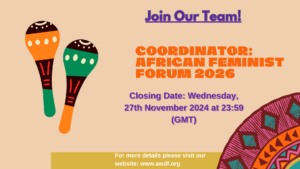
Our team is growing at AWDF,
Are you a dynamic individual with experience in facilitating cross-regional movement-building, conceptualising and coordinating multi-stakeholder regional and international level events? Are you familiar with or excited about African feminist organising structures and tools like the African Feminist Forums (AFFs), the Charter of Feminist Principles for African Feminists and various Non AFF communities within which activists and movements organise?
Are you excited about steering initiatives linked to key moments like the 20th anniversary of the Charter and the AFFs and mobilising resources, people, processes and spaces to honour, reflect and celebrate such moments?
Are you comfortable with navigating multiple stakeholder interests, providing strategic leadership and thought to diverse autonomous co-leadership groups, funders, grantee partners, and diverse movement entities to foster solidarity, partnerships and community? We would like you to join our team!
Then this could be the opportunity that you are looking for.
How to Apply:
To apply check out more information and apply HERE
Applications for the vacancy should reach AWDF no later than Wednesday, 27th November 2024. Due to our limited capacity, only short-listed candidates will be contacted for additional information and interviews.
Disrupting power hierarchies in convening spaces: What could go right and how can conveners and funders enable it?
Disrupting power hierarchies in convening spaces: What could go right and how can conveners and funders enable it?
By Dinnah Nwabire,
Cape Town, 6 November: For Nandis in all our diversities.
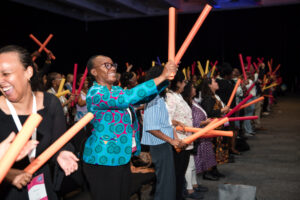
“Did you see Nandi? She stepped up to the performance stage at the opening Gala, grabbed the microphone and immersed the crowd in the power of her voice as she sang Mafikizolo’s Ndihamba Nawe – it was like a revolution!”
Jodi Williams, a colleague at the African Women Development Fund (AWDF) shared this highlight of Nandi (the real activist’s name is listed in the credits) in our team debrief from last week’s Sexual Violence Research Initiative (SVRI) Forum. The forum convened over 1,500 global researchers, practitioners, survivors, activists, and funders focused on addressing violence against women and children (VAW&C).
Across the forum, one could not miss the bold intention and the visible actions by the Sexual Violence Research Initiative to hold space for, among others, African feminist researchers, queer people, survivors, activists, and global South-based movements to equitably engage.
Nandi, a lead activist with the Sex Workers Education and Advocacy Taskforce (SWEAT) was sponsored to access the SVRI Forum by AWDF, a pan-African feminist fund. As it were, she was not a listed performer but as soon as she could, she seized the stage, grabbed the microphone and sparked a powerful charge that sustained the energy in the room with her passion, skill, courage and stewardship. For millions of global South-based partners on whose invisibilised labour we stand, this claiming of space is not an unfamiliar pattern.
I left the team debrief with a lingering question. What could go right, if more Nandis not only accessed, but equitably shared centrality and voice in rooms filled with big-profile non-profits and a complex co-existence of the global North and South hierarchies? This article shares my reflections from communing with frontline activists, researchers, survivors, funder staff and new friends I made at the forum. It showcases the desired change, courage, fatigue, and leadership brought to the fore by several Nandis. Lastly, it invites us to advance truly feminist and decolonial convening spaces that centre the most excluded among us.
Before the convenings: We know that access is not a given…
Convenings are built on weeks and months of planning processes that are critical entry points to address historical participation barriers. The limited funding to most marginalised people’s organising exacerbates their exclusion as many cannot afford set registration fees, pre-paid session costs or air tickets and accommodation. Funder sponsorships like travel grants and bursaries can enable conveners to achieve equitable access to hosted forums. Without this funding, we will continue to recycle the usual voices both from the global North and the South which further narrows our perspective of the actual issues at hand.
In particular, what could go right is that funding access for more Nandis is a critical step in enabling the decentering of International NGOs that predominantly have guaranteed access funds to convenings. It also neutralises South-based intellectual hierarchies to usher in new and unfamiliar bodies, voices and leadership that enriches impact for gender justice.
Aside from affordability, it was disappointing to listen to colleagues list activists denied Cape Town visas. Inequitable, racist and xenophobic visa laws continue to disproportionately disadvantage participants from Africa and other global South countries. Conveners must choose host countries with lesser restrictions as a bare minimum. This sometimes means putting convening outcomes over pre-defined physical countries of work by host partners. Yet, these are just a few of the outermost layers on the ‘participation onion’ many Nandis must peel off to access. More layers unfold once they are in the actual convening spaces!
Disrupt and challenge exclusion within actual convening spaces
Any kind of disruption is uncomfortable for power and privilege, so, definitely many things could go right with the slightest attempt to divert from the norm. For Nandis, many must step out of crowds where it feels ‘safe’ to create own platforms of visibility and co-leadership.
Conveners and funders must meet this labour halfway by enabling most excluded people to influence the agendas and contribute to debate as speakers, moderators, facilitators, performers or presenters. It is critical to ensure that the politics of inclusion that define the broad forums and convenings genuinely trickle into conversation rooms like parallel sessions, side events or poster areas. Asking key questions like who accesses microphones, who gets spotlighted and who gets access to podiums, how frequently, why and why not can help conveners to flatten hierarchies in all sessions.
Connect the dots by tapping into national voices and movements
International and regional convening spaces often prioritise ‘flying in’ speakers, performers and other content leads with minimal attention to national, local and community-based movements in the host countries and regions. The irony of what could have otherwise gone right is the missed opportunity to enable audiences to connect the dots with what happens right under our noses. Nothing disconnects us more from the pressing needs of movements.
As a part of a national sex worker collective, activists like Nandi in themselves embody a discomfort to the ways discrimination finds itself in convening spaces. Thus, funding their presence is a political act against erasure. Elsewhere, South-based feminist funds have argued that what makes feminist collectives, activists and feminist funders unique, is, among others, their connection to the issues they seek to address through lived experiences and sharing of community. Prioritising community and national movements in host countries is a critical reminder of how close we are to the issues and how grounding in this knowledge validates and regenerates our organising.
Enabling what could go right: some critical priorities
- Visibilise the Nandis
A lot of the work led by individual activists and non-traditional entities remains largely shadowed by International NGOs and big-brand nonprofits. In the exhibition hall, groups of Nandis from ‘unregistered’ collectives wondered what alternatives there were to visibility in a space taken up by big brand logos that left minimal space for them to connect and share their work in intimate non-conventional ways.
Similarly, in session rooms, several Nandis called out their fatigue from ‘collaborative’ studies that never mentioned them or the collectives they affiliated to. Their intellect, labour, lived realities and unique knowledge of study communities, erased by ‘well-meaning’ global North researchers and South-based agents of intellectual hierarchies who proudly called on them to come and “briefly share testimonies” after main study presentations were done. Conveners must track who the lead researchers are and how non-researcher experts and participating communities, activists and volunteers are credited, cited and visibilised.
- Pursue long-term transformation
Convening spaces must enable the reimagining of how systems of oppression are constructed and deliberately seek to disrupt those patterns. If the goal is to decolonise the global research economy, Nandis demand more of us than exchanging tips for equitable partnerships between global North and global South researchers. We can identify and sponsor the centring of lead global South voices on subjects of decolonisation, research and gender like African feminist Sylvia Tamale to promote the needed consciousness and narrative shifts in convenings. In addition, the use of theatre and opportunities for multilingual engagement that includes bringing in non-colonial languages will radically transform our convening spaces.
- Centre care and healing
For many Nandis, it is already many years of dealing with extractive research approaches and the harm of violence on their bodies and souls. These wounds often get re-opened in convening spaces with available but not fully encompassing spaces and tools for collective care, healing and wellness. Funders must accompany conveners to access and install diverse healing and collective care tools that embody the politics of decoloniality beyond Western medicalised framings of mental health and wellness.
Credits with permission
- The identity of Nandi depicted in this article seeks to honour the leadership of Pam Ntshekula and the work of the Sex Workers Education and Advocacy Taskforce (SWEAT), the biggest sex worker organization in South Africa that advocates for full decriminalisation of sex work.
- I acknowledge the input of Elizabeth Dartnall and Lizle Loots of the SVRI and Jodi Williams and Nana Zulu at AWDF.
- Photo courtesy of SVRI
Written by: Dinnah Nabwire | Independent Policy Researcher and Programmes Manager – Nurturing at the African Women’s Development Fund
Feminist financial management learning offering to foster accountability, flexibility and inclusion
Feminist financial management learning offering to foster accountability, flexibility and inclusion
Accra, 4 September: The African Women’s Development Fund (AWDF) is hosting 40 participants for a feminist financial management learning offering in Accra, Ghana from 4-11 September 2024.
Attendees included in this engagement have been drawn from partners supported under the Leading From the South programme and Foundation for a Just Society (FJSI) as well as non-funded entities.
This learning offering responds to gaps identified in the AWDF Programmes mapping of entities in feminist movements which highlighted critical gaps in reaching entities within women’s and feminist movements that do not meet mainstream categorisations of “traditional grantee partners”. These include individual activists and unregistered collectives. Influenced by a feminist movement centered approach to financial management this space has been created to build stronger partnerships, inclusion, accountability and flexibility.
The Arabic, French and English speaking partners who are part of this offering will have an opportunity to engage in peer learning and sharing, connecting and knowledge exchange , fostering a deep understanding of each other’s diverse contexts and experiences.
This financial management learning offering is being hosted in alignment with AWDF’s Lemlem Strategic Priority 1 on Resourcing and accompanying African Women’s Rights and Feminist movements.