
Author: Bintou
The Journey of AGE Network Girls in Nigeria
The Journey of AGE Network Girls in Nigeria
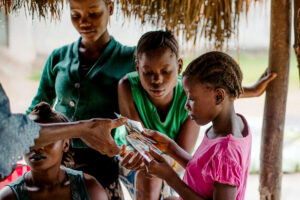
11 October 2025 marks International Day of the Girl. From classrooms to community halls, AGE Network Nigeria shows that when a girl lifts her voice, a nation begins to listen.
In Nigeria, AGE Network is dismantling barriers that hold girls back from child marriage and gender-based violence to economic exclusion and lack of access to education.
Education at the Core and economic Empowerment
Through scholarships, mentorship, and school retention programmes, AGE Network ensures girls not only enter school but also thrive and complete their studies. By training girls in digital literacy, entrepreneurship, and vocational skills, AGEN equips them with independence and pathways to leadership.education alone is not enough in a context where economic exclusion continues to silence girls’ ambitions.
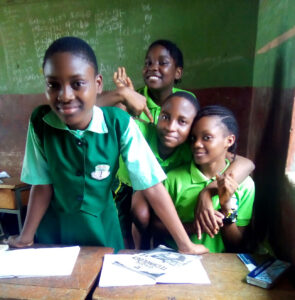
That is why AGE Network invests in economic empowerment as a companion to education. By equipping girls with digital literacy, entrepreneurship, and vocational skills, AGEN enables them to build independence and resilience. These skills become stepping stones toward leadership, giving girls the tools to not only survive crises but to lead change in their families, communities, and nation.
Advocacy & Voices of Change
AGE Network creates platforms for girls to speak for themselves — from producing advocacy videos to engaging policymakers.
“When I speak about child marriage, I know I am speaking for thousands of girls who cannot.”
— AGE Network beneficiary
Girls across Nigeria are stepping forward as advocates for change:
- “The girl I am is focused. The change I lead is helping girls avoid teenage pregnancy and achieve their dreams.”
— Alex Hannah, girl’s advocate at AGE Network - “The girl I am is bold. The change I lead is ending sexual exploitation so every girl is safe in school.”
— Joseph Destuny, girl’s advocate at AGE Network - “As a climate leader, the change I lead is keeping my community clean and safe for tomorrow.”
— Mfonlso Kingsley, girl’s advocate at AGE Network
Watch all the testimonies for Happy International Day of the Girl 2025 here
Bintou Mariam Traoré
From the Ring to the Page, from Silence to Voice: Boxgirls’ Storytelling Mission
From the Ring to the Page, from Silence to Voice: Boxgirls’ Storytelling Mission
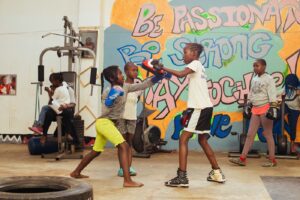
On 11 October 2025, International Day of the Girl, Boxgirls Kenya reminds us that a punch can break silence, a pen can rewrite history, and a girl’s voice can spark a movement.
Boxgirls Kenya has shown that boxing is not just about sport ,it is a powerful entry point for girls to claim voice, visibility, and leadership. Their work has evolved from the ring to national advocacy, and each output reflects the bigger mission: enabling girls to tell their own stories and transform limiting narratives.
Lulu Magazine (2024)
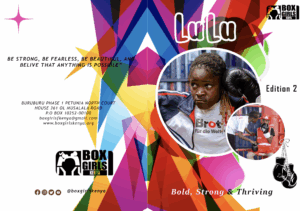
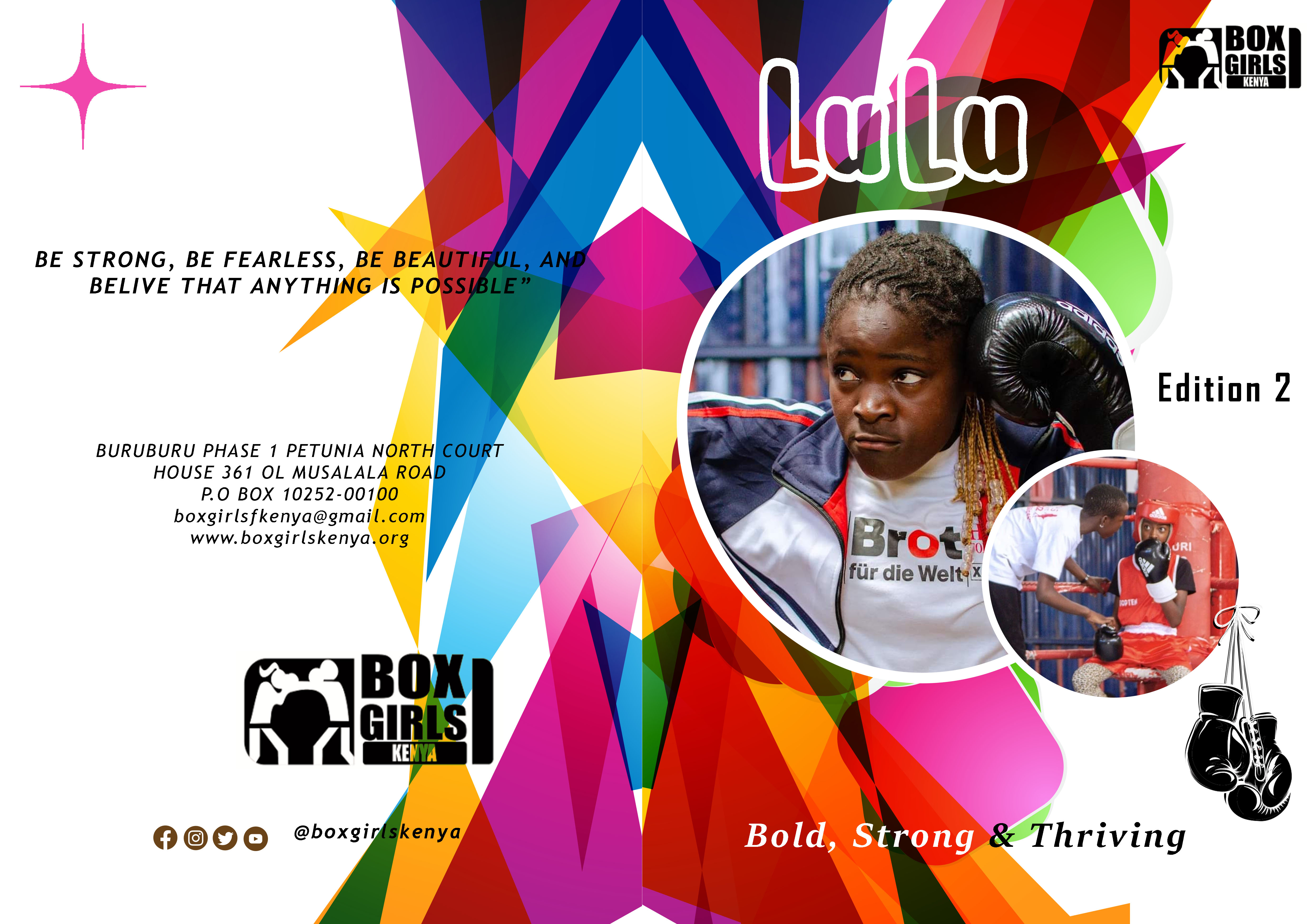
Written entirely by girls, Lulu Magazine is more than a publication—it is a declaration of authorship.
“When I write, I feel like my voice matters. I know another girl somewhere will read this and dream bigger,”
— Young contributor, Lulu Magazine
What began in Nairobi has now reached schools across Kenya and is traveling globally, proving that girls are not only subjects of stories, but authors shaping narratives beyond borders.
🔗 Read Lulu Magazine | Instagram
The Bloody Truth (Documentary & Campaign)
As the documentary highlights:
“According to the 2019 population and housing census, the population of Kenya is 47,564,296, and females represent 24,014,716 (50.5%). This means that a significant number of women and girls menstruate every month and therefore face challenges related to unsafe and inappropriate sanitation and hygiene.”
This groundbreaking documentary exposed the harsh realities of period poverty. Girls revealed how the lack of sanitary products forced some into unsafe practices or even transactional sex.
“We just want to learn without shame,”
— Girl featured in The Bloody Truth
The outrage sparked the Uzuri Project, a nationwide advocacy campaign that pushed menstrual justice onto the national agenda and demanded free sanitary products in schools.
Coach Sophia’s Journey (Video Story)
Sophia’s story embodies Boxgirls’ spirit of resilience. Once constrained by cultural and religious restrictions, she broke barriers to become a boxing coach.
“My father gave me reasons why I could not do boxing—because I’m a Muslim and because boxing is a male-dominated sport. Still, under his nose I kept training. At the end of the year, I told him Boxgirls Kenya had paid my scholarship. He asked me, ‘What did you say Boxgirls do again?’”
— Coach Sophia, Boxgirls Kenya
Her journey inspires a new generation to see beyond imposed limits and claim leadership in their communities.
Perita, a young “mini-coach” and beneficiary, explains:
“Because of boxing, the coach has taught me proper hygiene as a girl. We’ve even been given pads by our coaches. We’ve been told how to take care of ourselves so we don’t engage in things like early pregnancy that can cause us to drop out of school. I can control myself and not engage in bad company.”
Bintou Mariam Traoré
International Day of the Girl Child 2025 :Girls Writing Feminist Futures in Benin
International Day of the Girl Child 2025 :Girls Writing Feminist Futures in Benin
11 October 2025, International Day of the Girl: ADO REPORTERS shows that every article, every video, every testimony is not just a story told but power reclaimed. In Benin, young feminist reporters are reshaping the media landscape, proving that to be young and female is to be powerful and unstoppable.
Civic Engagement & Accountability
ADO REPORTERS use media to challenge decision-makers, demanding transparency and better conditions for girls’ education and participation. Their online campaign on civic engagement drew wide attention, inspiring youth across Benin to recognize their role as change-makers.
🔗 See the campaign on Facebook
Testimonies of Courage
On YouTube, ADO REPORTERS shares personal stories of girls who have faced discrimination yet found courage through journalism to speak out. Each testimony is an act of resistance, reminding communities that girls’ lived realities are political and must shape policy.
🔗 Watch testimonies on YouTube
Mobilizing Against Anti-Rights Movements
At a time when anti-rights groups are gaining momentum across Africa, ADO REPORTERS mobilizes young feminists to defend hard-won gains and resist regression. Their campaigns confront backlash head-on, amplifying voices that refuse silence.
🔗 See campaign on Facebook
“Before, I thought my voice did not matter. Today, I know my story can change my community.”
— ADO REPORTERS participant
Why It Matters
Through ADO REPORTERS , girls are no longer invisible subjects of development reports; they are active reporters of their realities and narrators of feminist futures. On this International Day of the Girl 2025, their voices remind us that storytelling is not just about visibility, it is about transformation.
Bintou Mariam Traoré
Reclaiming the Narrative: Feminist Communication as Political Practice
Reclaiming the Narrative: Feminist Communication as Political Practice
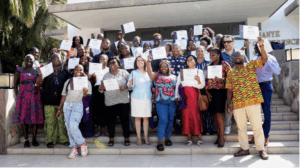
In feminist organising, we have often been asked to document the fight, narrate the work, and “give voice” to those unheard. But what if communication is not simply the storytelling of activism what if it is the activism itself? That was the central question sometimes spoken, sometimes lived during the feminist gathering held in Accra in May 2025. It was not a traditional convening. It was a space of reckoning: with language, with strategy, with the politics of representation. It brought together feminists from Africa not to learn how to better communicate for impact, but to radically reimagine what feminist communication is, can be, and must refuse to be.
🎥 Watch the video that captures these voices, silences, and acts of redefinition here:
Communication as a Site of Structural Violence
One of the most potent revelations from the convening is that communication, as practiced within development systems, is not neutral. It is a site of structural and epistemic violence.
The feminists gathered in Accra did not discuss communication merely as the final layer of a project. They dissected how the words we are asked to use empowerment, awareness, beneficiaries, impact stories do not simply describe the world. They shape what counts as legitimate knowledge. They delimit who gets to speak, and on what terms.
Participants exposed how this language is often inherited from colonial structures and donor expectations. It flattens complexity, sanitises struggle, and turns resistance into palatable narratives for funding cycles. In this context, to say “we are fighting” becomes “we are raising awareness.” To say “we are healing” becomes “we are building resilience.”
The violence of this translation is real. It erases the very people and processes it claims to support.
What Accra made clear is that every word carries ideology and feminist organisers must remain vigilant, constantly renegotiating the terrain of language.
The Politics of Naming and Renaming
Faced with imposed vocabularies, the women at the convening did more than critique they actively re-authored. They turned to ancestral languages and culturally embedded concepts as a way of reclaiming voice.
Words like tchologo (power), yaté (strength), or gbèlè (truth) surfaced repeatedly in discussions. These were not symbolic gestures of cultural pride. They were tactical. These words are embedded in contexts of resistance, in embodied histories, in epistemologies that predate colonial imposition.
What happens when feminists speak from these words instead of about them?
In Accra, we saw a linguistic insurrection. Feminists refused to use the vocabulary of those who have historically silenced them. Instead, they turned language into a weapon not of division, but of collective clarity. This is not just semantic. It is political. Because to name is to claim history, claim struggle, claim futurity.
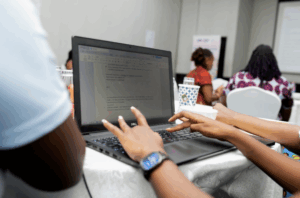
Visibility as a Trap
A central tension that emerged in the convening and which is powerfully visible in the video is the contradiction between visibility and voice. In the age of social media metrics and donor reporting, visibility has become a currency. But for whom? And at what cost?
Several participants questioned whether visibility, as currently practised, serves the movement or dilutes it. The logic of virality often rewards simplicity, speed, and relatability which leaves little room for contradiction, pain, or radical imagination.
In Accra, communication was not used to perform empowerment. It was used to hold contradiction, to carry silences, to document fracture. That kind of communication doesn’t trend. It doesn’t neatly align with hashtags. But it transforms. It listens instead of amplifies. It builds relationships rather than audiences.
This shift reframes communication not as a bridge between movements and the world but as the fabric of the movement itself.
Storytelling as Feminist Infrastructure
The role of storytelling in feminist movements is widely acknowledged, yet rarely theorised with the depth it deserves. In Accra, storytelling was not treated as a decorative output it functioned as method, memory, and movement.
Participants described how, in their organising, stories are far more than narratives: they are ways of transmitting intergenerational knowledge, of healing collective wounds, of resisting silence under regimes of repression. Stories allow feminists to build political memory in spaces where official records are absent, censored, or violently erased.
In this sense, storytelling is not “creative content.” It becomes infrastructure. It is how strategies are shaped, how histories are carried, how survival is sustained.
Importantly, these narratives are not always meant for public consumption. Some feminist stories must travel in hushed tones, encoded messages, or private networks. They circulate underground, resisting the extractive gaze. The documentary produced from the convening recognises this. It honours what must remain unsaid not by showing everything, but by refusing the compulsion to expose it all. It reminds us that feminist storytelling carries its own ethics of discretion, intimacy, and protection.
Feminist Media as Refusal
Alongside these reflections, the convening articulated a subtle but sharp critique of mainstream media logics. Feminist communication, participants insisted, must not replicate the formats and rhythms of extractive journalism or branded storytelling.
Instead of offering clarity at all costs, feminist media can embrace non-linearity, hold space for ambiguity, and move at the pace of trust. It may resist translation. It may choose opacity. Not everything must be immediately understandable especially to systems that have historically consumed and commodified feminist voices for institutional gain.
In this refusal to simplify, to smooth, or to explain, lies a powerful act of resistance. Feminist media does not always aim to be useful. Sometimes, it exists to disorient, to haunt, to protect.
The documentary itself reflects this ethos. It does not narrate the convening through a voiceover. It does not insert easy lessons. Instead, it evokes. It feels. It unsettles. Through its atmosphere, its silences, its unrushed rhythm, it invites the viewer to unlearn the demand for resolution and to witness on different terms. In doing so, it rejects surveillance and spectacle, and joins a long tradition of feminist media that resists not only what is said, but how it must be said.
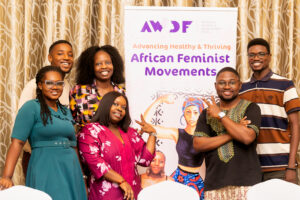
Rethinking Resources and Recognition
If feminist communication is infrastructure, then it must be resourced as such. And yet, participants described communications teams being underfunded, isolated, and last in line for organisational support.
This devaluation is not accidental. It reflects a broader refusal to see voice, memory, and imagination as strategic.
What Accra offers both in practice and in theory is a call to reverse this logic. To treat communication not as a way of “disseminating” change, but as making it. To invest in the people who hold the stories, who shape the discourse, who refuse the easy narrative in favour of a truer one.
We Speak, Therefore We Fight
The video that emerged from the Accra gathering does not simply document what happened. It extends it. It holds the texture of a political moment a moment where African feminists refused to be tools of someone else’s message. A moment where they reclaimed time, language, narrative, and voice.
What this convening proved is that communication when treated as feminist practice becomes something else entirely. Not a deliverable. Not a campaign. But a mode of existence. A form of resistance. A method of care.
To communicate, in this way, is to organise. To remember. To insist.
And in a world that constantly tries to silence, flatten, or consume feminist voices, this insistence is everything.
Bintou Mariam Traoré is a Communication officer , AWDF. This blog is a personal reflection of the Advocacy and Communications training that took place in Accra, Ghana.
Programme Assistant Intern– Portuguese speaking
Programme Assistant Intern– Portuguese speaking
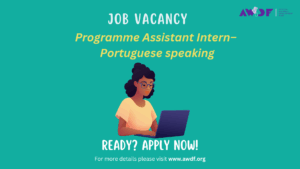
Are you a Portuguese-speaking feminist passionate about advancing gender justice across Africa?
Are you ready to be part of a vibrant Pan-African team supporting powerful feminist movements and organisations working to create long-lasting social transformation?
The African Women’s Development Fund (AWDF) is thrilled to announce an exciting internship opportunity that could be your next big step.
About the Role
AWDF is looking for a Programme Assistant Intern (Portuguese-speaking) to join our team on a short-term basis. You will work closely with the Programmes and Grantmaking teams to support our engagement with feminist partners—particularly in Portuguese-speaking African countries.
Your responsibilities will include coordinating grant-related tasks, facilitating communication with grantee partners, supporting programme officers, and assisting with mapping and outreach efforts in Lusophone regions.
Internship Duration
18 months, full-time (Monday to Friday), based at the AWDF office in East Legon, Accra, Ghana.
This is more than an internship—it’s an opportunity to contribute to meaningful change across Africa by supporting the people and organisations at the forefront of gender justice.
Apply Now
Send in your application no later than Wednesday, 14th May 2025.
Due to limited capacity, only shortlisted candidates will be contacted.
Join us, and help write the next chapter of feminist solidarity and social transformation in Africa.
🚨 AWDF is hiring & looking for consultants!
🚨 AWDF is hiring & looking for consultants!
The African Women’s Development Fund (AWDF) is thrilled to announce five exciting opportunities to join our team and contribute to advancing feminist agendas across the continent. We are currently recruiting for two full-time positions and three short-term consultancy roles. If you are passionate about feminist movement-building, capacity strengthening, and transformative development, we encourage you to apply!
🌍 Job Opportunities
-
Programme Officer – “At Scale” Partners
This role focuses on building and managing strategic partnerships that amplify the impact of feminist movements through scalable, sustainable initiatives.Read more details of this vacancy and how to apply HERE -
Programme Officer – Non-Traditional Actors (NTA)
This position supports AWDF’s engagement with diverse and emerging actors in the feminist ecosystem, including creatives, activists, and non-conventional partners.Read more details of this vacancy and how to apply HERE
📝 Consultancy Opportunities
-
Consultant – Capacity Strengthening for Grantee Partners
We are looking for a skilled consultant to support the design and delivery of tailored capacity-strengthening initiatives for AWDF’s grantee partners. For more details on this consultancy, please click HERE -
Consultant – Implementing Capacity Support for National Feminist Forums
This consultancy aims to bolster the work of national feminist forums through coordinated support and innovative facilitation strategies. Read more HERE . -
Consultant – Programme Evaluation of the Kasa! Initiative
Join us to evaluate the impact and learnings of the Kasa! initiative—AWDF’s bold effort to support feminist voice and action across Africa. Apply Here
Ready to make a difference?
We’re Hiring! Programme Assistant – CBO / NGO Entities Cluster
We’re Hiring! Programme Assistant – CBO / NGO Entities Cluster
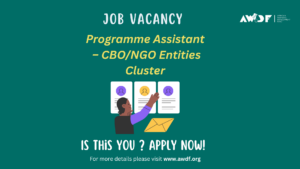
Are you a highly motivated individual passionate about women’s rights in Africa, excited about African feminisms, and committed to gender justice? Do you have experience in programme administration, planning, and coordination? Are you eager to support feminist movements and strengthen CBO/NGO entities across Africa? We would love to have you on our team!
The Programme Assistant – CBO/NGO Entities Cluster will work closely with the Senior Programme Officer to support the implementation of AWDF’s CBO/NGO strategy, contributing to movement-building, feminist resourcing, and gender justice advocacy. This role requires a proactive and organised individual who can support programme implementation, budget monitoring, relationship management, and organisational learning.
Find more details here: https://bit.ly/43NYfNU
Apply by Thursday, 27th March 2025. .
IWD 2025 : Stories of Resistance & Resilience
IWD 2025 : Stories of Resistance & Resilience
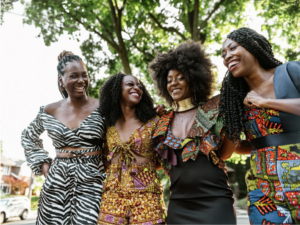
As we commemorate International Women’s Day 2025, African Women’s Development Fund (AWDF) reflects on the remarkable victories, challenges, and unwavering resilience of feminist movements across the African continent. Through in-depth conversations with our partners, we have gathered powerful stories of perseverance, advocacy, and transformative impact.
This year’s theme, “Accelerate Action for Gender Justice” – #AccelerateAction, underscores the urgency of sustaining feminist movements and ensuring that gender justice remains a priority in the face of growing resistance. This article amplifies the voices of AWDF’s KASA, Leading From South, and KOMBOA partners in the Democratic Republic of Congo, Niger, Mozambique, Angola, Zimbabwe, and Nigeria—feminist organizations that continue to break barriers and champion the rights of women and marginalized communities.
REFED-NK, Democratic Republic of Congo: Defending Women’s Rights Amidst Conflict
Operating in North Kivu, Democratic Republic of Congo, Réseau Femmes et Développement Nord-Kivu has been advocating for women’s rights since 2004. The organization tirelessly works to protect and empower women, girls, children, and marginalized groups, despite persistent instability and human rights violations in the region.
“The current state of our city is deeply alarming, characterized by severe human rights violations, including sexual violence against women and young girls. Since January 23, our activities have been suspended due to escalating insecurity. We have been unable to access our office, as ensuring the safety of our staff is paramount. However, we remain hopeful that peace will soon be restored, and we will once again raise our voices for justice and equality.”
— Deborah Mupita, Executive Secretary, REFED-NK
The call for transitional justice for Congolese women victims of war remains central to REFED’s mission. In times of crisis, their advocacy is more crucial than ever.
CNJFL, Niger: Empowering Young Women Amidst Growing Opposition(LFS Partner)
The Cellule Nigérienne des Jeunes Filles Leaders is committed to strengthening girls’ and women’s leadership, fighting gender-based violence, and promoting education and healthcare access in Niger. However, their mission is increasingly challenged by conservative forces that seek to suppress progress.
“Conservative sociocultural norms and opposition from religious and political groups obstruct the implementation of our initiatives. Despite these barriers, we have adopted transformative approaches that allow us to continue our work effectively. This year, we successfully organized mentorship and leadership camps, equipping over 60 young urban and rural girls with the skills to become changemakers.”
— Halimatou Zika, President, CNJFL
CNJFL’s achievements are made possible through the unwavering solidarity of feminist allies, including AWDF.
AMPDC, Mozambique: Strengthening the Fight Against Gender-Based Violence (KOMBOA Partner)
In Mozambique, the Associação das Mulheres para Promoção de Desenvolvimento Comunitário plays a pivotal role in advocating for gender justice. Their work focuses on influencing societal attitudes, combating gender-based violence (GBV), and empowering women economically.
“One of our greatest achievements has been the establishment of the Femicide Watch and the Unified System for the Prevention and Response to Gender-Based Violence (GBV). The support from public institutions and feminist movements in Sofala Province has been instrumental in driving institutional change. “
— Angela Jorge, Executive Director, AMPDC
Mwana Pwo, Angola: A Lifelong Commitment to Sexual and Reproductive Health Rights (LFS Partner )
Despite systemic obstacles, Mwana Pwo in Angola continues to provide critical information on sexual and reproductive health. Their work is fueled by an unwavering sense of duty and passion.
“What keeps me going is my deep commitment, passion, and love for this work. Supporting young women who have survived violence and oppression has been the most powerful and transformative aspect of my journey. Even in our lowest moments, we must lift our heads high and keep moving forward.“
— Aida Gilberto João, Gender Assistant, Mwana Pwo
Tag a Life International, Zimbabwe: Pushing for Legal Reforms and Leadership
Nyaradzo Mashayamombe , Founder and Executive Director of Tag a Life International, remains steadfast in her fight for women’s rights in Zimbabwe and across Africa.
“Despite rising anti-women movements, I draw strength from the women before me. They fought for our rights, and now it is our duty to carry the baton forward. Each time a girl graduates through our Leadership Economic Mentorship (LEMS) program and steps into public life—whether in politics or business—it is a triumph. One of our young women even became a mayor, proving that feminist activism leads to real change.“
A landmark victory for her organization was leading the advocacy for the Education Amendment Act, signed into law by the President of Zimbabwe. This legislation ensures that girls from rural and low-income communities have access to state-funded basic education.
Girl Child Art Foundation, Nigeria: Art as a Tool for Healing and Resistance (KASA Partner)
In Nigeria, Girl Child Art Foundation harnesses the power of art, storytelling, and advocacy to combat gender-based violence.
“We refuse to be silenced. Through murals, community workshops, and creative expression, we create safe spaces where girls reclaim their voices. For us, this was proof that art is not just about painting and drawing—it is a powerful medium for expression, healing, and change. ”
— Blessing Onyejike-Ananaba, Executive Director, GCAF
The Power of Feminist Funding and Solidarity
The testimonies from AWDF partners reinforce the vital role of feminist funding in ensuring the resilience, growth, and sustainability of grassroots feminist movements. In regions where civic space is shrinking and opposition is intensifying, organizations like AWDF provide crucial support that enables activists to continue their work despite mounting challenges.
As we mark #IWD2025, we reaffirm our commitment to #AccelerateAction—ensuring that feminist movements across Africa remain strong, impactful, and enduring. The fight for justice and gender equality continues, propelled by the steadfast solidarity of women dedicated to creating lasting change.
Bintou Mariam Traoré, communications Officer
KOMBOA- Here’s how African feminists are resisting the growing anti-rights movement in Africa
KOMBOA- Here’s how African feminists are resisting the growing anti-rights movement in Africa
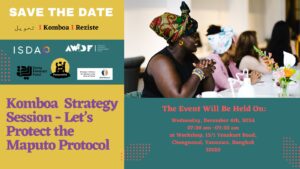
The growing anti-rights movement in Africa threatens the rights of girls, women, and marginalized groups. In response, AWDF, ISDAO, Purposeful, Doria Feminist Fund, and SIHA have formed Komboa, a feminist consortium supporting threatened communities. Here’s how African women are resisting:
In 2024, Feminists in Kenya and hundreds of women protested femicides, with the hashtag #EndFemicideKE fueling national conversations on the issue.
With 14% of girls married before adulthood in Morocco
Project Soar‘s BIGGER Movement is empowering teenage girls to advocate for changes to the Family Code, which allows child marriage.
Ma’Mara Sakit Village in South Sudan empowers communities through research, art, and culture, while the Suk-Sukna Project creates sustainable jobs for South Sudanese women by reviving traditional beadwork.
Bintou Mariam Traoré
#WorldAIDSDay 2024 Leading from the south
#WorldAIDSDay 2024 Leading from the south
On this #WorldAIDSDay , we shine a spotlight on the women leading the fight against HIV. In partnership with the Leading from the South (LFS) consortium, we stand in solidarity with African women-led organizations like the Coalition of Women Living with HIV and AIDS (COWLHA), the African Girls Empowerment Network (AGEN), and the AIDS and Rights Alliance for Southern Africa (ARASA), who are at the forefront of tackling the HIV epidemic in Africa. These women—activists, community leaders, and advocates—are driving change and offering transformative solutions to the HIV crisis. They are not only fighting the virus but also challenging the stigma and discrimination that often accompanies it. Their leadership is proof that grassroots, women-led initiatives are essential in the global response to HIV/AIDS.
Leading from the South (LFS) is a feminist, South-South global consortium designed and managed by four prominent women’s funds: the African Women’s Development Fund (AWDF), Fondo de Mujeres del Sur, FIMI – International Indigenous Women’s Forum, and Women’s Fund Asia. Together, these organizations amplify the voices of women from the Global South, ensuring that they are central to global conversations and actions around HIV/AIDS. Their collective efforts are helping to shape policies, raise awareness, and build local capacity to address the HIV epidemic in ways that are sensitive to the realities and needs of women in the Global South.
The leadership and expertise of these women are vital in the fight against HIV, and it is crucial that we continue to support and elevate their work. By amplifying local voices and empowering women to take charge of their health, we can work towards a world free from HIV, discrimination, and inequality.
Let’s unite in this effort, strengthen our solidarity, and continue to take action together.
Bintou Mariam Traoré, communications Officer