
Spotlight: Leading the collective – Viviane Tathi – Chair of the Board of Directors, Sourires de femmes, Cameroon
Jul 8, 2026
Media Center /
Blog
“Feminism is not a stepping stone,” she asserts.
For several years, Viviane Tathi has been leading, alongside other women, the organisation Sourires de femmes in Cameroon, in a context marked by precarious living conditions, violence against women and growing threats to feminist activists. For a long time, she believed that the most important work lay in advocacy campaigns, public speaking or political struggles. But as the AWDF’s feminist leadership and governance programme unfolded, another truth became clear: an organisation cannot survive if the collective, as well as the internal conflicts and the material conditions of those who run it are constantly pushed into the background.
Founded on 13 April 2018, Sourires de femmes grew out of the life stories of its founders, both of whom come from rural areas. The very name of the organization – Sourire, for Smile – carries an ambiguity that Viviane fully embraces. The smile, she explains, refers both to women’s ability to stand tall despite the violence, discrimination and inequalities they face, and to a deeply ingrained social expectation that women must remain gentle, pleasant and smiling, no matter what violence they endure.
“Because we smile, people think everything is fine,” she explains. “But behind the smile, there are traumas and difficult journeys that society does not see.”
Through its work raising awareness, supporting survivors of violence, capacity-building and, more recently, feminist research, the organisation seeks precisely to bring these hidden realities to light. Today, Sourires de femmes has around forty members, some of whom are very young. The youngest members take part in empowerment programmes and awareness-raising activities focusing on menstrual dignity, leadership and career guidance. For Viviane, the issue of empowerment goes hand in hand with the transmission of feminist knowledge.
It was with this in mind that the project MIIMBO: Le rempart féministe was launched, developed as part of the AWDF’s feminist leadership and governance programme. The project focuses on the knowledge of Cameroonian women, their lived experiences, and the history of forms of female resistance often absent from mainstream narratives.
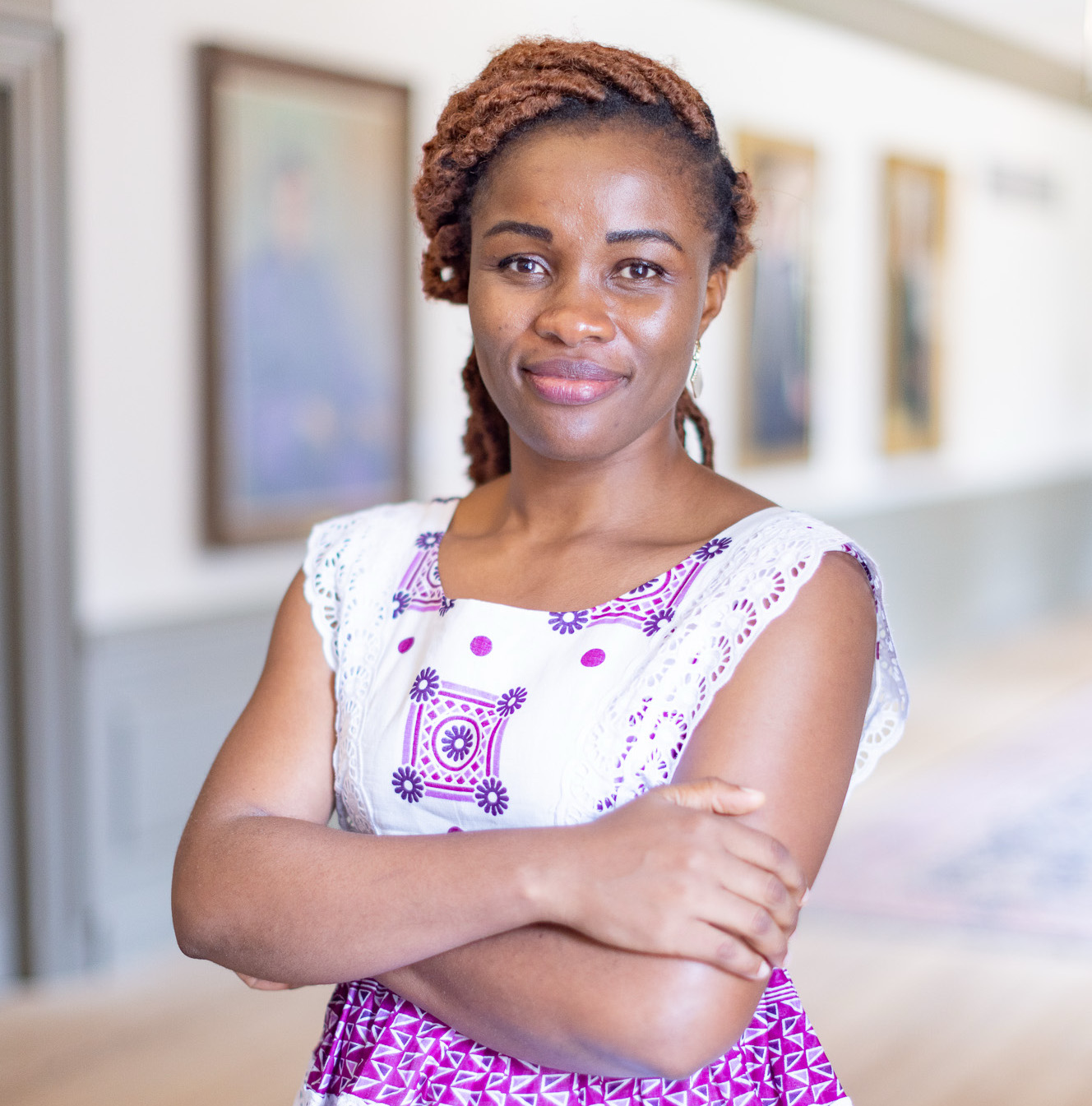
Before the programme, Viviane said she was exercising leadership ‘blindly’. Yet she is no novice. She has taken part in several international leadership programmes and led major advocacy campaigns, particularly on femicide, in Cameroon. Outside the organisation, it works. She knows how to build connections, engage with decision-makers and take campaigns into institutional spaces. But internally, things are more complicated.
“I felt that leadership and feminist identity were two parallel concepts,” she explains.
Her main challenge lay in a question she could not resolve: how to build a feminist organisation without replicating hierarchical or authoritarian management styles? How to introduce concepts such as accountability, work organisation or task monitoring without feeling she was betraying the values of sisterhood and care upheld by the organisation?
There was also the fact that she believed internal conflicts were secondary to the urgency of the activist cause. Advocacy campaigns, violence against women, femicides and security threats seemed to her more important than what she then called internal “minor issues”. But this stance eventually weakened the organisation.
“Some members didn’t feel valued or taken into account,” she acknowledges today.
The coaching offered as part of the AWDF programme proved to be a major turning point. Viviane saw that the issue of accountability was not incompatible with a feminist organisation. On the contrary, it is a prerequisite for its sustainability.
“I thought that because we were sisters, there was no need to set boundaries. A feminist organisation doesn’t, for example, tell its sister that she hadn’t done a good job.”
Gradually, the team established spaces for conflict resolution, more structured working frameworks, and a clearer division of responsibilities. This evolution profoundly transformed her leadership style. The coaching also made her realise the burden she had been carrying alone.
“I told myself it was up to me to do everything,” she explains. “But when you don’t give people feedback, they don’t feel valued.”
Behind this realisation lies immense exhaustion. Viviane speaks of mental exhaustion, emotional strain, but also the security risks linked to her activism. As a feminist activist in Cameroon, she faces regular threats. She has been attacked at home, threatened with death and rape, and forced to move house several times with her children. The organisation’s offices do not even have a nameplate to minimise risks.
“The more you assert your feminist identity, the more the threats increase,” she explains.
This violence is compounded by another reality: the economic precariousness of feminist activism. For Viviane, the lack of resources is one of the major tensions between feminist values and the realities on the ground.
“Activism requires money,” she says bluntly.
In an organisation made up largely of young women from precarious backgrounds, material difficulties directly affect the very possibility of embracing a feminist identity. Some members do not dare identify as feminists for fear of being rejected by their families or deprived of financial support.
“When you assert your feminist identity, you are cut you off,” she explains.
This precariousness creates another contradiction: how can young women be asked to commit to the struggle in the long term when wages remain extremely low and activist work offers no social security?
For Viviane, this reality forces a rethink of feminist leadership itself. What is missing today, she believes, is not just more visible women leaders, but a genuine culture of collective action.
“We see women everywhere, but where is the collective?” she asks.
She is wary of feminist leadership centred on individual success or personal visibility. For her, feminism loses its meaning when it becomes a tool for individual positioning rather than a project for systemic transformation.
“If we take the path of leadership to position ourselves, then we lose the meaning of the struggle,” she asserts.
And yet, despite exhaustion, threats and doubts, Viviane carries on. She says she recently went through a period where she was considering withdrawing completely from activism, convinced she had already given so much. But something still holds her back: the conviction that collective change remains possible.
When asked which figures have acted as a transmission chain to her, she cites first and foremost Winnie Madikizela, whose story taught her that certain difficult decisions sometimes become necessary in political struggles. She also mentions the secret societies of Cameroonian women such as the ANLU or the Movoungou, pointing out that African women’s resistance did not begin with contemporary feminism. Then she turns to a more personal story: that of her mother, who wanted to raise her to be a wife who conformed to social expectations, and that of her father, who encouraged her to choose her own path.
“To show her love,” she says today when speaking of her mother, “is to understand the journey of women in her society and of her time.”
This sentence perhaps also sums up her approach to feminist leadership: not as a heroic individual stance, but as a fragile, collective and deeply human attempt to transform the world without forgetting those who came before us.